
NEW YORK (AP) — Earlier this month, Illumination founder and chief executive Chris Meledandri was honored with a star on the Hollywood Walk of Fame — and he greeted the milestone with characteristic self-deprecating humor.
“In years to come, as people walk down Hollywood Boulevard, they’ll come across my star,” he told the crowd gathered for the ceremony. “And unless they’re related to me, they’ll ask: ‘Who the hell was that guy?’”
Despite keeping a low profile in an industry full of big personalities, Meledandri has built one of the most dependable hit-making machines in Hollywood. At a time when the entertainment business seems to be in constant turmoil, his studio has thrived by focusing on family-friendly animated fare that keeps audiences coming back.
Since its debut film in 2010, “Despicable Me,” Illumination has racked up more than $11 billion in worldwide ticket sales. Its most recent release, “The Super Mario Galaxy Movie,” is the only film of 2026 so far to cross the $1 billion mark. The studio’s next project, “Minions & Monsters,” had its world premiere Sunday at the Annecy Film Festival in France and looks poised to match that performance.
The Minions — Illumination’s version of iconic cartoon characters like Mickey Mouse or Bugs Bunny — have been central to that success. But the studio, which operates as a division of Universal Pictures, has grown well beyond its original franchise. It now partners with Nintendo on the “Mario” films, has an animated “Barbie” movie in the works with Mattel, and continues to develop earlier series like “Sing” and “The Secret Lives of Pets.” If there’s one thing Illumination is known for, it’s lighthearted, cartoonish entertainment.
“From the outset, we really wanted to make films that would be joyous above everything else,” Meledandri said in a recent interview. “I found myself working with filmmakers who appreciated that Looney Tunes style of cartooning integrated into the creation of these animated films today.”
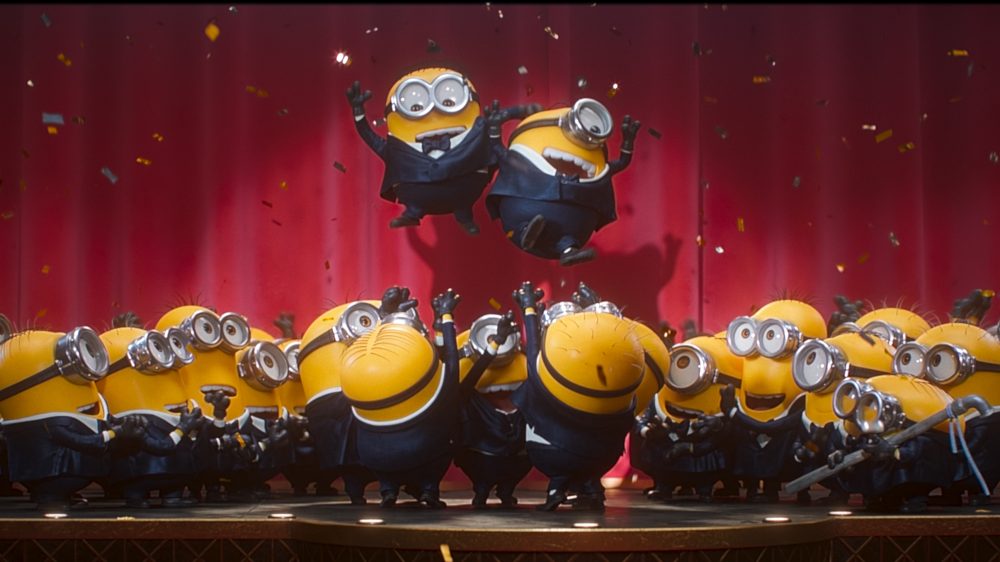
“Minions & Monsters,” set to hit theaters on July 1, may be the studio’s most playfully absurd adventure yet. The seventh entry in the “Despicable Me” series and the third standalone Minions film, it hands those lovable chaos agents a movie camera. The plot drops the Minions into the 1920s Golden Age of Hollywood, drawing comparisons to silent slapstick classics like Charlie Chaplin’s “Modern Times” and Harold Lloyd’s “Safety Last!” Jeff Bridges provides the voice of a studio boss, and the film has been described as the Minions’ take on “The Muppet Movie.” James, the most artistically inclined Minion, is even credited as director — at least in a first draft of the end credits.
The film’s actual director is Illumination veteran Pierre Coffin, who has helmed many of the studio’s productions and is also the well-known voice behind the Minions themselves. Coffin had a complicated history with the franchise’s ever-growing reach, and Meledandri knew convincing him to return would take some doing — the same executive who, as a producer, managed to reassemble the cast of DreamWorks’ “Shrek” for a fifth installment due next year.
“He called me one weekend and he said, ‘You’re going to say no but I’ve got to ask,’” Coffin recalled from Paris. “He said: ‘It’s Minions wanting to make a monster movie. They conjure monsters but then that creation turns on them and the Earth.’”
“He got me at ‘Minions making movies,’” Coffin added. “From that moment, I just had questions.”
The film arrives in theaters two weeks after Pixar’s “Toy Story 5” and will serve as a fresh gauge of just how powerful Illumination has become. Meledandri’s path to building the studio began after a stint overseeing Fox’s animation unit and producing the “Ice Age” series. He founded Illumination by leaning heavily on a group of artists at a Paris-based animation company then known as Mac Guff. While the studio’s headquarters are in Santa Monica, California, most of its film production work is done in Paris.
With partnerships now extending to Japan through Nintendo, Illumination has taken on a distinctly global character — something Meledandri says was always part of the plan.
“An objective from day one, when I started the company, was to have the complexion of creative leadership reflect our desire to make films for the entire world, as opposed to being so American-centric,” he said.
Meledandri never aimed to go head-to-head with Disney or Pixar. “Those goals just felt unrealistically ambitious,” he said. Instead, he gave filmmakers room to tell stories about mischievous antiheroes and leaned into subversive comedy rather than emotional storytelling. Audiences are far more likely to laugh at an Illumination film than cry.
That formula has turned Illumination into a box-office powerhouse. Universal’s output arrangement with Netflix — after films first stream on Peacock — has also helped expand the studio’s reach. But awards recognition has been another story. Illumination has never taken home an Oscar, a fact the new film cheekily acknowledges. Only one of its releases, “Despicable Me 2,” has ever received a best animated feature nomination.
“Minions & Monsters” may have a shot at broader industry appreciation, though, thanks to its love letter to filmmaking. Even filmmaker George Lucas lends his voice to the movie.
Whatever happens at awards season, the film is nearly guaranteed to turn a profit — something Meledandri has made a point of ensuring throughout his career. Ever since producing the 2000 box-office flop “Titan A.E.” at Fox, he has treated financial discipline as a core value. “Everyone’s expectation was that I would be fired,” he said of that experience. “I probably should have been fired.”
While many studio blockbusters carry budgets north of $200 million, “Minions & Monsters” was made for a comparatively modest $85 million. Illumination’s priciest production to date, “The Super Mario Galaxy Movie,” cost $110 million — still well below the $250 million budget attached to “Toy Story 5.”
“In 19 years, I cannot remember a single conversation where a director came back and said: We need more money. It’s just not part of our ethos,” Meledandri said. “It may be: How are we going to solve this problem? Or: We can’t get this done by this date. But it’s never: We need more money.”
On the subject of artificial intelligence, Meledandri is notably cautious. While some in Hollywood see generative AI as a tool for cutting costs, he’s not rushing to embrace it.
“My main focus right now is the preservation of jobs and at the expense of being the most technologically advanced,” he said. “It always feels better to be part of a front of a wave as opposed to a Luddite. But in this case, we’re not pushing AI into our pipeline.”
He also pushed back on the argument that past technological shifts should reassure workers about AI. “I do not believe that a sufficient answer is, ‘Well, we’ve had technological advances before and people were worried yet it all was fine and things kept surging forward,’” he said. “None of those other technologies had agency.”
Animation has seen its share of larger-than-life executives come and go. Neither Jeffrey Katzenberg of DreamWorks nor John Lasseter of Pixar still leads the studios they once defined. The 67-year-old Meledandri, who grew up on Manhattan’s Upper East Side, has emerged as an unlikely giant in the field — the self-described “big boss” of the Minion empire.
His road into the film industry began when a customer of his father’s men’s clothing store brought him on as an assistant on the film “Footloose.” His next major opportunity came when he produced the 1993 Disney hit “Cool Runnings.” Today he runs an animation studio that was once considered an underdog but now boasts a nearly spotless track record.
The competitive threat that keeps him up at night isn’t Disney or Pixar — it’s short-form content competing for audiences’ attention.
“It’s got to force us to be more imaginative and more surprising and to reach further than storytelling that could feel safe because it’s worked before,” he said. “In ‘Minions & Monsters,’ what Pierre Coffin has done is made a movie that is so wildly imaginative and unexpected that it’s exactly where I would wish Illumination to be in this moment in time.”