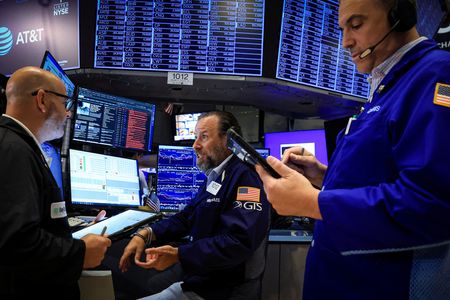

Global financial markets took a hit Thursday as U.S. semiconductor stocks experienced a sharp selloff, dragging down the tech-heavy Nasdaq while anxiety over artificial intelligence investments spread around the world. At the same time, stronger-than-expected U.S. economic data gave the dollar and Treasury yields a boost.
A closer look at market data reveals that foreign investors continue to pour money into U.S. stocks at a remarkable pace, suggesting that confidence in America’s AI-driven economic story — often called “U.S. exceptionalism” — remains intact, at least for now.
Key Market Moves for Thursday
Stock markets in South Korea plunged 7%, while Japan fell 2.8%. European and British markets were largely flat. On Wall Street, the three major indexes each slid between 0.2% and 1.5%.
In individual sectors, the U.S. chip index dropped 4% and communications services fell 3%, while consumer staples bucked the trend with a 3% gain. Sandisk tumbled 12.5% and Seagate Technology fell 10%. Netflix dropped 5% in after-hours trading, while Nike gained 4%.
The U.S. dollar rose 0.3%, while the British pound fell 0.5%. The dollar-to-yen exchange rate continued hovering near 40-year highs above 162.00.
On the bond side, short-term U.S. Treasury yields climbed 3 basis points, flattening the yield curve. In commodities, oil slipped 1%, U.S. natural gas hit a two-month low of $2.823 per million British thermal units, gold fell 2%, and silver dropped 4%.
South Korea in Crisis Mode
South Korean financial authorities are scrambling to rein in extreme swings in the country’s stock market. Their latest effort on Thursday targeted leveraged, derivative-based exchange-traded funds linked to major technology companies such as Samsung and SK Hynix.
Volatility in South Korea’s KOSPI index has reached historic levels — 30-day realized volatility is higher than at any point on record except for late 1998, during the LTCM crisis and Russian debt default. Foreign investors are also pulling out of South Korean stocks at the fastest pace in 25 years.
The Fed’s New Communication Strategy
In central banking, the signals policymakers send can sometimes matter just as much as the decisions they make. New Fed Chair Kevin Warsh has pledged to overhaul the Federal Reserve’s communications approach, moving toward a “less is more” philosophy — a shift that is creating uncertainty among investors.
It remains unclear how the Warsh-led Fed will respond to changing economic conditions, what would trigger a policy move, or what form that move would take. The Fed is currently in a quiet period ahead of its July 28-29 policy meeting.
AI’s Growing Role — and Risk
A new paper from the Federal Reserve and fresh data on U.S. capital flows both highlight just how central artificial intelligence has become to the American economy and its markets. The Fed paper suggests that AI-related imports could widen the U.S. current account deficit more than previously anticipated. Meanwhile, the latest Treasury International Capital data shows foreign investors are still pouring enormous sums into U.S. stocks, chasing AI-driven returns.
However, growing concern over the enormous costs of building out AI infrastructure is starting to shake Wall Street. The “SOX” chip index has fallen 20% over the past month. If that slide continues — or if foreign investors begin to pull back — the consequences for U.S. markets could be significant.
What Could Move Markets Friday
Investors will be watching developments in the Middle East, global sentiment toward AI and semiconductor stocks, and remarks from German Chancellor Merz and French President Macron. On the data front, the preliminary July reading of the University of Michigan’s consumer sentiment and inflation expectations survey will be released, along with June U.S. industrial production figures.
Opinions expressed in this report are those of the author and do not reflect the views of Reuters News.