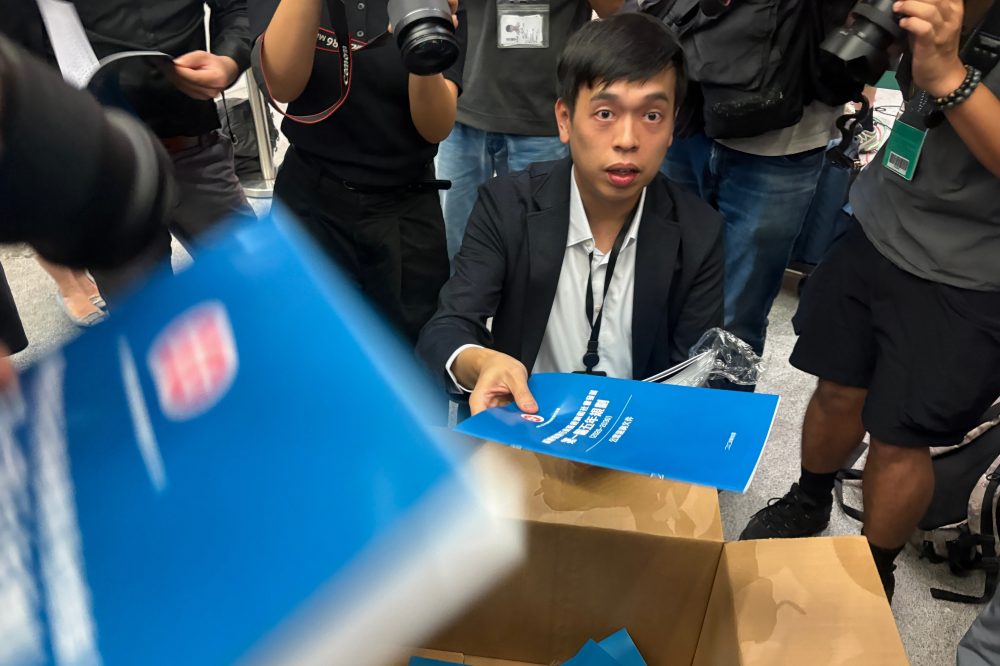

HONG KONG — Hong Kong took a politically significant step Monday, opening a public consultation period for its first-ever five-year development plan — a move that draws the territory closer to the way mainland China manages its economy.
Secretary for Constitutional and Mainland Affairs Janice Tse told reporters that mainland China launched its own 15th five-year plan covering 2026 to 2030 this year. Hong Kong has historically taken pride in keeping government involvement in the economy to a minimum, even as it has looked to Beijing for broader direction.
Tse said Hong Kong’s plan will work in step with China’s national development strategy while still maintaining the city’s free-market principles.
“Aligning with the national 15th five-year plan does not replace the free market,” she said. “Rather, it channels a clear vision and strategic planning through major policies, and that allows the market to develop more stably and clearly.”
The consultation window runs for two months, during which residents can share their thoughts through a dedicated website, by email, or by sending letters. The government also plans to hold events to gather input from residents, lawmakers, and industry representatives. Officials hope to unveil a finalized plan during the third quarter of the year.
According to Tse, the plan will reinforce Hong Kong’s role as a global hub for finance, shipping, and trade.
Among the proposals, officials want to speed up development of the Northern Metropolis — a large-scale project aimed at building a technology center and university town near the mainland Chinese tech city of Shenzhen, just across the border.
The plan also looks to deepen Hong Kong’s involvement in the Greater Bay Area, Beijing’s initiative to create an integrated economic and business zone that includes Hong Kong, Macao, and nine other mainland cities.
Hong Kong leader John Lee said on June 9 that the five-year plan would better blend what he called a “capable government” with “an efficient market,” with the government taking a leading role in boosting the market’s competitiveness. Lee added that the plan would help residents identify personal development opportunities and make business planning easier.
A Beijing official overseeing Hong Kong and Macao affairs was expected to visit the city Tuesday for a two-day trip focused on reviewing the territory’s alignment with the national 2026–2030 plan and progress on the Northern Metropolis project.
John Burns, a politics and public administration professor at the University of Hong Kong, acknowledged that the city had previously put itself at a disadvantage by lacking strategic planning. However, he was skeptical about the consultation process, noting that public consultations in Hong Kong have long lost credibility because officials rarely change direction based on public feedback.
“This is the government selling its notion of a local five-year plan to the community that dovetails with central government priorities,” Burns said, also pointing out that the consultation document lacks specific targets or timelines.
Since Britain handed Hong Kong back to China in 1997, the former colony has grown increasingly tied to the mainland through economic links, cultural connections, and shared transportation and border infrastructure.
Although Hong Kong maintains its own government, legislature, and court system under Beijing’s “one country, two systems” framework, China’s influence over the territory has grown considerably in recent years.
After widespread anti-government protests erupted in 2019, Beijing enacted a national security law that Hong Kong authorities say was needed to restore stability. Critics say the law has effectively crushed all political opposition. Many prominent activists have been imprisoned under it, and the city’s legislature is now dominated by politicians loyal to Beijing following a sweeping overhaul of the electoral system.