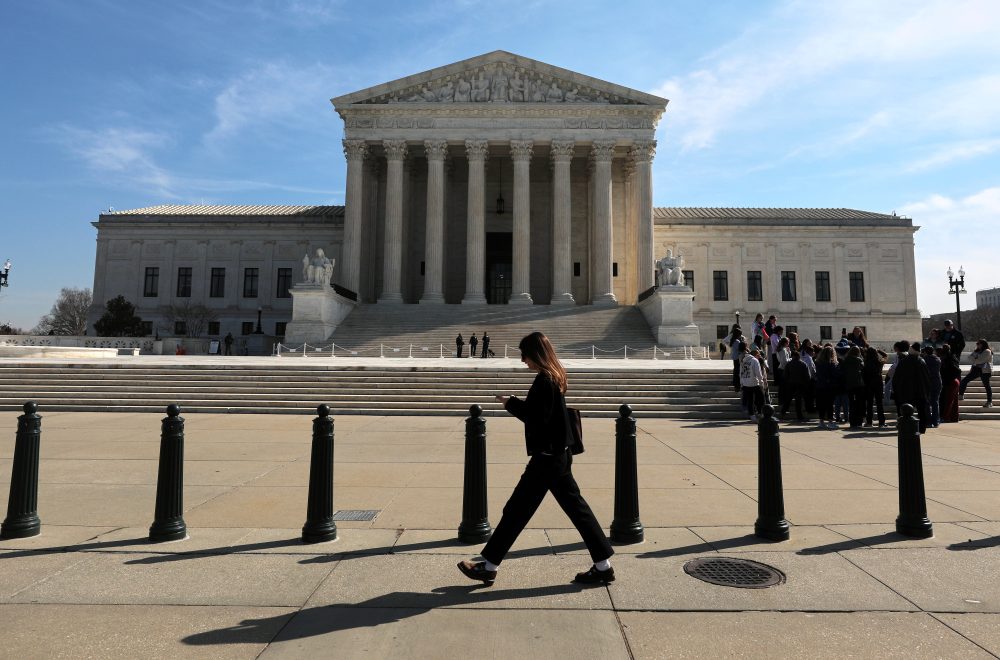

WASHINGTON — During oral arguments Tuesday, U.S. Supreme Court justices appeared inclined to side with a Black Mississippi death row prisoner who alleges racial discrimination influenced his jury selection.
The high court is considering an appeal from Terry Pitchford, whose case bears striking resemblances to another Black Mississippi death row defendant whose murder conviction was reversed by the Supreme Court seven years ago.
Pitchford received a death sentence for his involvement in a grocery store owner’s murder in northern Mississippi. His jury included just one Black member after prosecutor Doug Evans, now retired and known for systematically removing Black potential jurors, dismissed four other African American candidates.
Four decades ago in Batson v. Kentucky, the Supreme Court established that prospective jurors cannot be removed based on race, creating procedures for trial judges to assess discrimination claims and evaluate prosecutors’ race-neutral justifications.
The central question in Pitchford’s appeal concerns whether his defense attorneys adequately challenged Judge Joseph Loper’s decisions and if Mississippi’s highest court reasonably determined they had failed to do so.
Justice Brett Kavanaugh indicated he believed one of Pitchford’s attorneys had raised proper objections. Referencing the trial record, Kavanaugh observed, “She’s trying to make the objections right there.”
Multiple justices agreed that both the presiding judge and defense counsel performed poorly during jury selection.
“This is the most timid and reticent defense counsel that I have ever encountered,” Justice Samuel Alito remarked.
However, Alito also criticized Judge Loper for accepting Evans’ explanations without properly examining whether racial bias motivated the dismissals. “The judge didn’t handle this the way it should have been handled,” Alito stated.
In 2019, the Supreme Court reversed Curtis Flowers’ death sentence and conviction due to what Kavanaugh characterized as a “relentless, determined effort to rid the jury of Black individuals.”
Mississippi Solicitor General Scott Stewart attempted to differentiate Pitchford’s situation from the Flowers case.
“In Flowers versus Mississippi, this Court faced an extraordinary case and ruled against the state,” Stewart argued. “This case is also extraordinary but in a very different way that requires a very different result.”
The Supreme Court might rule in Pitchford’s favor while allowing lower courts to determine whether his conviction warrants reversal.
Pitchford, currently 40 years old, was 18 when he and an accomplice planned to rob Crossroads Grocery near Grenada in northern Mississippi. His companion fired three fatal shots at store owner Reuben Britt but avoided death penalty eligibility due to being under 18. Pitchford faced capital murder charges and received a death sentence.
The legal proceedings have continued for two decades. In 2023, U.S. District Judge Michael P. Mills vacated Pitchford’s conviction, determining that the trial judge failed to provide defense attorneys adequate opportunity to challenge the prosecution’s improper dismissal of Black jurors.
Mills indicated his decision was influenced partly by Evans’ conduct in previous cases. A three-judge panel from the 5th U.S. Circuit Court of Appeals unanimously overturned Mills’ ruling.
During his exchange with Stewart, Kavanaugh commended Mills’ case management. “Mills is a very experienced district judge. He had been a former Mississippi Supreme Court justice. He knows what he’s doing. He read the record entirely differently than you did,” Kavanaugh noted.