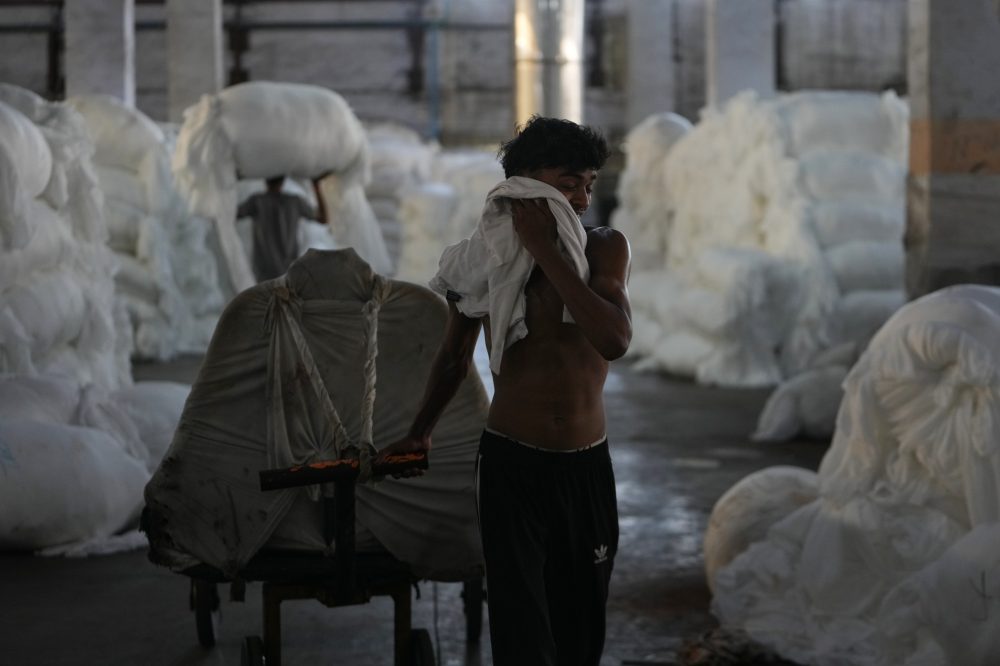

SURAT, India — Inside a textile factory on the outskirts of Surat, India, dozens of workers endure not just scorching temperatures and thick humidity, but also waves of steam, radiant heat, and chemical odors pouring off the massive machines that crowd the low-ceilinged factory floor.
The machines — known as stenters — thunder like engines. Boilers hiss constantly. Drum washers belch clouds of steam. The noise never lets up, and the air sits heavy and hot.
Soni Pande, a 27-year-old single mother, said the fans and mist-spraying coolers installed in the factory offer some relief, but they are no match for the worst days of heat.
“The heat does make us weak. We sweat a lot. Some people feel dizzy, unwell,” said Pande, who relocated from Bihar state in eastern India. “There are fans and coolers, but it’s still so hot inside.”
Across this major industrial city on India’s western coast, workers put in day and night shifts feeding wet fabric into machines that dry, print, dye, and finish cloth using extreme heat. The millions of meters of polyester fabric churned out daily are shipped to textile companies worldwide, eventually becoming sarees, dresses, and other affordable garments.
Like much of India, Surat is experiencing hotter days and nights and longer summers, a trend tied in part to climate change. Workers describe conditions inside the factories as sometimes unbearable. The problem is difficult to solve — even when cooling equipment is installed, its impact is often limited. On top of that, factory owners are facing financial strain from U.S. tariffs and supply chain disruptions caused by the Iran war, making it harder to spend the thousands of dollars required for adequate cooling systems.
Some factories have installed exhaust fans, while others use water-evaporation coolers that pull in fresh outside air to lower temperatures. These coolers, unlike air conditioners, don’t need sealed spaces, making them practical for factory settings with open entryways.
At the factory in the Sachin industrial area where Pande works — which The Associated Press visited — coolers were set up in quieter spots where employees gathered during 10 to 15 minute breaks. At a second factory, a central air duct ran cool air along the floor from coolers positioned at each end. In both locations, the cooling provided only short-term relief and was easily overwhelmed by the heat produced by the textile machinery.
“We sweat a lot and feel dizzy sometimes,” said Kundan Kumar, a worker from Bihar who operates a dyeing machine at Vinit Fabrics, the second factory, located in the Palsana industrial area near Surat.
Kumar acknowledged that the coolers help somewhat, but conditions remain difficult.
“Dyeing work is tough. It is difficult, but we have to do our work,” he said. “We need money to help our families, so we have to work.”
India, the world’s most populous nation, is also considered one of the countries most at risk from climate change. Each year, extreme weather events — including storms, floods, and dangerous heat — affect millions of people, causing thousands of deaths and billions of dollars in losses.
A 2022 World Bank report estimated that 75% of India’s workforce — roughly 380 million people — is exposed to heat-related risks, from construction laborers to factory employees, with temperatures sometimes reaching life-threatening levels.
India has laws and guidelines designed to shield workers from extreme heat, but labor unions wrote to the government earlier this year calling for stronger regulations and better enforcement. A further complication is that many of these labor protections do not apply to the more than 550 million informal workers — nearly 90% of India’s total workforce — a group that includes many of Surat’s textile employees.
Pooja Yadav, a researcher with the think tank WRI India, said the combination of humidity and heat in Surat’s factories creates genuinely dangerous working conditions.
“In textile processing units where steam and hot water are used, indoor conditions can be worse than outside,” she said.
Workers inside the factories face a mix of hot air and chemical fumes that can lead to headaches, dehydration, and fainting during shifts that can stretch to 12 hours, Yadav said.
“They can also develop long term issues with their lungs and kidneys,” she added, noting that high heat and humidity also reduce how efficiently workers are able to perform their jobs.
The financial pressures on Surat’s textile industry have grown due to shipping disruptions, rising material and energy costs from the Iran war, and steep tariffs imposed by the Trump administration — all of which are cutting into factory owners’ ability to invest in better cooling infrastructure.
Surat ranks among the world’s largest producers of polyester and other synthetic fabrics. The textile sector there employs more than 1.4 million workers and generates an estimated 30 million meters of polyester cloth every day, according to local government figures.
Because polyester is made from a petroleum-based plastic, producers are especially exposed to price swings tied to the Iran war. Factory managers say many workers went back to their home regions after production dropped sharply and have been reluctant to return because of the intense heat.
Subhash Sharma, the textile production manager at Vinit Fabrics, said the company normally employs around 700 people but is currently operating at just 60% capacity due to a combination of economic pressures and a shortage of workers.
“In the last few years, we are seeing that the number of laborers are reducing due to increasing heat,” he said.
According to WRI India, working conditions can be improved by installing systems that remove hot air or bring in cooler air — such as turbo ventilators and air coolers — improving overall ventilation, and better insulating the machines that generate heat.
Vinit Fabrics invested approximately $5,300 in cooling systems, Sharma said. The company has also wrapped heat-radiating machines in jute bags for insulation and ensured that floor gutters carrying hot water are kept sealed.
However, Yadav said the majority of factories in Surat still depend primarily on fans, and more effective cooling technology remains uncommon across the industry.
Yadav also stressed that policymakers need to factor industrial zones into their heat action plans.
Back on the factory floor, workers like Pande earn $7 for shifts lasting 10 to 12 hours. She said that for her, sitting out a shift is simply not an option.
“We don’t have a choice. I must provide for three kids. Heat or not, we have to work,” she said.