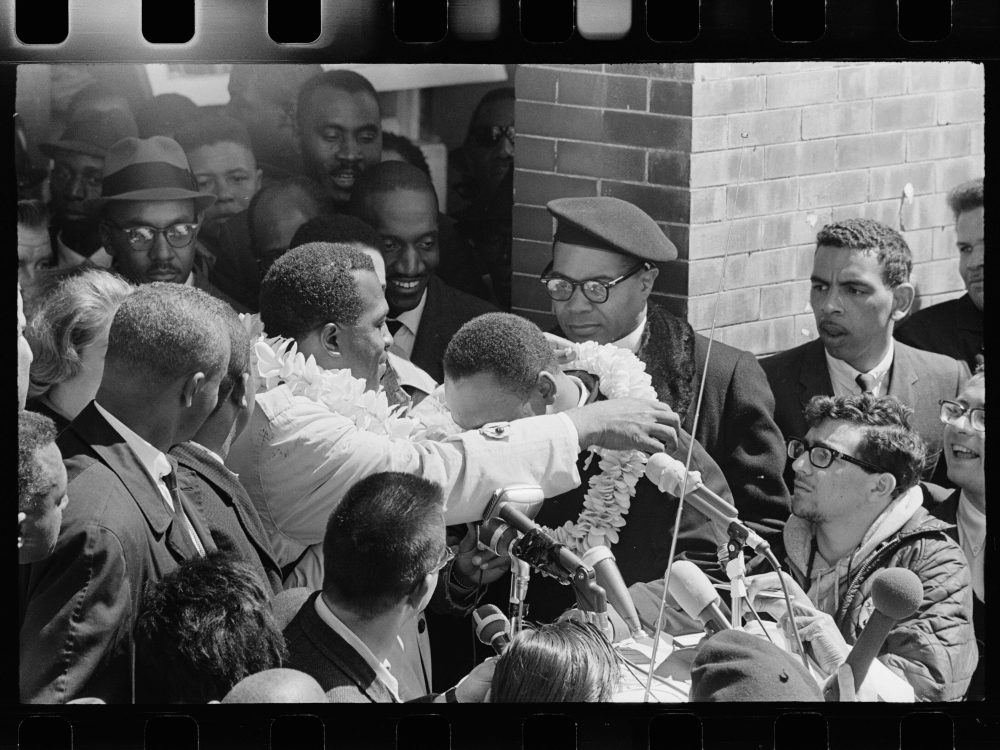

HONOLULU (AP) — A new exhibit at Hawaii’s state Capitol in Honolulu is giving the public its first look at many never-before-seen photographs of the Rev. Martin Luther King Jr. draped in Hawaiian flower lei during one of the most consequential marches of the Civil Rights era.
The images went on display Tuesday, capturing King wearing lei — floral garlands deeply tied to Hawaiian culture — during the historic Selma-to-Montgomery marches in Alabama. Those marches were a turning point in American history, ultimately driving the passage of the Voting Rights Act of 1965, which eliminated most barriers to voting that had been used to disenfranchise Black Americans in the Deep South, including poll taxes and other discriminatory practices.
According to a March 20, 1965, article in The Honolulu Advertiser, a group of four people made the long journey from Hawaii to Alabama carrying 48 flower lei. While some photos of King wearing lei have been published in the past, the majority of the images in this new exhibit have never been publicly shown. Some of the previously unseen photos feature slight variations, while others include individuals who may not have been considered significant at the time. The exhibit will remain open through July 7.
Among those who brought lei to Selma was Charles Campbell, a high school teacher and chairman of the Hawaii Civil Rights Conference. He was quoted in the 1965 newspaper article as saying: “Selma has the capability of becoming a real sore that could affect the entire nation.”
The photographs were captured after the notorious event known as Bloody Sunday, when state troopers launched a violent assault on Civil Rights demonstrators crossing the Edmund Pettus Bridge in Selma on March 7, 1965. The images were taken by Civil Rights photographer Matt Herron. His widow later donated them to Hawaii’s Department of Accounting and General Services for preservation in the state’s archives.
Following Tuesday’s unveiling, Steven Springel stood quietly before a photograph of his mother, Nona Ferdon, who was a divorced mother of two and a graduate student when she made her way to Selma. Springel recalled that he was just about to turn 7 at the time and only came to fully appreciate the significance of his mother’s journey as an adult. Growing up in Hawaii, he said, “we never experienced segregation or racial inequality” — a reflection of both his and his sister’s childhood. Ferdon passed away in 2021.
Keith Regan, who oversees the department as the state’s comptroller and served as acting governor while Gov. Josh Green was out of state, presided over the photo unveiling. He described the exhibit as a meaningful reminder that people from the Aloha State played a role in a pivotal chapter of American history. The small delegation had traveled thousands of miles, he said, “to be a part of the Civil Rights movement, to show ‘aloha’ to the world that Hawaii was there holding hands with our fellow brothers and sisters to ensure equality and justice were heard throughout the nation.”
The Hawaiian delegation also wore lei throughout the 50-mile march itself. The Mothers of Kawaiahaʻo Church in Honolulu had carefully strung together fragrant plumeria blossoms picked from the church grounds to create the lei.
Presenting lei — a word that functions as both singular and plural in the Hawaiian language — remains a cherished tradition for expressing the “aloha” spirit. In Hawaii, lei are given and received for a wide variety of occasions, from celebrating birthdays and promotions to showing gratitude and honor.
Tomi Knaefler, who had accompanied the delegation to Selma in 1965 as a reporter for the Honolulu Star-Bulletin, had planned to attend Tuesday’s news conference. However, at 96 years old, she was not feeling well enough to make it, according to her daughter, Pamela MacDonald, who attended in her place. MacDonald said she was 14 years old when her mother traveled to cover the march — describing it as “the one that she holds dearest to her heart.”
The exhibit’s debut coincides with the close of the U.S. Supreme Court’s 2026 term, which included a ruling that effectively dismantled the remaining protections of the Voting Rights Act. That decision has since triggered a wave of partisan redistricting across Southern states and put at risk decades of progress in Black political representation.