
Hamas issued sharp criticism on Friday following Israeli Prime Minister Benjamin Netanyahu’s announcement that his nation would increase its territorial control in Gaza, calling the move a dangerous escalation that has also alarmed Palestinian residents.
Netanyahu revealed plans to grow Israel’s controlled territory from the current 53% established under an October ceasefire agreement to an initial 70%, though he provided no specific details or timeline for the expansion.
The Palestinian militant organization, whose October 7, 2023, assault on Israel sparked two years of devastating conflict in Gaza, characterized Netanyahu’s remarks as a strategy for ethnic cleansing and the forced relocation of Palestinians.
MAJOR DISPUTES POSTPONED
Ismail al-Thawabta, head of the Hamas-run Gaza government media office, stated that “Any attempt to impose a new reality of occupation in Gaza is null and illegitimate,” emphasizing that Netanyahu’s announcement “represents a dangerous escalation.”
Despite more than eight months of ceasefire and while global focus has shifted to the conflict in Iran, Gaza’s fundamental issues persist without resolution, marked by ongoing Israeli military actions, minimal humanitarian aid delivery, and the potential for renewed major violence.
Israeli forces have already increased their controlled territory in Gaza beyond the original 53% marked by a “yellow line” in the ceasefire agreement to approximately 64%, establishing restricted zones shown in maps distributed to humanitarian organizations.
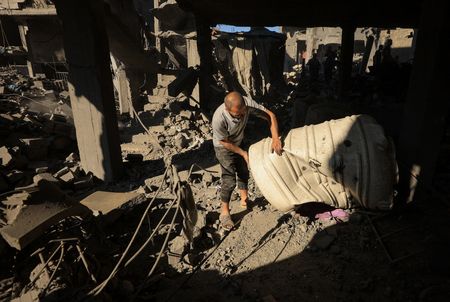
Any additional reduction of available space for Gaza’s more than 2 million residents, who are predominantly housed in temporary tent encampments throughout the small Palestinian territory, threatens to worsen the already catastrophic living conditions.
Mohammed al-Shagra, 72, from Khan Younis, expressed his frustration: “Where do we go? To the sea? There is no space.”
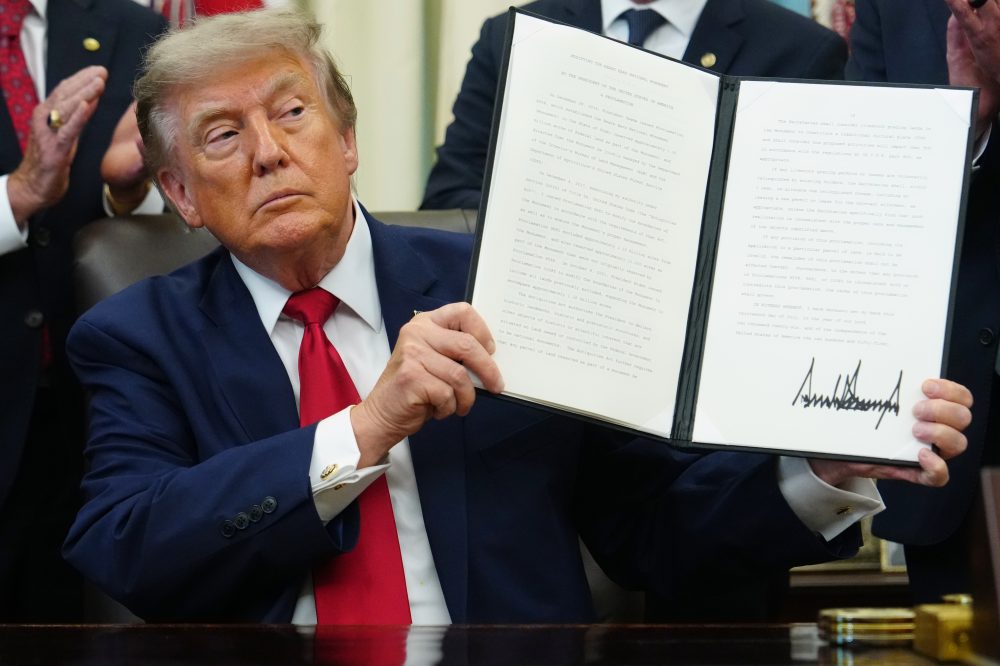
The agreement negotiated last year by U.S. President Donald Trump created a Board of Peace to supervise the staged ceasefire implementation and received United Nations Security Council approval.
Nevertheless, the most challenging disagreements, including Hamas disarmament, complete Israeli military withdrawal, and the structure of Gaza’s future government, were deferred to later phases of the process. Board of Peace mediators are currently engaged in discussions with both parties regarding disarmament matters.
Both Israel and Hamas have consistently blamed each other for ceasefire violations. Israeli military operations in Gaza have resulted in over 900 Palestinian deaths since the truce began, while Palestinian militant activities have killed four Israeli soldiers.
Neither Israel’s military nor the prime minister’s office provided immediate responses to Reuters’ requests for additional information and commentary regarding Netanyahu’s announcement.
A Board of Peace representative declined to comment on Netanyahu’s statement. Foreign ministries from permanent U.N. Security Council members Britain and France did not immediately respond to comment requests.
A spokesperson for Germany’s foreign ministry expressed concern about Israeli intentions to seize additional Gaza territory and opposed any permanent partition of the Palestinian region.
RISK OF FURTHER VIOLENCE
With elections approaching this year and facing criticism over Israel’s inability to achieve strategic objectives in conflicts with Iran and Lebanon, Netanyahu may be attempting to strengthen his position with voters.
Max Rodenbeck, Israel-Palestine Project Director at International Crisis Group, explained: “He’s determined to look tough in front of the electorate and he’s blamed by his opponents for having fought this seven-front war, but having won none of the wars.”
Rodenbeck warned: “Unless there’s some sort of pushback from the Trump administration it really does risk a return to something very bloody,” noting other ways Israel has intensified pressure on Hamas, including continued aid limitations on Gaza and targeted strikes against Hamas leadership.
For Gaza’s population, where virtually all residents were forced to evacuate their homes during the war and most remain in temporary tents or shelters, the possibility of increased Israeli military pressure is deeply concerning.
Mohammed al-Jundi, a displaced resident in Gaza City, questioned: “We see no ceasefire or anything and they keep advancing beyond the yellow line. For how long will the world stay silent?”
In Israel, security advocates view renewed military pressure as the sole method to compel Hamas disarmament and secure a lasting agreement.
Kobi Michael, a researcher at Israel’s Institute for National Security Studies and former strategic affairs ministry official, stated: “It looks as if we are taking a step towards another collision. But I believe this time it will be much shorter and maybe would open the path towards a new future.”