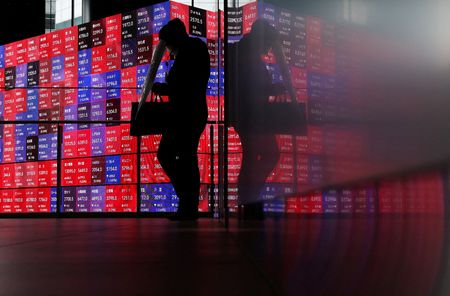

Most stock markets across Asia declined Monday as growing skepticism about the Middle East peace process pushed oil prices and bond yields higher, prompting investors to factor in a greater likelihood of rising U.S. interest rates.
The British pound weakened following reports that Prime Minister Keir Starmer was weighing his political future. Those reports came after rival Andy Burnham’s commanding election win to parliament, which led more members of the ruling Labour Party to call for Starmer’s departure.
U.S. President Donald Trump posted online that Starmer was preparing to resign, while simultaneously threatening new strikes against Iran — even as Vice President JD Vance sat down with Iranian officials for the first round of talks under a temporary peace agreement.
Those diplomatic discussions were overshadowed when Tehran announced it had once again closed the Strait of Hormuz. Ship-tracking data showed fewer vessels making the passage, with 32 ships transiting on Friday and 26 on Saturday before the closure.
Iran’s latest threats pushed Brent crude futures up 1.1% to $81.43 per barrel, though that remains well below the May peak of $126.41. U.S. crude climbed 2.7% to $78.70 per barrel, staying above the $67 level where it traded before the conflict began.
U.S. stock futures also slipped, with S&P 500 futures falling 0.5% and Nasdaq futures dropping 0.7%. In Europe, EUROSTOXX 50 futures declined 0.5%, DAX futures fell 0.3%, and FTSE futures edged down 0.1%.
Japan’s Nikkei bucked the trend, rising 0.7% after climbing nearly 8% the previous week to reach all-time highs. South Korea’s market, which had surged more than 11% last week on strong demand for semiconductor stocks, pulled back 0.9%. The MSCI index tracking Asia-Pacific shares outside Japan slipped 0.4%.
U.S. Treasury bonds remained under pressure following a more aggressive tone from the Federal Reserve last week, which led markets to assign a 75% probability to a rate increase as early as September. Bond futures now suggest 38 basis points of tightening by year’s end, with yields on 2-year notes climbing 4 basis points to 4.2276% — the highest level since early 2025.
Fabio Bassi, head of cross-asset strategy at JPMorgan, offered his outlook: “Our baseline call is for patience and a first hike in the second half of 2027, but believe the margin for error and the tolerance for further inflation is limited, with genuine risks of earlier hikes.”
Bassi added, “We remain constructive on risk assets as improving labour markets will keep rates higher for longer, supporting a narrow leadership in Quality Growth, Large Cap and Tech. We see upside risks for the S&P target tilted towards 8,000.”
The Federal Reserve’s preferred measure of core inflation is set to be released Thursday and is expected to tick up to 3.4% for May, reinforcing concerns about tighter monetary policy ahead. Fed Governor Christopher Waller and Federal Reserve Bank of New York President John Williams are both scheduled to speak this week.
The Fed’s hawkish stance kept the U.S. dollar firm at 161.44 yen, with only the threat of Japanese government intervention holding back a test of the 161.96 resistance level — a high last seen in mid-2024. The euro dipped to $1.1462 after touching a three-month low of $1.1418 on Friday.
Skye Masters, head of market research at NAB, commented on the British political situation: “Amid the uncertainty around a potential challenge against the UK PM and what that means for the fiscal outlook, the likelihood is that gilts will remain under selling pressure to start the week.”
In commodities, gold slipped 0.1% to $4,154 an ounce, weighed down by the pressure that higher bond yields place on assets that don’t pay interest.