
Global financial markets experienced turbulence Tuesday as tensions between the United States and Iran continued to escalate, keeping oil prices elevated above $100 per barrel despite recent declines.
Asian stock markets posted losses during Tuesday trading, with the MSCI Asia-Pacific index excluding Japan dropping 0.3%. Australian shares fell 0.4% in lighter trading volumes, while both Japanese and South Korean markets remained closed for holiday observances.
Futures markets in the United States and Europe also showed weakness, with Nasdaq and S&P 500 futures each declining approximately 0.1%. European markets faced steeper losses, with EUROSTOXX 50 futures down 0.2% and FTSE futures falling 0.75%.
The market volatility stems from ongoing confrontations between Washington and Tehran in Gulf waters, where both nations have implemented competing maritime blockades around the strategically important Strait of Hormuz. These clashes occurred shortly after President Donald Trump initiated a new initiative aimed at helping stranded vessels navigate through this crucial energy shipping corridor.
Shipping giant Maersk confirmed that the Alliance Fairfax, an American-flagged vehicle carrier operated through its Farrell Lines division, successfully passed through the Strait of Hormuz on Monday with US military escort.
However, the continuing confrontations have unsettled financial markets and underscored the persistent nature of Middle Eastern conflicts.
“We started yesterday with high hopes that operation ‘Project Freedom’ would be, I guess, a success on the ground, that it was being pitched as more of a humanitarian effort,” said Tony Sycamore, a market analyst at IG.
“But as we saw, the Iranians weren’t taking that bait at all… It really signifies that the stalemate remains in place, it’s been a very shaky start.”
Energy markets reflected these geopolitical concerns, with Brent crude futures declining 0.5% to $113.85 per barrel and US crude dropping 1.3% to $105.03. Both benchmarks had surged in the previous session due to heightened supply disruption fears.
Beyond geopolitical developments, market participants are preparing for a busy earnings week, with major companies including Advanced Micro Devices and Pfizer scheduled to report results Tuesday.
According to S&P Global Market Intelligence data, 83% of S&P 500 companies that have already reported quarterly results have exceeded earnings per share projections, while 78.2% have surpassed revenue expectations.
“With no signs of slowing down, AI-driven spending will likely continue to do the heavy lifting for S&P 500 earnings growth, led by the technology sector,” said Jeff Buchbinder, chief equity strategist at LPL Financial.
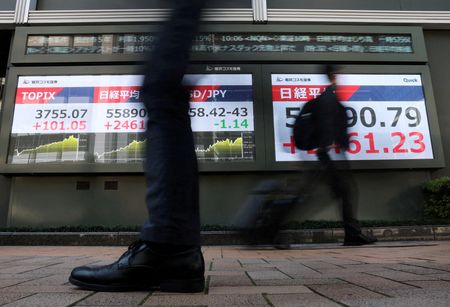
Currency markets remained focused on the Japanese yen, which held steady at 157.22 against the dollar following Monday’s brief rally that pushed the currency to an intraday peak of 155.69.
Japanese Finance Minister Satsuki Katayama issued statements Monday criticizing speculative foreign exchange trading, keeping market participants alert for potential government intervention after sources indicated Tokyo had acted to support its weakening currency last Thursday.
Abbas Keshvani, Asia Macro Strategist at RBC Capital Markets, suggested authorities might intervene again if the dollar-yen exchange rate approaches 160, a level they have historically defended. He noted that in 2022, Tokyo “fired three volleys of intervention in a few weeks.”
“We suspect intervention will merely act as a lid on USD/JPY, not a catalyst for protracted yen strength,” he said.
The Australian dollar weakened slightly by 0.06% to $0.7163 ahead of the Reserve Bank of Australia’s interest rate decision, where analysts widely anticipate a rate increase.
Meanwhile, the US dollar strengthened on safe-haven demand amid global uncertainties.
Federal Reserve policy expectations could shift based on upcoming economic data, including Friday’s April nonfarm payrolls report. Economists forecast the US economy added 62,000 jobs following March’s robust gain of 178,000, though seasonal adjustment challenges create significant uncertainty.
Current market expectations suggest the Fed will maintain its policy interest rate at current levels throughout the year due to inflationary pressures from global energy market disruptions.
Gold prices rose 0.2% to $4,529.19 per ounce, remaining within recent trading ranges.