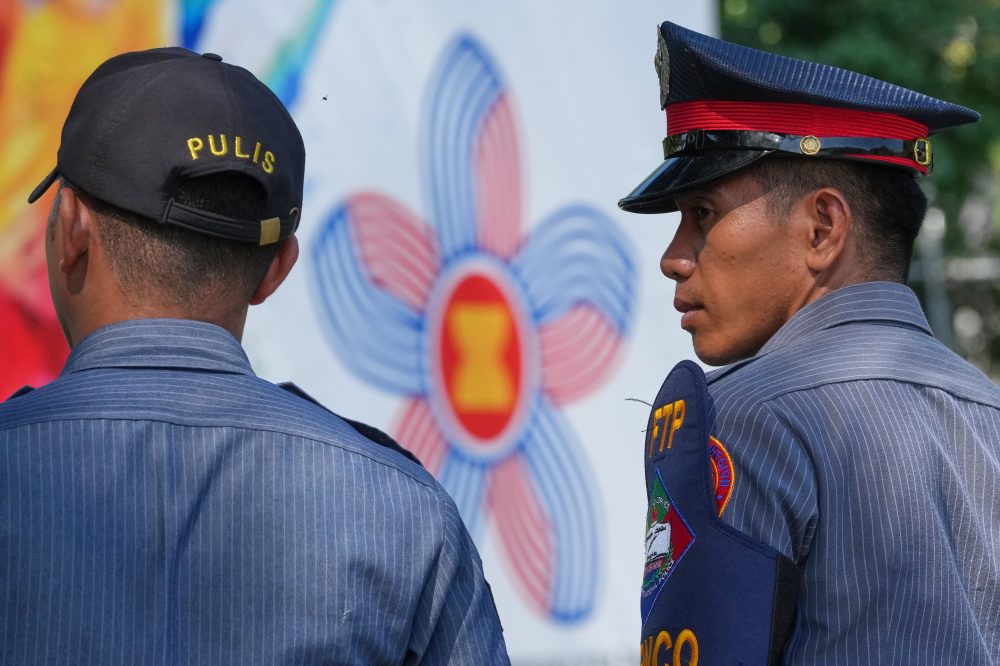

MANILA, Philippines — The leading diplomats of Southeast Asia are convening in the Philippine capital this Tuesday, joined by counterparts from Western and Asian nations including the United States, China, Russia, and the European Union, with the conflict involving Iran topping the list of urgent concerns.
The gathering is the annual ministerial meeting of the Association of Southeast Asian Nations, known as ASEAN. The Philippines, which holds the chairmanship of the 11-nation bloc this year, is hosting the three-day sessions in Manila.
Among those attending are U.S. Secretary of State Marco Rubio, Chinese Foreign Minister Wang Yi, and Russian Foreign Minister Sergey Lavrov. Ukraine’s top diplomat, Andrii Sybiha, has been invited to a Friday ceremony marking a 1976 nonaggression treaty tied to ASEAN, though he will not be part of the main ASEAN sessions that Rubio and Lavrov are attending. Neither Rubio nor Lavrov has announced any plans to hold meetings with each other or with Sybiha while in Manila.
Before the broader multilateral discussions begin, ASEAN foreign ministers are scheduled to meet among themselves Tuesday. A central topic will be the hostilities between the United States and Iran, which have spread to other parts of the Middle East and raised fears of an all-out war resuming. Two Southeast Asian diplomats told the Associated Press that the ministers plan to release a joint statement expressing serious concern and calling on both parties to return to the negotiating table.
The conflict has once again put shipping through the Strait of Hormuz at risk — a critical waterway through which roughly 20% of the world’s oil supplies moved before the war broke out.
Southeast Asia, a region home to more than 680 million people, depends significantly on oil and gas from the Middle East and has been hard hit by supply disruptions and price spikes tied to the Iran conflict. Philippine President Ferdinand Marcos Jr. declared a national energy emergency in March to safeguard the availability of fuel, food, and other essential goods and to crack down on hoarding and price gouging.
There are also growing concerns that Washington’s military focus on the Iran conflict has drawn attention away from Asia-Pacific issues — particularly China’s assertive moves in the contested South China Sea and toward Taiwan, areas where the Trump administration has pledged to push back. Rubio’s participation in the ASEAN meetings is intended to reaffirm the United States’ commitment to the region.
State Department spokesperson Thomas Pigott said in Washington: “The secretary’s visit advances a clear U.S. priority: a free and open Indo-Pacific that delivers safety, security and prosperity for the region and for the American people.”
On the sidelines of the ASEAN meetings, Rubio is expected to participate in a session of the Quad — a grouping made up of the United States, India, Japan, and Australia that was first formed in 2007. The Quad is widely seen as a key piece of the American strategy to counter China’s influence, and Beijing has repeatedly criticized it as an effort to contain its rise.
Beyond conflicts outside the region, ASEAN foreign ministers are also under mounting pressure to take stronger action on crises within Southeast Asia itself — particularly Myanmar’s ongoing civil war and the territorial disputes simmering in the South China Sea.
Myanmar’s military seized power from the democratically elected government of Aung San Suu Kyi in 2021. Since then, according to the Assistance Association for Political Prisoners, a rights-monitoring organization, more than 8,100 people have died in the fighting and nearly 22,500 remain detained.
A five-point peace plan that ASEAN leaders put forward in 2021 has not succeeded in halting the bloodshed, largely because Myanmar’s military-backed government has refused to comply. As a result, the bloc has barred Myanmar’s leaders and foreign minister from its high-level meetings, including this week’s sessions in Manila.
In an effort to move past the deadlock, ASEAN foreign ministers led by Philippine Foreign Secretary Theresa Lazaro met Myanmar’s top diplomat for the first time in five years earlier this month in Bangkok. At that meeting, they renewed calls for a reduction in violence and pushed for dialogue among all factions involved in the conflict. The following day, Lazaro — in her role as ASEAN’s special envoy — and Thai Foreign Minister Sihasak Phuangketkeow held consultations with high-level representatives of ethnic armed groups from Myanmar in the Thai resort city of Pattaya.
The decision to meet with Myanmar’s foreign minister, Tin Maung Swe, drew sharp criticism from human rights organizations, who argued it effectively undermined the bloc’s ban on engaging with the country’s senior officials and gave the military government a diplomatic win without requiring any concessions in return.
Lazaro pushed back on that characterization, saying: “It was not and should not be mischaracterized as an abandonment of the five-point consensus. The path to peace can only be obtained through resolute diplomacy with all parties to the conflict.”
The ASEAN foreign ministers are also set to meet with Chinese Foreign Minister Wang Yi in Manila to assess progress on negotiations over a proposed “code of conduct” for the South China Sea — an agreement designed to keep long-standing territorial disputes from escalating into open conflict.
The disputes involve China, Taiwan, and the ASEAN member states of Brunei, Malaysia, the Philippines, and Vietnam. In recent years, tensions between Chinese and Philippine coast guard and naval forces in the contested waters have grown particularly sharp.