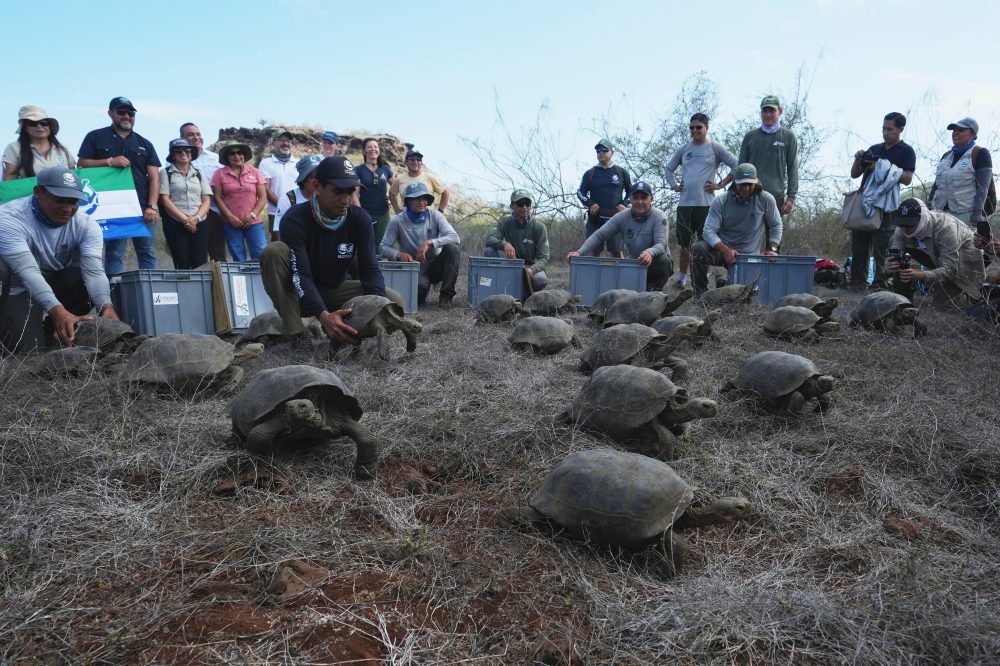

FLOREANA ISLAND, Ecuador — For the first time in almost 150 years, giant tortoises are once again roaming Floreana Island in Ecuador’s famous Galápagos archipelago after conservationists released 158 young hybrid specimens on Friday to help rebuild the island’s damaged ecosystem.
The juvenile tortoises, ranging in age from 8 to 13 years old, have started exploring their new home just as the first winter rains of the season began to fall. Officials say the timing couldn’t have been better for the historic release.
“They are large enough to be released and can defend themselves against introduced animals such as rats and cats,” explained Fredy Villalba, who directs the Galápagos National Park breeding center on Santa Cruz Island. He noted that researchers carefully chose the healthiest animals with the best genetic heritage for this mission to Floreana.
The newly released tortoises represent just the beginning of a larger effort, with plans to eventually introduce 700 of the animals to the island. Christian Sevilla, who oversees ecosystem management for Galápagos National Park, says these hybrid tortoises contain between 40% and 80% of the DNA from Chelonoidis niger, a tortoise species that disappeared from existence 150 years ago.
Scientists remain baffled by how these genetic connections survived, tracing the hybrid lineage back to Wolf Volcano on Isabela Island. Through careful selection of breeding adults with the strongest genetic traits, Sevilla explained, the program hopes to slowly restore the extinct Floreana species to something closer to its original form.
Floreana once supported roughly 20,000 giant tortoises two hundred years ago. But whaling operations, a catastrophic fire, and continuous human activity ultimately wiped out every last tortoise on the island.
“In genetic terms, reintroducing a species to that island with a significant genetic component of the original species is vital,” biologist Washington Tapia explained to reporters.
Tapia, who researches the islands through his company Biodiversa-Consultores, stressed that the project goes beyond simply adding animals to the island — it’s about bringing back a genetic heritage that was lost.
The volcanic island of Floreana covers about 173 square kilometers and sits as the southernmost island in the Galápagos chain, located roughly 1,000 kilometers off Ecuador’s coast in the Pacific Ocean.
The returning tortoises will coexist with nearly 200 human residents and native wildlife including flamingos, iguanas, penguins, sea gulls and hawks. However, they’ll also face challenges from invasive species like blackberry and guava plants, along with non-native animals including rats, cats, pigs and donkeys that humans brought to the island over time.
Local resident Verónica Mora called the tortoise release a dream fulfilled. “We are seeing the reality of a project that began several years ago,” she remarked, expressing how proud the community feels about welcoming back the giant tortoises.
The United Nations recognized the Galápagos Islands as a Natural World Heritage Site in 1978, acknowledging the archipelago’s extraordinary collection of land and sea creatures that exist nowhere else on Earth.