
BERLIN — Wildlife rescue teams in Germany announced Wednesday they no longer believe a humpback whale can be saved after it became trapped for a third time in the shallow waters of the Baltic Sea.
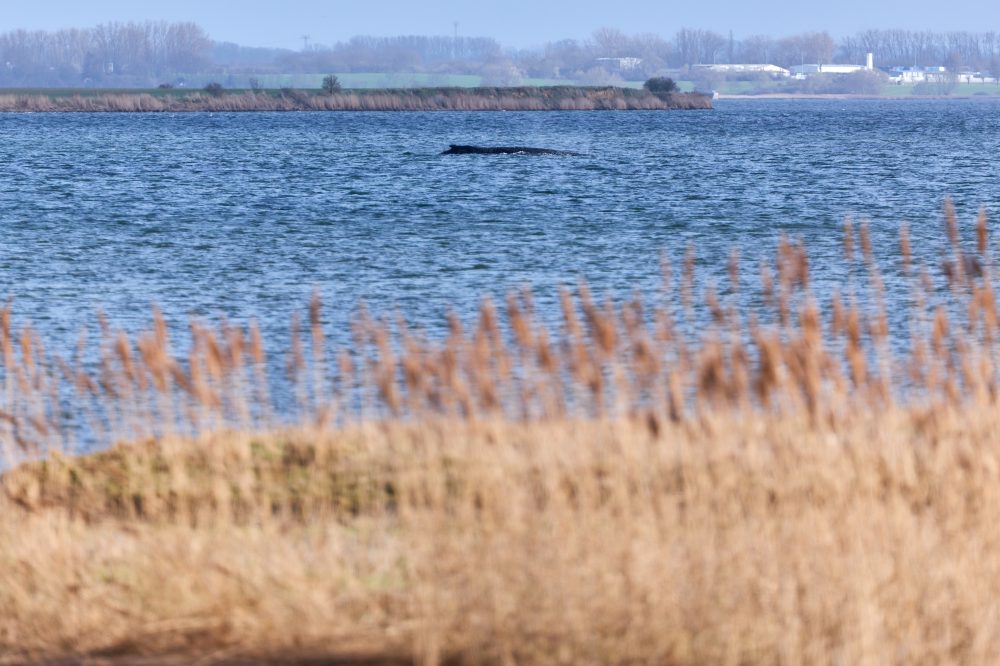
The massive marine mammal swam into shallow waters near Poel island, close to Wismar port, on Tuesday where it became stuck once again. The whale had previously been freed from even more shallow waters at Timmendorfer Strand resort town about 50 kilometers away last week, requiring heavy machinery to assist in the rescue, but quickly found itself in danger again.
Recent rescue attempts focused on allowing the exhausted whale to rest quietly, hoping it would regain enough energy to swim to deeper waters on its own. Teams occasionally used boats to try encouraging the animal to move toward open water.
Burkard Baschek, who serves as scientific director at Ocean Museum Germany and coordinates the rescue mission, reported the whale showed highly irregular breathing patterns Wednesday. Aerial drone footage revealed minimal movement in the sediment beneath the 39-49 foot long creature, and it showed little response when rescue teams approached.
Though the whale displayed slightly more movement after rescuers departed, Baschek explained during a televised press briefing that this activity provided no reason for optimism. “We firmly believe that the animal will die there,” he stated.
Unlike two earlier incidents where the whale managed to free itself after resting, the animal now appears significantly weaker and must contend with dropping water levels. “The prospects that it will free itself are very small,” Baschek explained. “The approach of maximum rest and respect for nature demands at some point that we let it go.”
The whale’s struggle has captured widespread attention throughout Germany, with news outlets providing regular updates on its condition. The animal earned the nickname “Timmy” during its journey along the coast.
Marine biologists first observed the whale in the area on March 3. Experts remain uncertain why the creature entered the Baltic Sea, which lies far from its natural environment and provides unsuitable conditions. Some specialists theorize the whale may have become disoriented while following a school of herring or during seasonal migration.
Even under the best circumstances, the animal faced enormous challenges reaching the North Sea, requiring a journey of several hundred kilometers, before continuing to the Atlantic Ocean.