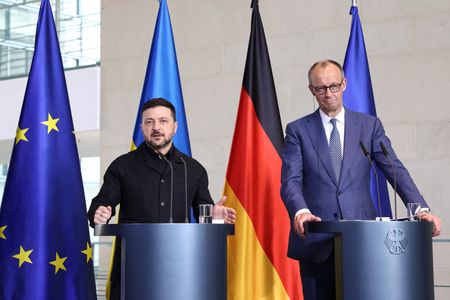

A top German official has unveiled a plan to provide Ukraine with special standing in European Union operations as a stepping stone toward complete membership, suggesting this approach could support efforts to resolve the ongoing conflict sparked by Russia’s military action.
According to a communication to EU leadership obtained by Reuters, the German chancellor recommended Ukraine receive a new designation as an “associate member” that would enable Ukrainian representatives to participate in EU leadership gatherings and ministerial sessions without voting privileges.
The German official also recommended that EU nations make a “political commitment” to extend the organization’s mutual defense provision to Ukraine “in order to create a substantial security guarantee”.
Political experts indicate that establishing a definitive pathway to EU membership could prove crucial for President Volodymyr Zelenskiy when presenting any peace agreement to Ukrainian citizens, especially if Ukraine fails to reclaim all its territory or secure NATO membership as many anticipate.
However, European representatives indicate that achieving complete membership for Ukraine within the coming years remains unrealistic, despite a target date of 2027 being included in a 20-point peace framework discussed between the United States, Ukraine and Russia.
This proposal attempts to bridge the gap between rapid admission and Ukraine’s present status as a candidate nation beginning the membership journey.
“My proposal reflects Ukraine’s particular situation, a country at war. It will help facilitate the ongoing peace talks as part of a negotiated peace solution,” the German leader stated, noting this was “essential not only for Ukraine’s but for the entire continent’s security”.
The standard membership process typically involves extensive bureaucratic procedures, including comprehensive negotiations and legal changes to satisfy EU democratic and economic requirements.
EU admission demands approval and confirmation from all 27 member nations, creating potential for considerable hurdles.
The German official detailed advantages Ukraine might gain through associate membership, a classification not currently recognized in EU regulations.
Such advantages could encompass a Ukrainian non-voting associate representative on the European Commission and non-voting delegates in the European Parliament.
The chancellor noted that safeguards could be established to reverse Ukraine’s status if the country fails to maintain rule-of-law principles or falls behind in the admission process.
The proposal would not impact other candidate nations, and the German leader suggested the organization “look into innovative solutions” for countries that have pursued EU membership for extended periods.
The German official indicated plans to present these concepts to other European leadership.
“My aim would be to reach an agreement soon, and to set up a dedicated Task Force to work out the details,” the communication stated.