
WASHINGTON (AP) — Georgia wraps up primary voting Tuesday in what promises to be heated contests for both the governor’s mansion and a critical U.S. Senate position that may determine which party controls the narrowly split upper chamber.
These primary battles will establish the framework for two high-profile November elections with political consequences extending well past Georgia’s state lines.
Voters across Georgia will select candidates for numerous positions including U.S. House seats, state legislative posts, and various statewide roles like lieutenant governor, secretary of state, and attorney general. Ballot measures also include nonpartisan judicial elections, featuring two contested state Supreme Court races.
Eight Republican candidates are competing for the chance to replace term-limited GOP Governor Brian Kemp. The field features state Attorney General Chris Carr, healthcare business leader Rick Jackson, Lieutenant Governor Burt Jones, and Georgia Secretary of State Brad Raffensperger.
While Jones has secured President Donald Trump’s backing, Jackson is challenging the worth of that presidential support by investing over $83 million of his own money into his campaign.
Democratic contenders include former Atlanta Mayor Keisha Lance Bottoms, former Republican Lieutenant Governor Geoff Duncan, former state Senator Jason Esteves, state Representative Derrick Jackson, and former state labor commissioner and former DeKalb County CEO Mike Thurmond.
Should no candidate capture a majority in the primary election, the leading two vote recipients will compete in a June 16 runoff.
The eventual successor to Kemp will serve during 2028 and may become a significant player in the upcoming presidential race if Georgia maintains its competitive status from 2020 and 2024. Trump previously criticized Kemp for declining to assist in overturning his 2020 Georgia defeat to Democrat Joe Biden, though the two politicians reconciled in 2024 before Trump’s successful reelection bid.
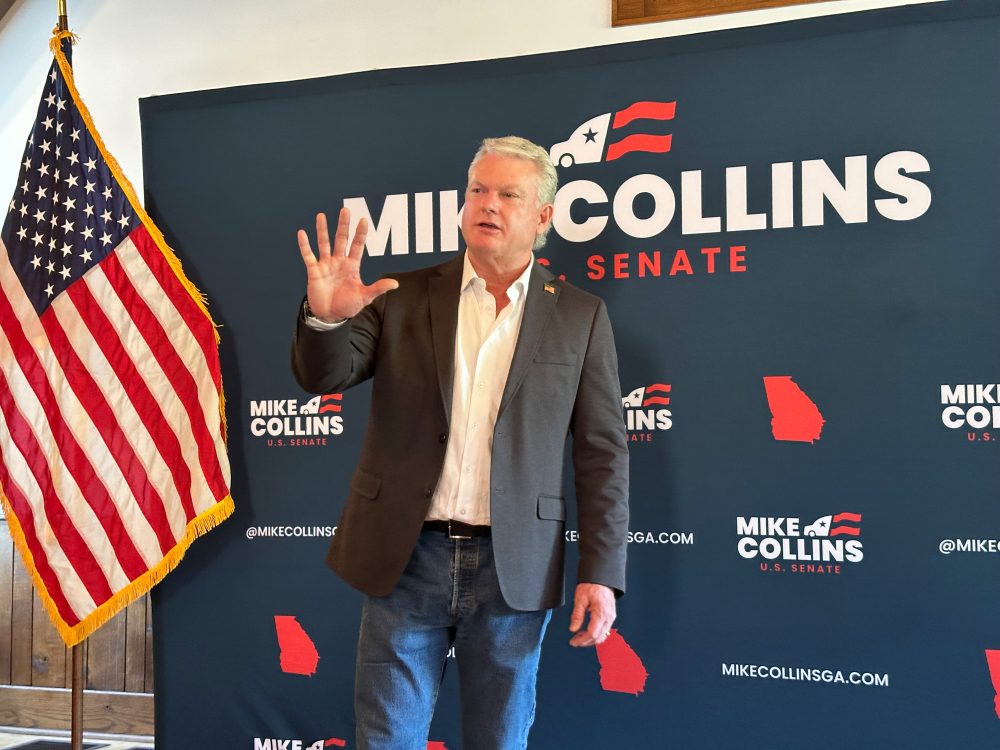
For the U.S. Senate contest, five Republicans are campaigning to face first-term Democratic Senator Jon Ossoff, who faces no primary opposition. Candidates include Representatives Buddy Carter and Mike Collins, plus former University of Tennessee football coach Derek Dooley, who has received Kemp’s support.
Carter has collected and spent more funds than his GOP competitors, though he, Collins and Dooley entered the month with similar financial resources of approximately $1.7 million in their campaign accounts.
A successful Ossoff reelection campaign in November would be essential for Democratic ambitions to regain chamber control.
The Atlanta metropolitan counties of Fulton, Gwinnett, Cobb and DeKalb represent the state’s largest population centers and hold significant influence in both parties’ statewide primary elections. Fulton and DeKalb typically carry more weight in Democratic primaries, while Cobb and Gwinnett generally provide larger vote shares in Republican races. Cherokee and Forsyth counties, also part of the greater Atlanta region, tend to play bigger roles in Republican rather than Democratic primaries. Both counties delivered strong support for Trump across his three presidential campaigns.
Key election details and data points the AP Decision Team will track during vote counting include:
Polling locations close at 7 p.m. Eastern Time.
The Associated Press will deliver vote tallies and announce winners in competitive primaries for U.S. Senate, U.S. House, governor, lieutenant governor, secretary of state, attorney general, agriculture commissioner, insurance commissioner, state school superintendent, labor commissioner, Public Service Commission, state Senate and state House, plus nonpartisan state Supreme Court and Court of Appeals elections.
All registered voters may vote in either primary since Georgia doesn’t require party registration.
Thursday’s count showed approximately 8.1 million registered Georgia voters.
During 2022, around 1.2 million ballots were submitted in Republican governor and U.S. Senate primaries, compared to roughly 730,000 votes in Democratic primaries.
Early voting accounted for about 51% of the 2022 Democratic primary turnout and approximately 41% of Republican primary participation.
By Thursday, around 696,000 votes had already been submitted for Tuesday’s election, with about 381,000 in the Democratic primary and roughly 305,000 in the Republican primary.
Counties typically report mail-in and early in-person voting results at the beginning of election night. More than half of all counties usually release their complete or near-complete mail and early voting tallies in their initial update.
During the 2022 primary, the Associated Press published initial results at 7:13 p.m. Eastern Time, just 13 minutes after polls closed. The final vote update occurred at 3:29 a.m. Eastern Time with approximately 99% of votes tallied.
The Associated Press avoids making projections and only declares winners when determining no possible scenario exists for a trailing candidate to overcome the deficit. For uncalled races, the AP continues reporting significant developments like candidate concessions or victory claims while clearly stating no winner has been declared and explaining the reasoning.
Georgia lacks automatic recount procedures, but candidates may request recounts when margins equal 0.5% or less of total votes. The Associated Press may declare winners in recount-eligible races if determining the lead is too substantial for recounts or legal challenges to alter results.
As of Tuesday, 28 days remain until the June 16 primary runoff and 168 days until the 2026 midterm elections.