
ATLANTA (AP) — Georgia’s legislative session concluded early Friday morning with no resolution to a critical voting equipment dispute that faces a July deadline, creating uncertainty for elections in the key swing state.
Months of legislative discussions failed to produce a workable solution, raising questions about how Georgia residents will cast ballots in November and potentially forcing the matter into courtrooms or requiring lawmakers to reconvene in a special session.
“They’ve abdicated their responsibility,” said Democratic state Rep. Saira Draper, criticizing the Republican-controlled legislature’s inability to act.
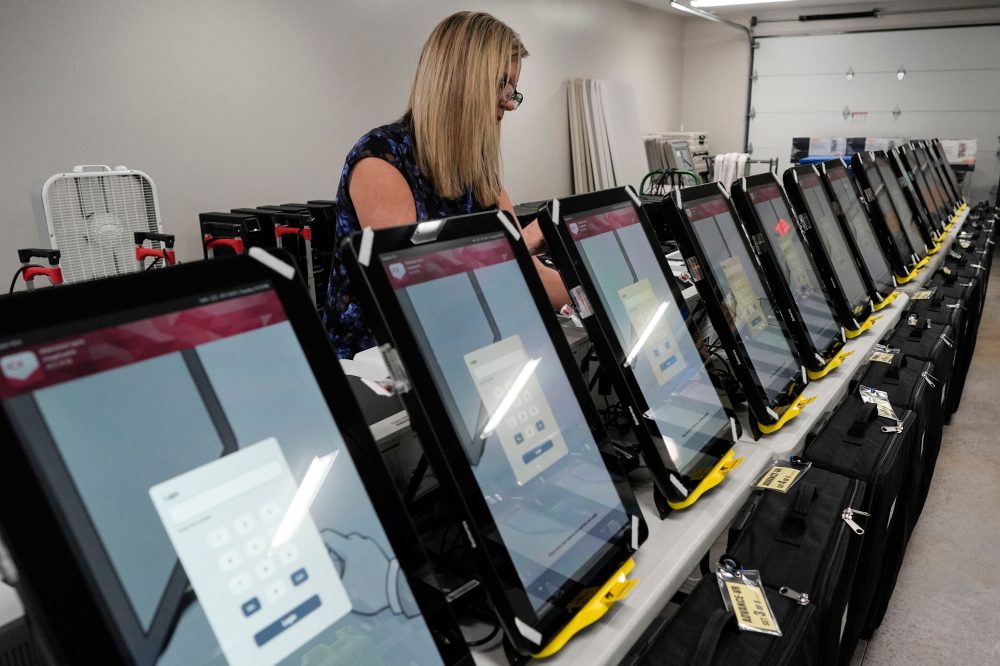
Georgia voters currently use Dominion Voting equipment that produces printed ballots containing QR codes, which scanning devices read to record votes. These systems became targets of criticism from President Donald Trump after his 2020 defeat, prompting his Georgia allies to pass 2024 legislation prohibiting the use of barcodes for vote counting.
However, existing state law continues to mandate county use of these machines. No funding has been designated to modify the equipment, and legislators couldn’t reach consensus on alternative systems.
“We’ll have an unresolvable statutory conflict come July 1,” explained House Governmental Affairs Committee Chairman Victor Anderson, a Cornelia Republican who supported continuing current machine use through 2026 — a proposal Senate Republicans refused to consider.
Anderson’s plan gained support from both House Republicans and Democrats and would have mandated Georgia select a QR code-free voting method by 2028. Election administrators favored this approach.
“The Senate has shown that they’re not responsible actors,” Draper stated. She suggested Lt. Gov. Burt Jones, a Trump-endorsed Republican seeking the governor’s office, appeared more focused on maintaining Trump’s support than “doing right by Georgia voters.”
Jones’ office did not respond to early Friday requests for comment.
Joseph Kirk, who supervises elections in Bartow County and leads the Georgia Association of Voter Registration and Election Officials, said he expects guidance from the secretary of state and anticipates judicial intervention to direct election officials.
“This is uncharted territory,” Kirk noted.
Robert Sinners, speaking for Republican Secretary of State Brad Raffensperger, who is also pursuing the governor’s office, said officials remain “ready to follow the law and follow the Constitution.”
Republican House Speaker Jon Burns explained to reporters that his chamber sought to limit changes during this election year.
“You can’t change horses in the middle of the stream,” Burns commented.
Burns indicated he would consult with Gov. Brian Kemp to gauge interest in calling a special session. Kemp’s office did not respond to questions about the departing Republican governor’s intended actions.
Anderson warned that without legislative action, the state might need to implement hand-marked and hand-counted paper ballots for November voting.
Election administrators argue that adopting new systems within months, as some Republicans advocate, would be virtually impossible.
“They made no way for this to happen except putting a deadline on it,” said Cherokee County elections director Anne Dover regarding the barcode elimination. Dover noted that certain proposals would require printing extremely large quantities of ballots.
Paulding County Election Supervisor Deidre Holden criticized lawmakers for prioritizing political positioning over practical planning.
“If anyone is resilient and can get the job done, it’s all of us election officials, but the legislators need to work with us, and they need to understand what we do before they go making laws that are basically unachievable for us,” Holden said.
Advocates for hand-marked paper ballots argue voters would have greater confidence in accurate counting if they could observe what scanners process.
Conservative election activists pushed legislators for immediate adoption of hand-marked paper ballots, but the House rejected a Senate proposal for such changes.
Anderson expressed uncertainty about whether a special session could navigate the political tensions but emphasized that Georgia lawmakers must address the issue.
“This is a legislative problem,” Anderson concluded. “It’s a legislative solution that has to happen.”