
Fourteen-year-old Fadel al-Naji once loved playing soccer, but now he spends most of his time at home in Gaza City after losing both legs in an Israeli drone strike last September.
The teenager sits quietly on a sofa, one empty pant leg hanging down while the other is folded at his waist, next to his 11-year-old brother who lost an eye in the same attack.
“He has become withdrawn and isolated,” his mother Najwa al-Naji explained while showing old videos of her son juggling a soccer ball on her phone. “It is as if he is dying slowly, and I wish that they would fit him with prosthetic limbs.”
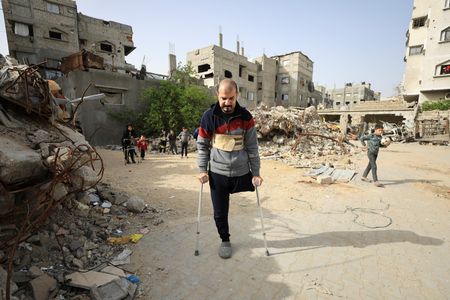
However, artificial limbs remain extremely difficult to obtain for Gaza’s approximately 5,000 war amputees — one-fourth of whom are children like al-Naji — due to Israeli limitations on importing materials such as plaster of Paris, according to seven aid and medical sources who spoke with Reuters.
Israel, which engaged in a two-year conflict with Hamas militants in the Palestinian territory, justifies the restrictions by pointing to security concerns.
When combined with Gaza’s existing amputee population before the war, Palestinian health officials report that the territory’s per capita amputation rate now surpasses even Cambodia, which previously held that distinction due to landmine injuries, according to aid organization Humanity & Inclusion.
The shortage has become so severe that two medical facilities report attempting to salvage old prosthetic devices from war casualties. Other medical professionals are constructing improvised artificial limbs using plastic tubing or wooden boards, though doctors warn this approach could damage residual limbs or lead to infections.
Gaza’s amputee crisis represents the gap between promises made during October’s ceasefire and President Donald Trump’s 20-point plan that envisioned complete aid delivery “without interference.”
The plan also called for reopening the Rafah border crossing — Gaza’s only exit to Egypt — but medical evacuations for amputees and others have remained sporadic.
Israel maintains restrictions on imports of items it considers to have both military and civilian applications, a policy that existed before the two-year conflict. Although plaster of Paris and other plastic components for prosthetics aren’t specifically listed on Israeli dual-use item catalogs, “construction products” do appear there, according to an Israeli export control document.
COGAT, Israel’s military agency overseeing Gaza access, states it allows regular entry of medical equipment but prohibits materials that Hamas could use for “terrorist build-up.”
When asked about prosthetic supplies, COGAT indicated it maintains discussions with the United Nations and other aid organizations to find ways to enable proper medical responses.
The International Committee of the Red Cross, which assists Gaza’s Artificial Limbs and Polio Centre — the territory’s primary prosthetic facility — reports that plaster of Paris imports have been almost entirely blocked for more than four months, with remaining supplies lasting only until June or July.
“What we are producing now are very small quantities compared to the actual need,” explained Hosni Mhana, the center’s spokesperson, though he declined to provide specific numbers.
The Qatari-funded Sheikh Hamad Hospital reports receiving no supplies throughout the war and has completely run out. The facility can now only perform maintenance on existing prosthetics. “There are no local alternatives for prosthetic manufacturing materials,” stated the hospital’s General Director Ahmed Naim.
Humanity & Inclusion, which has fitted 118 temporary prosthetics in Gaza since early 2025, says supplies from its final December 2024 shipment are nearly exhausted.
The Trump-led Board of Peace, which has worked to increase Gaza aid, stated it takes the struggles of amputees and other patients very seriously.
“These are urgent civilian needs,” the board told Reuters, emphasizing that ceasefire obligations included sustained delivery of humanitarian, commercial and medical supplies.
The board noted that restrictions and delays are discussed with appropriate authorities. “We have significant guarantees and commitments that these restrictions will be eased and eliminated as armed parties agree to decommission their weapons and hand over authority to a Palestinian technocratic government in Gaza.”
Prosthetic limbs cannot be shipped complete to Gaza since each device must be custom-built for individual patients, with plaster used to create precise casts of remaining limbs to form fitted sockets.
Reuters spoke with three additional Gaza amputees, all facing difficulties returning to their pre-war routines without prosthetics.
Many amputees remain on waiting lists and may have completed preliminary procedures, including stump revision surgeries to improve the limb’s shape.
Among those waiting is Hazem Foura, a 40-year-old former office employee who hasn’t worked since losing his left leg above the knee in December 2024 when he says Israeli forces bombed his residence.
“I am not asking for the luxuries of life, I am asking for a limb so I can regain my humanity,” he stated.
The absence of prosthetics significantly hampers recovery and extends psychological trauma for amputees, many of whom could have avoided limb loss with more specialized surgeons available.
This situation also increases their vulnerability to continuing Israeli attacks, which have claimed 750 Palestinian lives since the ceasefire, according to Palestinian health officials.
Israeli limitations on items like wheelchairs have relaxed since the ceasefire, the ICRC and UNICEF reported, but medical staff say navigating Gaza’s debris-filled streets remains challenging.
Beyond materials, expertise is also scarce, with only eight prosthetists remaining in Gaza according to the World Health Organization. Follow-up treatment for children presents particular difficulties, medical professionals noted, since they require regular adjustments as they develop.
“The amputation itself is not just a lost limb, it’s lost hope, it’s lost independence,” said Heba Bashir, prosthetic and orthotic technical officer for Humanity & Inclusion. “For the kids, it means losing their future.”