
GAZA CITY, Gaza Strip — During the first session of President Donald Trump’s Board of Peace held in Washington, the administration highlighted commitments of billions in funding to reconstruct the Gaza Strip and envisioned a “new and harmonious” Middle East emerging from conflict. Presentation materials displayed at the session featured visions of sparkling skyscrapers and fresh athletic facilities.
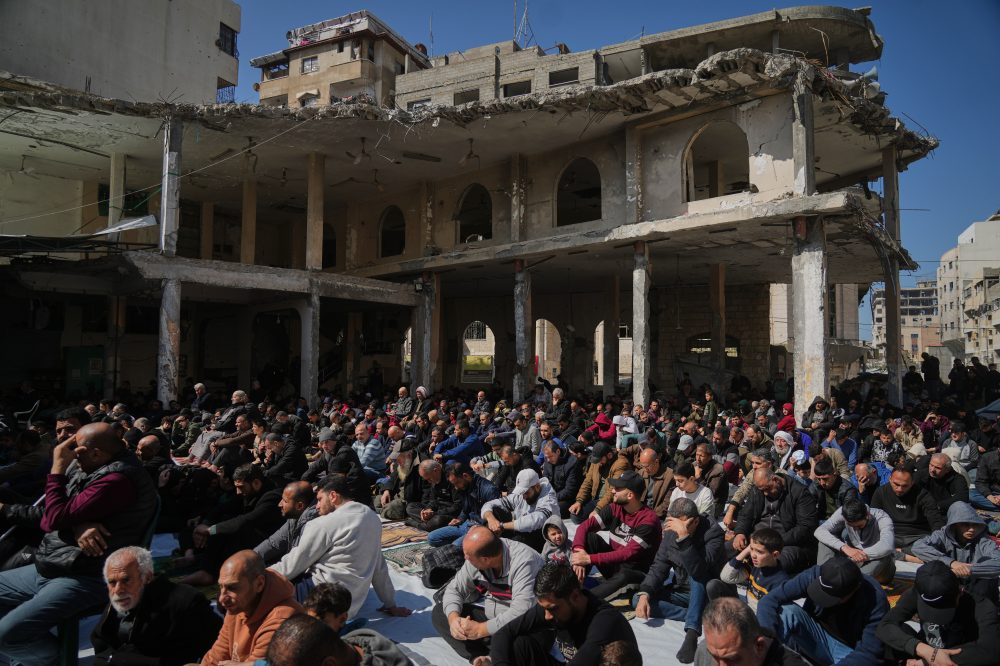
However, such hope remains absent among Gaza’s population, where Palestinians enduring months or years in overcrowded temporary settlements or destroyed neighborhoods express little faith in promised changes.
“Since the beginning of the war, we’ve been hearing about conferences and meetings. They say there’s a solution and peace, but it’s all a joke. They’re all liars,” said Faraj Abu Anze, who is among tens of thousands of Palestinians living in a sprawling tent camp on the Mediterranean coast.
“We see nothing of that on the ground. There is no hope. Education and health care are gone. There is no life,” he said.
The president revealed that nations participating in his comprehensive peace initiative had committed $7 billion toward rebuilding efforts and agreed to deploy thousands of military personnel as part of an International Stabilization Force.
However, officials provided no specific schedule, and rebuilding activities have not yet commenced.
Israeli authorities maintain that Gaza reconstruction cannot proceed until Hamas surrenders its arsenal, a provision within the October ceasefire agreement that has become a significant obstacle.
International organizations including the United Nations, European Union and World Bank have calculated reconstruction costs at $70 billion — potentially ten times Thursday’s announced commitments. Clearing enormous amounts of debris containing unexploded weapons alone could require multiple years.
Gaza’s Health Ministry reports that over 72,000 Palestinians have died in the conflict that began with Hamas’ Oct. 7, 2023 assault on Israel. Though part of the Hamas-controlled administration, the ministry’s casualty figures are considered generally accurate by the United Nations and independent analysts.
Palestinian fighters killed approximately 1,200 individuals, primarily civilians, during their initial assault and captured 251 others as hostages. While the ceasefire agreement halted major combat operations and secured the freedom of all remaining captives, it left crucial questions about Gaza’s governance unresolved.
“There are meetings every day, but we see nothing,” said Ahmad Abu Selme, who has been displaced twice during the war. “There are tents everywhere and people are frustrated. We are tired.”
“I hope a real peace takes place and that we can go back to our homes,” he added. “I know there are no homes anymore, but we still want to return.”
American officials plan to initiate reconstruction efforts in Rafah, located along Gaza’s Egyptian border. The community suffered extensive destruction and population exodus during fighting, and currently sits within the Gaza territory under complete Israeli military authority.
Ruwayda Dheir, displaced from Rafah along with tens of thousands of others, doubts she and fellow residents will benefit from the promised funding.
“The most important thing is that they put the money where it belongs and give it to the people,” she said. “They’ll say they spent it on infrastructure, but we won’t see it.”