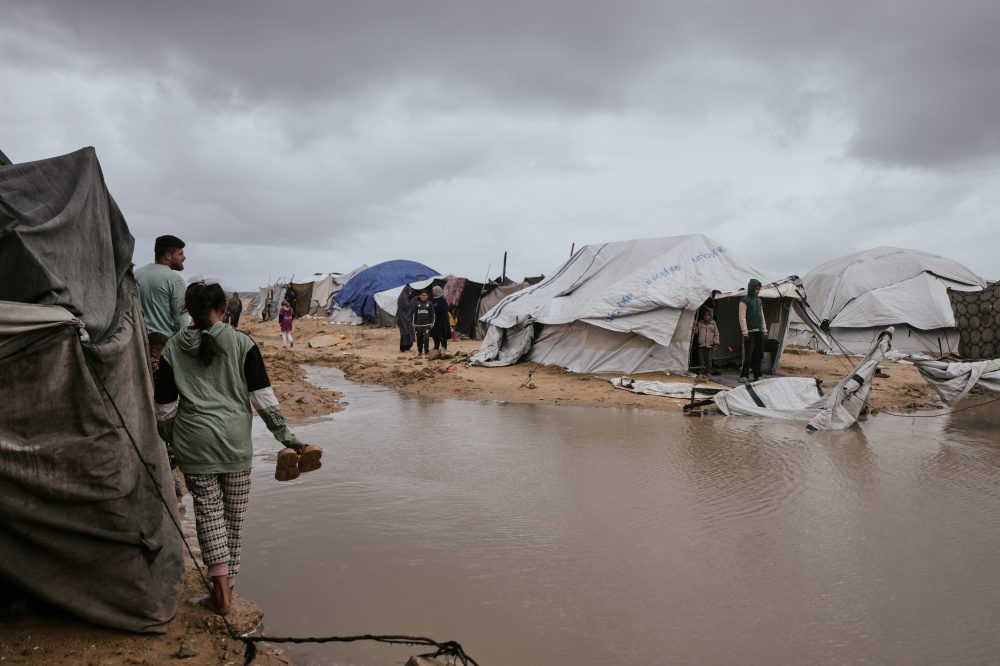

DEIR AL-BALAH, Gaza Strip — The Gaza Strip reached a significant milestone Friday as its ceasefire agreement completed six months since taking effect, though this achievement has been overshadowed by attention to the newer and more unstable truce in the Iran conflict.
The Palestinian enclave, home to 2 million residents, has experienced an end to the heaviest combat between Israeli military forces and Hamas-led fighters. However, the majority of ceasefire implementation work still lies ahead, including dismantling Hamas’ military capabilities, ending their 20-year governance, establishing an international peacekeeping presence, and launching massive rebuilding efforts. Gaza’s population remains in uncertainty, with restricted humanitarian assistance arriving through just one border crossing under Israeli oversight.
These obstacles may preview what lies ahead for the newest conflict, as President Donald Trump’s peace strategy seems focused on halting bombardments while delegating broader solutions to other parties.
Whether Trump can push through similar agreements regarding Iran, given the increased number of stakeholders and global economic sensitivity to every development, remains uncertain.
Attention to agreement specifics proves essential. The Iran conflict’s two-week truce has already generated fatal misunderstandings regarding Lebanon, with Israel maintaining the accord excludes Lebanese territory and continuing strikes against Iranian-supported Hezbollah, while Iran claims coverage extends there and warns of potential agreement collapse. Israel unexpectedly announced Thursday its authorization of direct talks with Lebanon, despite absent diplomatic relations.
Recently, the U.S.-established and Trump-directed Board of Peace launched with $7 billion in commitments and ambitious goals to address not only Gaza but additional conflicts emerging worldwide.
Nine days following the board’s first session, the U.S. and Israel launched attacks on Iran.
The Board of Peace has not reconvened, and continues awaiting Hamas’ response to its disarmament proposal, representing a significant compromise and potentially the most difficult requirement. Hamas’ founding document advocates armed opposition to Israel.
A U.S. official indicated Hamas has not received a specific response deadline but noted that “patience is not unlimited.” The official lacked authorization for public statements and requested anonymity.
The absence of deadlines may reduce pressure for action. Meanwhile, diplomatic efforts focus on addressing various crises.
Board of Peace director Nickolay Mladenov informed the U.N. Security Council last month that Gaza should not be forgotten as new warfare emerged. The Gaza situation presents a choice between “a renewed war, or a new beginning; the status quo, or a better future,” he stated. “There is no third option.”
Palestinians might propose an alternative: abandonment.
Six months after the Gaza truce began on Oct. 10, minimal changes have occurred beyond the mostly quieted explosions.
Extensive temporary camps shelter most territorial residents. Additional inhabitants take refuge in damaged residential structures. Medical personnel and humanitarian workers report minimal advancement in anticipated increases of medical resources and other assistance.
The U.S. 20-point Gaza ceasefire framework is mostly unsuccessful regarding humanitarian aspects, according to five international relief organizations in a report released Thursday. They indicated conditions have worsened in Gaza since the Iran conflict started.
“During the first two weeks of March 2026, trucks entering Gaza declined by 80%, and the price of basic goods increased dramatically,” they reported. Medical evacuations have stopped.
Palestinians voiced diminishing expectations for immediate life improvements.
“There is pollution and disease. It’s as if there’s no ceasefire at all,” said Maysa Abu Jedian, a displaced woman from Beit Lahiya.
“The war is still ongoing and life is still terrible as it is,” said Eyad Abu Dagga, also sheltering in a camp in Khan Younis.
Temporary shelters moved in the wind, and children played in sand with destroyed buildings in the background.
Although the most intense combat has decreased, Israeli forces have conducted air attacks and shot at Palestinians near military-controlled areas. Fighters have executed shooting assaults on soldiers, and Israel has stated its strikes respond to these and other ceasefire breaches.
Through Thursday, Israeli operations have resulted in 738 deaths during the six months since the ceasefire, according to Gaza’s Health Ministry. The ministry, operating under the Hamas-led administration, keeps comprehensive casualty documentation considered generally accurate by U.N. organizations and independent analysts. It does not separate civilian and fighter casualties.
In total, the ministry reports 72,317 Palestinians have died since Gaza warfare began with the Oct. 7, 2023, Hamas-led assault on Israel.
Consistent attention to Gaza, previously central to intense international concern, has diminished with the emergence of new regional warfare. This has also reduced pressure for ceasefire advancement.
The humanitarian organizations’ assessment observes that any progress on aid matters in the Palestinian territory has “generally required sustained diplomatic pressure at the highest levels, particularly from the United States. That pressure, however, has not been applied consistently or at the scale needed to secure full implementation.”
The Trump administration is not alone in being diverted. The entire Middle East, including important Gaza mediators Egypt and Qatar, now concentrates on Iran and that conflict’s economic impacts.
With additional uncertainty regarding Israel’s resumed conflict with Hezbollah in Lebanon, even fewer nations may be willing to provide forces for a Gaza stabilization mission. Among the limited confirmed troop providers, Indonesia has already lost three peacekeepers in southern Lebanon in recent days.