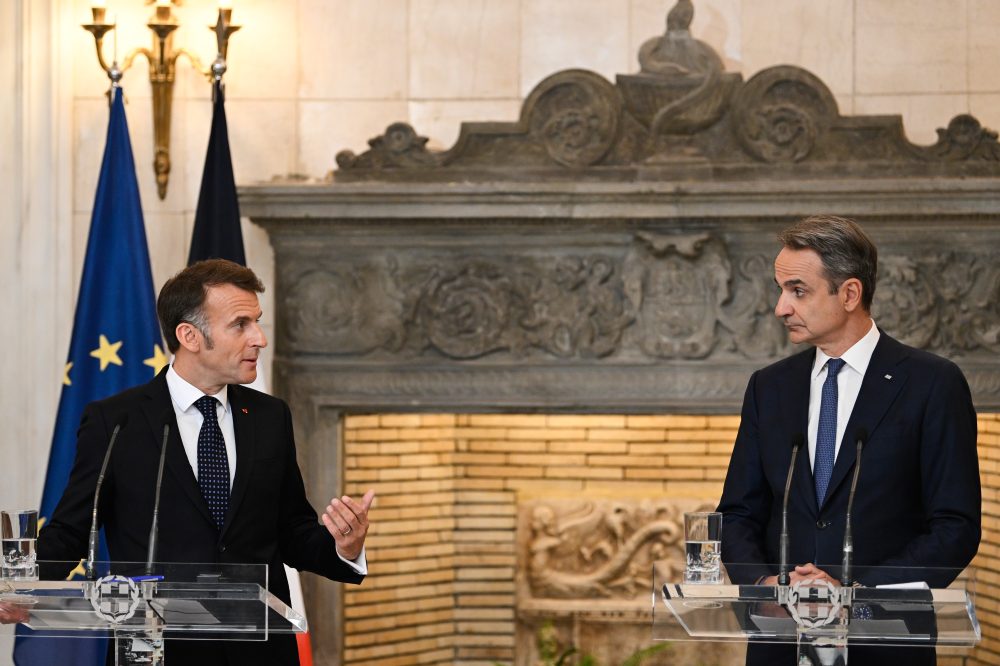

ATHENS, Greece — French President Emmanuel Macron emphasized Saturday that Europe’s increased military spending represents a response to longstanding American requests for greater self-reliance, not an effort to create a rival to NATO.
Speaking alongside Greek Prime Minister Kyriakos Mitsotakis in Athens, Macron stressed that European nations are finally addressing Washington’s decade-long appeals for the continent to shoulder more responsibility for its own protection.
“The lesson we must draw is, let us no longer be dependent,” Macron stated following discussions with Mitsotakis. “We Europeans must strengthen this European pillar of NATO, we must strengthen this Europe of defense — not against anyone, not as an alternative to anything.”
The Greek leader supported Macron’s position, arguing that the United States should welcome Europe’s commitment to greater self-sufficiency and increased defense investments, describing American calls for higher spending as “justified.”
Macron’s Athens visit followed an informal European Union summit in Cyprus and focused on reinforcing a 2021 defense agreement between France and Greece that features a mutual protection provision for armed attacks on either nation.
“This mutual assurance and assistance clause is inviolable, and it is not up for debate between us,” Macron declared. “So there are no question marks, no doubts to be entertained — and all our potential, or real, enemies need to be very clear about that.”
The comprehensive 3-billion-euro deal encompasses Greece’s acquisition of 24 Rafale fighter aircraft and four advanced frigates, including the Kimon vessel that both leaders toured Saturday.
Greece has been modernizing its armed forces amid ongoing tensions with neighboring Turkey, purchasing much of its new equipment from French suppliers. The procurement includes France’s MICA anti-aircraft missile technology designed for use across air, ground, and naval platforms.
Both officials promoted their partnership as a model for other EU members to enhance the 27-nation alliance’s global competitiveness. Mitsotakis urged European leaders to abandon “national egotism” that shields domestic industries and pursue greater consolidation for improved efficiency.
Macron highlighted the importance of European innovation and manufacturing to attract consumers with superior products that will fund the EU’s security objectives.
“All of us Europeans — the Franco-Greek relationship is a prime example — need to buy more European products, produce more European goods, and innovate more within Europe,” he explained.
The leaders referenced Article 42.7, the EU’s collective defense provision, which Macron insisted represents more than “just empty words.” He cited both nations’ rapid deployment of naval vessels to Cyprus in early March after a Shahed drone attacked a British facility during the Iran conflict.
Regarding concerns about energy supplies, Macron cautioned against creating alarm over potential fuel shortages linked to Strait of Hormuz disruptions, through which approximately one-fifth of global oil and gas flows. He described the fuel situation as “under control” and predicted no supply interruptions.
While acknowledging that normalizing conditions will require time, Macron said Europe remains committed to reopening the strategic waterway.
Mitsotakis, representing Greece’s significant maritime industry, insisted any diplomatic resolution must guarantee “non-negotiable” unrestricted passage through the strait without vessel fees, matching pre-conflict conditions.