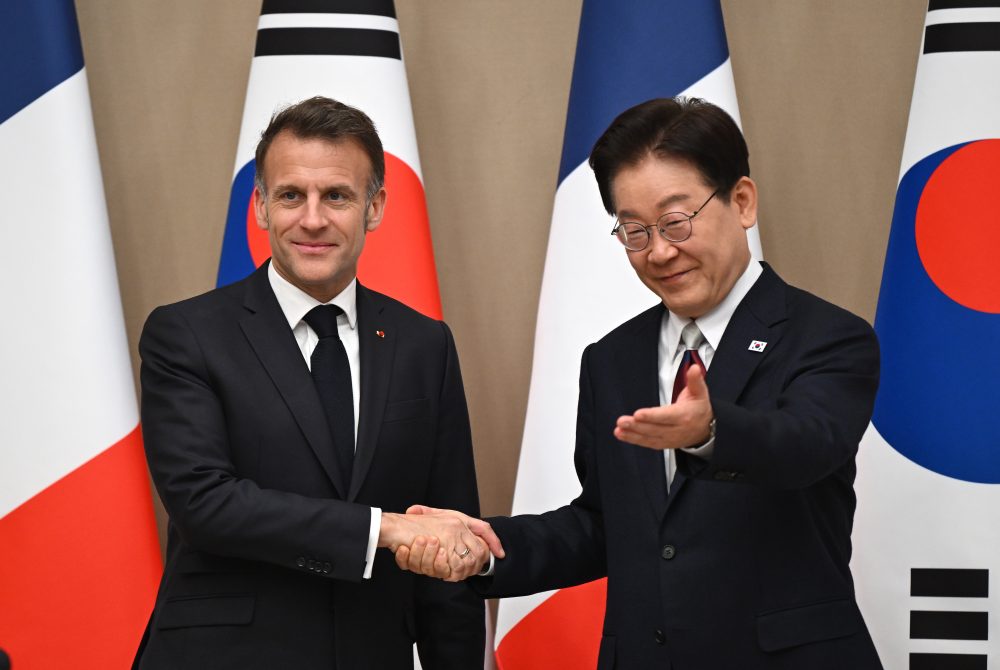

SEOUL, South Korea — During a diplomatic summit in Seoul on Friday, French President Emmanuel Macron and South Korean President Lee Jae Myung committed to joint efforts aimed at reopening the Strait of Hormuz and reducing worldwide economic instability stemming from Middle Eastern conflicts.
The high-level meeting occurred while U.S. President Donald Trump criticized international partners for insufficient support in the American and Israeli military campaign against Iran. This marked Macron’s inaugural trip to South Korea as president since assuming office in 2017, continuing his broader Asian diplomatic tour that previously included Japan.
During their initial discussions, Macron emphasized to Lee that both nations could contribute significantly to Middle Eastern stability, particularly addressing Iran’s control over the Strait of Hormuz, which has created turmoil in worldwide energy markets.
Speaking at a joint press conference following their talks, Macron highlighted the importance of French-South Korean collaboration in efforts to reopen the waterway and reduce Middle Eastern tensions. Lee confirmed that both leaders “affirmed their resolves to cooperate to secure the safe shipping route in the Strait of Hormuz.”
Neither president accepted media questions or provided specific details about their strategy for reopening the crucial passage — the narrow channel between Iran and Oman that typically handles approximately 20% of global oil shipments.
“We need to clearly define, at the international level, the conditions for a process to ease the crisis and conflict in the Middle East,” Macron stated. “We need to ensure that the Strait of Hormuz is reopened.”
Lee announced that he and Macron decided to broaden collaboration across technology, energy, and additional sectors. Representatives from both countries also formalized agreements covering nuclear fuel supply chain cooperation, joint investment in a southern South Korean offshore wind facility, and partnerships involving critical minerals. South Korea has been increasing nuclear reactor production to address energy shortages, while Lee has advocated for accelerated renewable energy adoption, noting how the conflict has highlighted the nation’s dependence on imported fossil fuels.
Macron’s Asian diplomatic mission coincides with Trump’s growing dissatisfaction with allied nations. During a Wednesday address, Trump declared that Americans “don’t need” the strait but countries that depend on it “must grab it and cherish it.”
At a previous White House Easter gathering, Trump urged Asian allies and China to participate in waterway reopening efforts.
“Let South Korea, you know, we only have 45,000 soldiers in harm’s way over there, right next to a nuclear force — let South Korea do it,” Trump commented. “Let Japan do it. They get 90% of their oil from the strait. Let China do it.”
The actual U.S. military presence in South Korea totals approximately 28,000 personnel, not the 45,000 figure Trump mentioned. American forces in South Korea serve as a deterrent against potential North Korean aggression.
Macron has previously stated that military action to reopen the Strait of Hormuz would be impractical.
South Korean officials report ongoing communication with Washington regarding the situation and confirm that Seoul is not considering payment of transit fees to Iran for securing fuel deliveries through the strait.