
A critical verdict awaits former South Korean President Yoon Suk Yeol on Thursday as the Seoul Central District Court prepares to determine whether he orchestrated an insurrection through his failed martial law declaration in December 2024.
The ruling represents the most significant legal challenge yet for the deposed leader, whose emergency rule attempt sparked a nationwide political upheaval and put the nation’s democratic foundations to the test.
In January, prosecutors demanded the ultimate punishment, stating “his unconstitutional and illegal emergency martial law undermined the function of the National Assembly and the Election Commission… actually destroying the liberal democratic constitutional order.”
Under South Korean legal statutes, orchestrating an insurrection can result in either capital punishment or life behind bars. The country’s last death sentence was issued in 2016, though no executions have occurred since 1997.
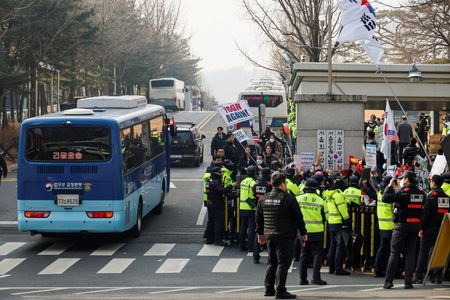
Heavy security surrounded the Seoul Central District Court Thursday, with law enforcement vehicles creating a protective barrier around the courthouse.
Beyond the insurrection allegations, the court will address accusations that Yoon overstepped his authority by commanding military forces to invade parliament and arrest political rivals, while also deploying personnel to restrict access to opposition party headquarters.
The 65-year-old defendant has rejected all accusations. The former prosecutor with conservative leanings maintained he possessed presidential powers to enact martial law, claiming his actions were meant to highlight how opposition groups were blocking governmental functions.
Currently held at Seoul Detention Centre, the former president will likely stay incarcerated whatever Thursday’s outcome brings. A guilty verdict would prompt an expected appeal, while acquittal wouldn’t end his extensive legal troubles.
Yoon confronts eight different court cases and already received a five-year prison term in January for charges including interfering with arrest efforts following his martial law announcement. He has challenged that conviction.
Though Yoon’s emergency rule lasted merely six hours before massive public demonstrations and parliamentary rejection ended it, the incident shocked South Korea – Asia’s fourth-largest economic power, a crucial American security partner, and a nation long viewed as having one of the world’s strongest democracies.
Current President Lee Jae Myung, who assumed office through a special election in June after Yoon’s removal, praised Korean citizens on social media platform X Thursday for stopping the martial law implementation.
“It was possible because it was the Republic of Korea,” Lee stated, referencing the country’s formal name and adding that the Korean people would stand as an inspiration throughout human history.
His message accompanied a news report discussing academic proposals to nominate the Korean public for a Nobel Peace Prize for their peaceful resistance against military and police forces during the martial law crisis.