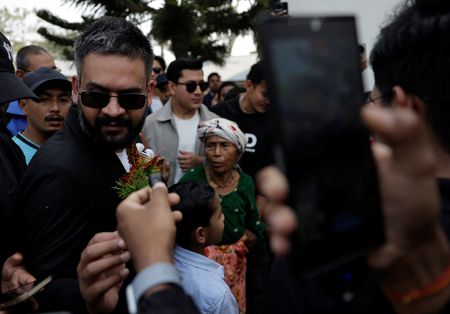

In Nepal’s eastern region, crowds gather wherever Balendra Shah appears, eager for photos with the musician-turned-politician who has captured the nation’s attention.
Shah, widely known by his stage name Balen, has emerged as a leading figure in Nepal’s political landscape, representing the centrist Rastriya Swatantra Party in a crucial March 5 election. The contest could dramatically alter the political dynamics of the mountainous country situated between China and India.
“I am here to see Balen, even though I have a fever,” declared a seven-year-old girl during her first encounter with the prime ministerial hopeful.
Standing nearby, a middle-aged woman revealed she had abandoned her cardiac appointment halfway through just to capture a photograph with Shah, the former Kathmandu mayor who entered national politics last September following unprecedented youth-driven demonstrations across the country.
Those protests, led by Generation Z activists frustrated with widespread government corruption and joblessness, resulted in 77 fatalities and ultimately forced Prime Minister K.P. Sharma Oli from office.
Now Shah is directly confronting the veteran politician in Oli’s stronghold – the Jhapa district where the 74-year-old has secured victory six consecutive times throughout his extensive political journey.
Should Shah and his party succeed, it would fundamentally transform Himalayan politics, which has long suffered from instability caused by the same established parties controlled by Oli and his contemporaries.
Political observers note widespread public frustration with traditional parties that have repeatedly held power but consistently failed to deliver meaningful results throughout Nepal.
The established political landscape includes Oli’s Communist Party of Nepal (Unified Marxist–Leninist or UML), the Nepali Communist Party formed by former Maoist insurgents, and the moderate Nepali Congress – all of whom have alternated control for decades.
However, these organizations maintain pockets of support, particularly in mountainous regions like Kavrepalanchok, where 38-year-old voter Raju Rasaili observes the persistent political divisions.
“In my village, there are loyal supporters of both the Maoists and the CPN-UML. I don’t think people easily let go of that kind of political loyalty,” he explained.
Back in Damak town within Jhapa district, Bipana Oli – who shares no family connection with the former prime minister – returned from her job in Kuwait specifically to participate in Thursday’s voting.
“How long I continue working in Kuwait as a migrant worker will depend on Balen’s victory, and the policies and job opportunities he creates,” stated the 25-year-old.
Supporters swarm around Shah, each receiving approximately ten seconds with the candidate, who maintains his signature look of dark blazer and sunglasses.
Most visitors seek only photographs. Others manage brief handshakes or quick conversations until Shah’s official photographer intervenes with firm instructions: “Step aside, next in line.”
After resigning from his mayoral position and joining the RSP in January, Shah has conducted an intensive campaign across Nepal, visiting nearly 50 of the nation’s 77 districts.
His campaign style breaks traditional political norms completely.
Shah frequently drives himself, making unplanned stops to interact with merchants, agricultural workers, students, and other citizens, often catching them off guard, according to two campaign assistants.
During one journey through Kamal town in Jhapa, Shah unexpectedly halted his vehicle and entered a wedding celebration without invitation, greeting attendees before continuing his travels, campaign team member Surendra Bajgain recalled.
“It’s spontaneous, his actions are instinctive and not strategic,” Bajgain observed about Shah’s approach.
Departing further from conventional methods, Shah has mostly avoided traditional media outlets, instead leveraging social media platforms where he commands millions of followers to spread his political message.
“Campaigning is easy,” Shah mentioned to Reuters during a brief exchange.
“It was more challenging when I ran for mayor because I was alone and I did everything on my own. Now, I have a party and a team supporting me throughout.”
His support team includes a specialized group carrying laptops to campaign events, systematically recording citizen complaints, documenting incomplete projects from previous administrations, and identifying voter priorities.
These concerns undergo investigation and are compiled into manifesto-style “Promise Letters” that Shah’s organization distributes during campaign activities, explained Subhas Basnet, one of the documentation specialists.
Not every Jhapa voter fully embraces Shah’s unconventional approach.
Mahesh Rai, 35, spoke directly to the RSP candidate, recommending he adopt his opponent Oli’s strategy of personal, door-to-door campaigning.
“I think you earn votes when you visit people at their home,” Rai advised Shah, who listened attentively and acknowledged the suggestion with a simple: “Okay.”
Meanwhile, dust clouds from a convoy exceeding 20 vehicles, several equipped with flashing emergency signals, herald Oli’s arrival – a political mainstay since the 1990s.
In rural Gauriganj within Jhapa, organizers arrange a plastic table and chair in the village center for Oli’s use immediately upon his arrival. He performs traditional hand gestures of respect, maintaining a subtle smile.
Despite representing this district for decades, many constituents encounter Oli face-to-face for the first time, as the former leader adjusts his strategy to salvage his political future following September’s uprising damage.
“In previous elections, I did not always have the time to meet local residents personally,” Oli acknowledged to Reuters.
“This time, we have structured the campaign in a way that allows me to stay here and interact directly with people.”
Singheswar Prasad Rajbanshi, 85, expressed his disappointment frankly to Oli, whose journey began as a teenage activist who spent 14 years imprisoned before ascending to key ministerial positions and eventually the premiership.
“Many years ago, you came here seeking my vote while I was resting on my daybed. I supported you,” Rajbanshi confronted the former prime minister.
“But after that, I never saw you again until now.”