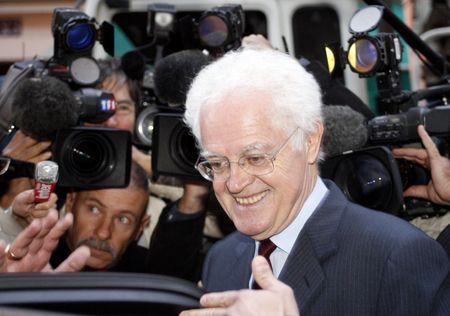

Lionel Jospin, the former French Socialist prime minister whose political career ended with a stunning upset loss to a far-right candidate in 2002, has passed away at age 88, according to sources within his Socialist party who confirmed his death Monday.
The cause of death has not been disclosed.
Jospin’s political downfall came on the evening of April 21, 2002, when French voters received shocking results from the first round of the presidential election. Jean-Marie Le Pen, representing the far-right, had secured enough votes to advance to the runoff – marking the first time in French Republic history that such a candidate reached the final round.
Shortly after the results were announced, Jospin spoke to his stunned supporters. The leftist leader, who had been widely expected to become the next president, accepted complete responsibility for the surprising loss. Standing before a crowd of crying supporters, a visibly shaken but controlled Jospin declared his retirement from political life.
The Socialist leader would never again seek elected office.
Reflecting on that devastating election years afterward, he remarked: “One may regret not having had the chance to prove oneself when there was a single step left to climb, and one stumbled before that step.”
This measured response exemplified the reserved nature of a politician many considered stern and distant.
PROGRESSIVE POLICIES WITH FISCAL DISCIPLINE
During his tenure as prime minister between 1997 and 2002, Jospin implemented significant social reforms. He reduced the standard work week, expanded free medical care, and established civil unions that granted unmarried couples – both heterosexual and same-sex – the same legal rights as married couples.
While championing progressive causes, he also maintained fiscal discipline and privatized more government-owned enterprises than any previous leader. His governing philosophy was captured in his motto: “Yes to the market economy, no to a market society.”
Le Monde newspaper’s editor-in-chief wrote on April 22, 2002: “For a time, Lionel Jospin was able to revive reformist politics which, after so many years of crisis, reconciled economic progress with social progress.”
Despite his accomplishments, the bespectacled politician with white hair never connected deeply with French voters. His serious demeanor and marriage to philosopher Sylviane Agacinski reinforced perceptions of a rigid leader more at ease with policy documents than inspiring public enthusiasm.
His final vote tally in 2002 – 16.18% compared to Le Pen’s 16.86% – dashed his presidential ambitions forever. Though Le Pen was decisively defeated by center-right President Jacques Chirac in the runoff, Jospin never returned to prominent political roles.
EARLY LIFE AND IDEOLOGICAL EVOLUTION
Born in 1937 in a middle-class Paris suburb, Lionel Robert Jospin inherited both the discipline of his Protestant upbringing and the socialist activism of his parents – unusual in a nation that is traditionally Catholic but maintains secular public institutions.
His father Robert worked as a teacher and organized for the French Section of the Workers’ International, which later became the Socialist Party that Jospin would eventually lead. His mother Mireille Dandieu served as a midwife before becoming a nurse and school social worker.
After studying at the Institute of Political Studies in Paris in 1956, he attended the École Nationale d’Administration, where France’s political elite are trained. There he embraced Trotskyist ideology, joining the Internationist Communist Organisation under the alias “Comrade Michel.”
Jospin began working for France’s foreign ministry in 1965 but resigned during the 1968 student uprising against President Charles de Gaulle to pursue studies in America. Upon returning to France in 1970, he taught economics at a Paris university for more than ten years.
He cultivated relationships with Left Bank intellectuals, including Agacinski, whom he wed in 1994. Pushing back against characterizations of his personality, he told reporters in 1999: “When you finally understand that I am a rigid person who evolves, an austere person who laughs, and an atheist Protestant, you will write less nonsense.”
RISE TO POWER
Joining the Socialist Party in 1971, Jospin climbed its hierarchy to become one of President François Mitterrand’s most trusted allies while mentoring future leaders including François Hollande, who would later become president.
Mitterrand, whom Jospin considered a mentor, taught him that politics represented “a will, an art, a culture and a skill,” he later explained to Le Nouvel Observateur magazine. However, by the 1990s, Jospin had emerged as leader of a faction critical of Mitterrand’s legacy.
Following a narrow loss to Chirac in the 1995 presidential race, Jospin got another chance when Chirac called an unexpected parliamentary election in 1997. The left won control of the National Assembly, forcing the president to work with an opposing government led by Jospin.
Television footage from that election night showed Jospin taking notes on a notepad as early returns arrived, already planning his future administration.
While allowing Chirac to handle foreign policy matters, Jospin managed domestic affairs. Leading a coalition of Socialists, Communists and Greens, he abandoned many radical beliefs from his youth.
The former Trotskyist, who eventually acknowledged his extremist past, pursued economic liberalization policies. He sold major state-owned companies and accepted public spending reductions to qualify France for the European single currency.
His leadership coincided with sustained economic growth and falling unemployment, partly due to creating approximately 300,000 public sector jobs for young people and reducing the standard work week from 39 to 35 hours – a change unions praised but many businesses criticized.
This combination of progressive and liberal reforms created tensions with both private sector interests and his coalition partners.
“Remain firm on ends, be flexible on means,” he once stated, a principle that helped him navigate ideological conflicts.
ELECTORAL DEFEAT AND REFLECTION
Just four days before the 2002 presidential election, Jospin dismissed suggestions he might finish third as unrealistic.
However, what appeared to be a standard rematch between Chirac and Jospin was disrupted by Le Pen’s strong showing and competition from multiple left-wing candidates.
Jospin’s third-place finish behind Le Pen sparked massive street demonstrations. Chirac ultimately won overwhelmingly thanks to left-wing voters who supported him to block Le Pen.
“I overestimated the extent to which Jacques Chirac was rejected, and I overestimated how positively the public viewed my record,” he told documentary filmmaker Patrick Rotman in 2010. “I underestimated the impact that the left’s divisions had. I underestimated the first round.”
When asked about losing to Chirac, who was later convicted of using taxpayer money to fund political allies’ fake jobs, Jospin emphasized his principled approach.
“For my part, I simply strove in politics to respect the rules, to cultivate the principles of the Republic, to be honest and to keep my commitments,” he told Rotman.
He expressed pride in leading a government that “worked well for five years and avoided every scandal.”
After briefly considering another campaign, he withdrew, allowing Socialist Ségolène Royal to make an unsuccessful presidential run in 2007.
In 2012, President François Hollande named Jospin to head his Commission on renewal and ethics in public life, focused on eliminating corruption from French politics.
Having earned recognition for his professionalism, he largely escaped the scandals and corruption that tainted many contemporaries in the late 20th and early 21st centuries.
He leaves behind Agacinski and his children from a previous marriage: composer Hugo and visual artist Eva.
Jospin represented the final generation of traditional French politicians – more connected to academic study and regulation than crowd-pleasing messaging – predating the era when political leaders used social media to reach voters directly.
However, his approach ultimately failed to unite the left’s diverse factions.
In 2002, each of the four parties in his coalition government fielded separate candidates. Had just two of them supported his campaign, he would have won the first round, he reflected in a France Info interview 20 years later.
Regarding his decision on election night to accept full blame for the defeat, he observed with characteristic understatement: “I acted as if I only blamed myself.”