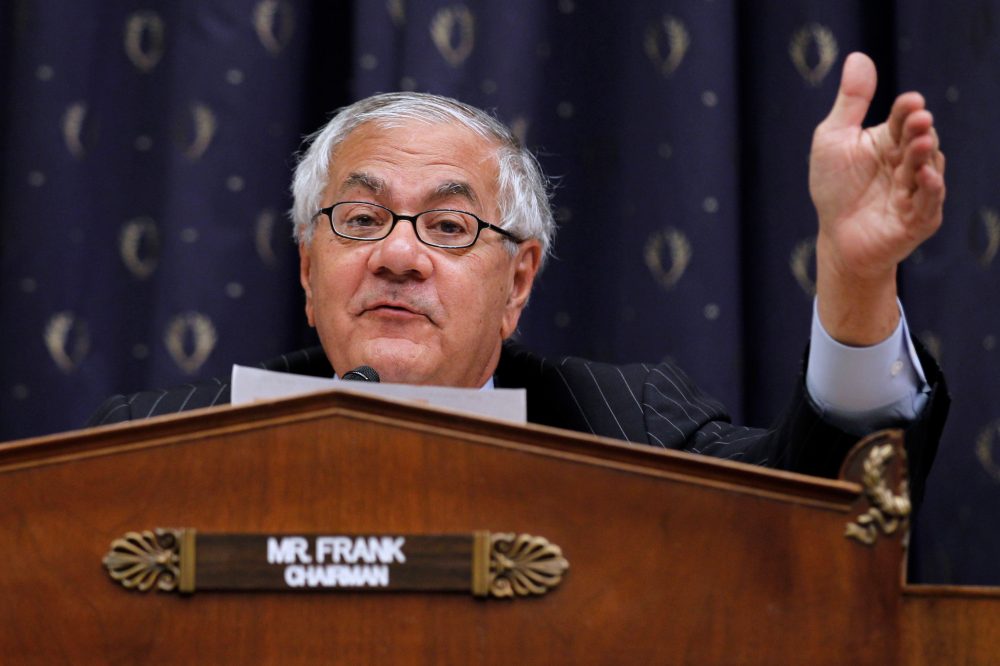

A pioneering figure in American politics and LGBTQ rights advocacy has passed away. Barney Frank, the former Democratic congressman who served Massachusetts for more than three decades, died Tuesday at age 86.
Jim Segel, who served as Frank’s former campaign manager and remained a close friend, confirmed the death occurred late Tuesday.
Frank had been receiving hospice care in Ogunquit, Maine since April, battling congestive heart failure. He leaves behind his husband Jim Ready, sisters Ann Lewis and Doris Breay, and brother David Frank. Lewis is recognized as a longtime Democratic strategist.
The congressman, who once characterized himself as a “left-handed gay Jew,” became famous for his sharp tongue, confrontational approach, and dedication to underrepresented groups. While championing progressive causes, he maintained relationships with Democratic leadership that sometimes disappointed more liberal activists.
Frank’s most significant contribution to American society came through his groundbreaking work for LGBTQ equality. Following years of personal struggle with his identity, he became the first Congress member to voluntarily reveal his homosexuality in 1987. His 2012 wedding to Ready marked another historic first, as he became the initial sitting lawmaker to enter a same-sex marriage.
During his final interview in April while beginning hospice treatment, Frank expressed hope his legacy would center on promoting progressive politics through practical means rather than forcing change before voters were ready. He worried this balanced approach was losing favor as Democrats look toward reclaiming the presidency in 2028 and moving beyond current political divisions.
“I hope I made the point that the best way to accomplish the improvements in our society that we need, particularly in making it less unfair economically and socially, is by conventional political methods,” Frank said. “The main obstacle to our defeating populism and going further in the right direction is that mainstream Democrats have to make it clear that we oppose that part of the agenda of our friends on the left that is politically unacceptable. They’re right about a lot of things but you have to have some discretion.”
“You should not take the most unpopular parts of your agenda and make them litmus tests,” he added. “And that’s what my friends on the left have been doing.”
Frank’s political awakening began in 1940 when he was born in Bayonne, New Jersey. In his 2015 autobiography, he credited the lynching of Emmett Till, a 14-year-old Black teenager from Chicago killed by white men in Mississippi, with inspiring his public service calling. He participated in Mississippi’s Freedom Summer campaign in 1964, though admitted his communication style posed challenges in that environment.
“My direct organizing of Mississippi voters was limited by the fact that my accent (to this day more New Jersey than New England), my poor diction, and my rapid speech, especially when I got excited, rendered me largely incomprehensible to rural Mississippians of both races,” he wrote.
His political career launched in 1968 working for Boston Mayor Kevin White, followed by election to the Massachusetts House in 1972. Frank secured his congressional seat in 1980, bucking a difficult year for Democrats when the party suffered major House losses and Republican Ronald Reagan captured the presidency.
Frank’s practical governing philosophy emerged quickly during his congressional tenure. While joining the liberal Democratic Study Group to pressure then-Speaker Tip O’Neill to more aggressively challenge the Reagan administration, Frank often found himself supporting O’Neill’s less confrontational strategies.
His willingness to compromise ideology for practical gains appeared years later during a major tax reform debate. Initially planning to oppose the legislation due to reduced top tax rates, Frank switched positions after negotiating increased affordable housing tax credits.
“I was happy to sacrifice my ideological purity to improve legislation that was going to become law with or without me,” he wrote.
Rep. Nancy Pelosi, the California Democrat and former House speaker, praised Frank as an “idealist to the nth degree.”
“The goals, the vision, the promise of it all,” she recalled in an interview. “Nobody could ever surpass what he brought to the table in that regard.”
Frank’s early Washington years involved maintaining separate public and private identities. While participating in the city’s gay social scene and maintaining relationships privately, he avoided public acknowledgment of his sexuality. Media coverage of sexual orientation typically occurred only during scandals. When Frank invited a reporter to his office in 1987 to directly address questions about his sexuality, Frank simply responded, “yeah, so what?”
While other officials like San Francisco’s Harvey Milk had previously come out, and Congress members including Rep. Gerry Studds had been outed through scandals, Frank’s voluntary disclosure made him the nation’s most visible gay political leader throughout the 1980s and 1990s. He successfully advocated for AIDS funding and unsuccessfully pushed the Clinton administration to eliminate military service restrictions for gay personnel.
However, Frank faced significant challenges, including a 1987 House reprimand for poor judgment involving a male prostitute he employed in 1985. Rep. Newt Gingrich of Georgia, serving as Republican whip, sought the more serious censure punishment, which was overwhelmingly rejected.
Frank endured personal attacks from conservative Republicans, including House Majority Leader Dick Armey of Texas, who used a homophobic slur against Frank in 1995. Armey later claimed he misspoke and issued a House floor apology.
Despite these challenges, Frank developed a reputation as one of Congress’s most quotable members. He criticized Republican positions on abortion by saying they believed “life begins at conception and ends at birth,” targeting their opposition to social programs. After Ken Starr released his detailed report on President Bill Clinton’s relationship with Monica Lewinsky, Frank complained it contained “too much reading about heterosexual sex.”
Rep. Steny Hoyer, who entered Congress alongside Frank, remembered his colleague’s approach: “You may get a blow, but it was softened by the humor that came with it.”
Frank’s most enduring policy impact came through his leadership of the House Financial Services Committee beginning in 2007, as the U.S. economy approached collapse. He collaborated with the Republican Bush administration on rescue legislation supporting financial institutions, though this sparked ongoing populist backlash in American politics.
Following the initial crisis, Frank helped develop the most comprehensive reform legislation since the New Deal era. Partnering with then-Senate Banking Committee Chairman Chris Dodd, the resulting Dodd-Frank Act strengthened consumer protections, established new bank capital requirements, and expanded regulatory oversight capabilities.
“Barney and I shared a fantastic relationship,” Dodd said. “I had many good moments in those 36 years in Congress, but none more significant, joyful, or productive than those almost two years working with Barney on our banking bill.”
The current Republican administration has worked to eliminate many provisions from this legislation, arguing the regulations were excessively burdensome.
Frank encountered his most challenging reelection battle in 2010 during the tea party movement’s political surge. He chose not to seek reelection in 2012 but remained politically active after leaving Congress and consistently criticized the former president.
When asked about potential future presidential candidates, Frank acknowledged “unfortunately I won’t get to vote for it.”