
WARNER, N.H. — A former Democratic powerhouse is testing the waters for a potential White House run, and his path to presidential ambitions includes pedaling through New Hampshire’s challenging terrain.
The ex-Democratic congressman who previously served as White House chief of staff, Chicago mayor, and U.S. ambassador to Japan hasn’t officially declared his intention to seek the presidency. However, his recent weekend journey through the state known for hosting the first presidential primary sent a clear message about his political aspirations.
His itinerary included traditional New Hampshire campaign activities: stops at union halls and cozy house parties. During one gathering in a Concord backyard, he mingled with voters while delivering remarks focused on middle-class struggles and problems with the current tax structure.
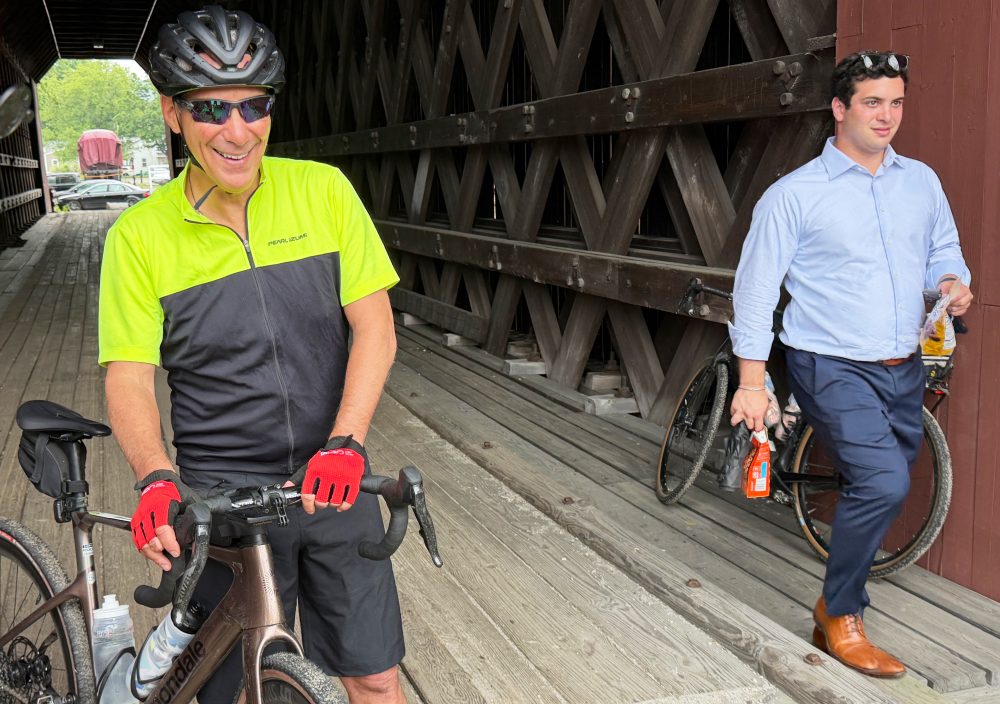
The centerpiece of his visit was an ambitious cycling expedition.
Across three days, he biked 117 miles through New Hampshire, starting in Portsmouth along the coastline and ending in Hanover near the Vermont state line. He branded this journey the “Spin-Free Tour,” referencing his direct communication style that he believes could benefit a Democratic Party recovering from significant 2024 electoral defeats.
“Tough times require a tough leader,” he shared with The Associated Press while taking a rest at a Warner coffee shop. “I don’t think this is just about learning the words to ‘Kumbaya.’”
Despite nearly three decades in top political positions, the 66-year-old finds himself without an obvious platform for launching a campaign. His potential Democratic primary opponents are generally younger and hold current positions as governors, senators, or recently served as vice president, giving them easier access to media attention.
Even with his extensive political background, he remains relatively unknown beyond political insiders. This became evident when a woman inquired about his identity after he departed the coffee shop. Upon learning it was him and hearing about his potential campaign plans, she asked, “A campaign for what?”
He’s relying on his persistent nature to address these obstacles.
While many prominent Democrats concentrate on criticizing President Donald Trump, he has unveiled numerous policy proposals covering topics from social media restrictions for minors to prediction markets and implementing a 75-year-old mandatory retirement age for public officials. This age limit would prevent him from pursuing a second presidential term if elected.
His travel schedule keeps him busy, discussing education matters in Mississippi and Michigan. He plans to visit Israel next month to speak about U.S.-Israeli relations as the Gaza conflict has created new political divisions, particularly affecting younger voters.
He frequently appears on various podcasts, from shows hosted by Katie Couric and Kara Swisher to programs about fly fishing. During these appearances, he often criticizes his own party for going too far in cultural discussions, especially regarding transgender rights issues. His centrist messaging echoes that of the first president he worked for, Bill Clinton.
“We did things that were really ridiculous,” he commented about Democrats during a recent episode of Couric’s podcast. “Rather than worry about classroom excellence, we were worried about bathroom and locker room access.”
The cycling tour serves multiple purposes for him.
It allows him to showcase his physical condition during a period when the age of political leaders has become a major concern, while also introducing himself to the state’s famously selective voters before other candidates arrive after the November midterm elections.
“It is early,” noted Rep. Maggie Goodlander, D-N.H., who joined him at the Concord house party. “But what I’d say is the people in New Hampshire know how to vet candidates and they’re the most engaged electorate in the country.”
Martha Kruse, a 76-year-old retired special education teacher from Laconia, New Hampshire, represents exactly this type of voter. As an active local Democratic Party member, she made the trip to Concord specifically to meet him after hearing his interviews.
“I’m going away really enthused about him,” she stated, praising his decision to begin campaign preparations so early as “right on.”
Presidential aspirations seemed distant during a challenging 20-mile Saturday ride that included climbing more than 1,300 feet in elevation. Accompanied by friends and staff members, he cycled past homes where residents worked in their yards or celebrated a recent graduation on their front porches. He alternated between chatting with the group and riding solo, appearing comfortable while tackling steep inclines.
As summer weather arrived in New England, high humidity and occasional heavy rain created additional challenges. The cycling group made stops for refreshments every 10 to 15 miles, taking shelter under a barn during one downpour. Local activists met with him at the Warner coffee shop, where he spoke from a rocking chair.
Modern political realities occasionally interrupted the tour. The cyclists passed signs supporting Trump and criticizing his predecessor, Joe Biden. Throughout the journey, a support vehicle periodically followed with cameras capturing footage for later social media use, where he maintains an almost daily presence.
The upcoming midterm elections remained a concern. In nearby Maine, Graham Platner faced ongoing reports about his past behavior with women, causing some Democrats to worry about the party’s chances of securing a Senate majority. Drawing on his experience helping Democrats achieve major 2006 House victories, he said the “jury is still out” on whether Platner can succeed in the Senate race.
“Everybody is holding their breath whether this is the start of something or the end of something,” he observed.
Regarding the Democratic Party’s ideological direction, he believes moderate voices are gaining influence. He highlighted recent victories by Rebecca Bennett, who won a crowded Democratic primary in New Jersey for a competitive House seat, and Josh Turek, the new Democratic Senate nominee in Iowa.
“There’s a bigger character piece to this than ideological,” he explained. “There’s radical moderates and their profile and character speak to kind of fighting a system, which is what’s needed right now.”
While his bike tour didn’t match John McCain’s “Straight Talk Express” — the 2000 campaign bus where the Arizona Republican senator answered any question to gain attention and achieve a surprising New Hampshire victory over frontrunner George W. Bush — some voters expressed interest in his candidacy.
Don Daley, a 60-year-old state employee from Concord, observed him speak from a bench during the backyard gathering. He acknowledged that he probably “steps on a few toes.”
“But I think that’s what we need right now,” he said. “Some of our Democratic leaders haven’t been strong enough.”