
DAKAR, Senegal (AP) — Senegalese farmer Abou Sow felt a wave of concern when he witnessed U.S. missile strikes against Iran on social media, knowing the conflict would soon impact farming across West Africa. Chemical fertilizer costs have surged 40% since hostilities commenced on Feb. 28.
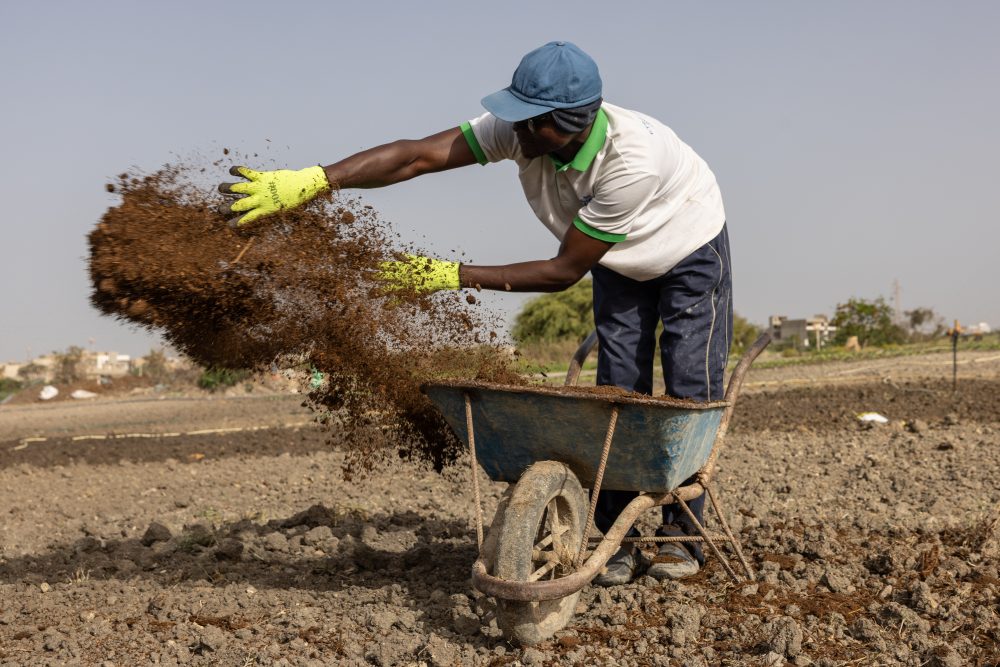
Unlike many of his peers, Sow had prepared for such disruptions. He transitioned away from synthetic fertilizers eight years earlier, embracing organic compost and natural alternatives instead. Today, he encourages fellow Senegalese farmers to purchase manure from nearby livestock owners and teaches them composting techniques, identifying healthy worms as positive indicators.
“We can’t afford to wait for a ceasefire,” Sow said. “It’s risky to depend on chemical fertilizers.” Iran’s control over the Strait of Hormuz has disrupted natural gas supplies needed for synthetic fertilizer production and impacted international shipping routes.
According to the International Food Policy Research Institute, the Gulf region accounts for 30% of chemical fertilizer traded worldwide, while the World Bank’s fertilizer price index shows global costs have climbed 50%.
“The clock is ticking very hard,” said Maximo Torero, chief economist at the U.N.’s Food and Agriculture Organization, as food security concerns mount.
Agricultural specialists note that moving away from synthetic fertilizers could yield broader environmental advantages, since their manufacturing and application generate substantial greenhouse gas emissions that drive climate change.
Organic fertilizers offer contrasting benefits by capturing carbon in soil and reducing pollution problems like runoff that contaminates water sources.
“It’s good for the planet because you’re weaning food production off fossil fuels,” said Susan Chomba, member of the International Panel of Experts on Sustainable Food Systems, a think tank.
Senegal brings in 125,000 tons of fertilizer each year. The minister of agriculture, Mabouba Diagne, has said the state sourced enough chemical fertilizer for the current season, but farmers said it is increasingly difficult to find.
Farmer Aliou Fall blamed U.S. President Donald Trump for the soaring fertilizer costs. “He brings war to the world and he doesn’t even think about it. Now farmers are suffering,” Fall said.
Each year, Sow uses six tons of compost as his alternative. He considers himself lucky to farm near a community where animal waste is abundant due to residents raising sheep for religious celebrations.
However, in remote farming regions, obtaining and transporting large amounts of manure presents significant challenges, and Sow worries some growers may abandon their land during these difficult times.
One emerging solution involves biofertilizer production, which uses bacteria and microorganisms to help crops extract nitrogen from air and soil. An increasing number of African companies are manufacturing industrial-scale compost from city waste, converting food scraps into agricultural nutrients.
In April, Senegal’s government announced plans to subsidize and distribute 30,000 tons of organic fertilizer products to assist farmers. Sow said that’s not enough.
According to the Organization of Economic Co-operation and Development, governments worldwide allocate $700 billion annually for agricultural subsidies, with substantial portions supporting chemical fertilizer provision. Chomba noted this makes natural alternatives costlier and less competitive.
“You’re incentivizing the wrong sort of products,” she said.
Brazil ranks among the world’s top exporters of soybeans, coffee, sugarcane, beef and poultry. However, the country imports more than 80% of its fertilizer, said Joana Colussi, assistant professor of agricultural economics at Purdue University.
Fertilizer costs have risen 50% since the Iran war began, according to Luis Barbieri, founder of the Folio Institute, a Brazilian organization that connects farmers, scientists and researchers.
“Whenever we have a war, farmers’ use of biofertilizers is turbocharged,” Barbieri said.
Although Brazil widely adopted chemical fertilizers during the 1970s, they prove less efficient in tropical conditions where heavy rainfall and high temperatures cause nutrient loss through runoff.
Brazil’s biofertilizer industry expanded 15% between 2023 and 2024, according to the state-run Brazilian Agricultural Research Corporation, Embrapa. Patent regulations allow farmers to produce their own biofertilizers at significantly reduced costs.
In Mexico, however, minimal advancement has occurred due to government subsidies favoring chemical fertilizer usage and insufficient funding for alternatives, said Gerardo Noriega, a research professor at the Autonomous University of Chapingo and one of the country’s leading advocates for organic fertilizers.
He suggested the current crisis “may force (farmers) to adopt organic fertilizers more quickly than they had imagined.”
In India’s southern Indian state of Telangana, Manohara Chari has been making jivamrita, a potent mix of cow dung, urine, flour, soil and sugar to replace the chemical fertilizer he used to apply.
“We do not depend on companies,” said Chari, one of 1.7 million farmers in Telangana and Andhra Pradesh states who have shifted to natural farming, which embraces natural fertilizers, integrates livestock waste and plants a diversity of crops to improve soil health.
Agricultural workers and experts indicate the Iran conflict and synthetic fertilizer shortages make natural approaches more appealing. On May 10, Prime Minister Narendra Modi announced a “national mission” to adopt natural farming and cut fertilizer use by 50%.
India imports 60% of its fertilizer from the Gulf. The government has rushed to source supplies and subsidized it to keep prices low, at significant expense to the state.
“There’s certainly been more interest this year in natural farming, especially after the Middle East conflict began,” said G.V. Ramanjaneyulu, agricultural scientist at the Center for Sustainable Agriculture. Some farmers have dedicated part of their land to assess the approach.
Converting to natural methods requires extra labor, and farmers experience a transition period. Chari suggested the government could provide assistance instead of subsidizing chemical fertilizers: “If even a fraction of that support is given to natural farmers, more people will shift towards it.”