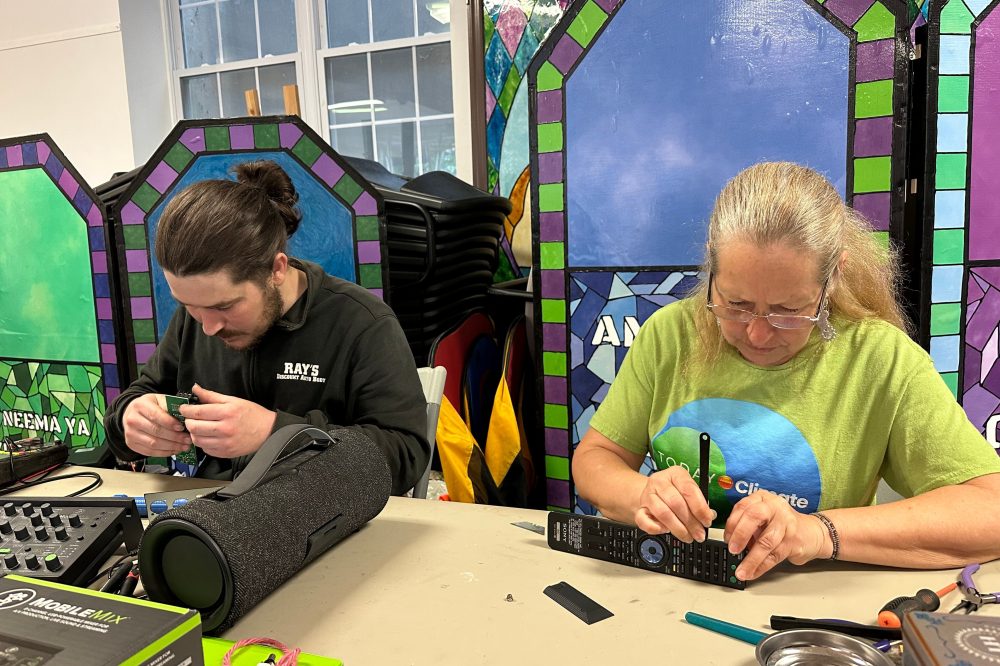

NEW PALTZ, N.Y. (AP) — During a soggy Saturday morning in recent weeks, the basement of the New Paltz United Methodist Church became home to damaged lamps, dull kitchen knives, broken audio equipment, and stubborn zippers.
Around a dozen volunteers greeted these damaged items and their owners as part of a global initiative promoting fresh connections between individuals and their possessions.
These Repair Cafes — no-cost gatherings where skilled volunteers assist community members in fixing various home goods — represent a fresh form of anti-consumption activism seeking to provide alternatives to mass-manufactured throwaway products that have shaped the worldwide economy over the past fifty years. Rising U.S. consumer costs, which increased significantly last month due to conflict with Iran bringing elevated fuel prices and additional hardship for Americans, are helping drive this shift toward repairing rather than purchasing.
Beginning in the Netherlands with one gathering in 2009, Repair Cafe has expanded into an international nonprofit boasting over 59,000 members, approximately 4,000 locations, and nearly 850,000 restored items annually.
“We need to change our mindset. We need to change the economy,” Repair Cafe founder Martine Postma said. “Even if Repair Cafes can’t solve the problem alone, then still they are a very clear sign that change is needed on a much higher level.”
In New Paltz, a Hudson Valley university community roughly two hours from New York, 50 visitors brought approximately 85 objects to the Repair Cafe: a vintage fan requiring new wiring, clothing items, outerwear, plush toys. Attendees also brought aged family photographs needing restoration and jewelry requiring work such as bead restringing or clasp replacement.
Skilled volunteers positioned themselves at lengthy cafeteria tables to demonstrate options, providing opportunities for people to discover that damaged items aren’t necessarily worthless.
“Maybe their initial reason for coming is monetary or sentimental,” organizer Holly Shader said.
Beyond that, she added, “it gives people a chance to work together and extend the life of something. People form relationships.”
The specialists present restored 71 items, determined four required additional work, and declared 10 irreparable. They explained their volunteer motivation comes from the relaxed satisfaction of restoration work, with community building as an added bonus.
“I get to come and actually do the work and meet the nice people and show them how to put something together,” contractor Patrick L. Murphy said.
The Buy Nothing Project, “right to repair” laws, and an increasing number of tool libraries also focus on fixing, exchanging, and sharing rather than purchasing and selling.
Beginning in Washington state in 2013, the Buy Nothing Project operates an application and social media platform connecting people offering items with nearby individuals seeking them — a global network of gift-based economies, as outlined on its Facebook page.
Founder Liesl Clark said the network has reached at least 12.5 million Facebook users, demonstrating growth capable of affecting corporate and government actions.
“What was a social movement has really become a safety net for millions of people,” she said. “People are seeing that you don’t have to go to the Amazons of the world to get what you might need, there is a robust material culture in your community.
“We want to change the way that the world consumes.”
The initiative “started as a social and economic and environmental experiment,” she noted.
“There’s going to be a conversation that you have, when you and someone else are fixing something together,” she said. “We’re finding that we’re crossing a lot of barriers.”
In contemporary throwaway society, many individuals have lost household repair abilities — skills that were previously almost universal, said Peter Counter, an engineer researching Repair Cafes while pursuing a doctorate at the University for the Creative Arts in Farnham, England.
“The idea that you can fix your own stuff has receded because the skills are not being passed down,” he said. “If you want something fixed, it’s almost certainly cheaper to go buy a new one.”
Community restoration is flourishing, Counter explained, because volunteers donate their time, making it economically feasible even when purchasing replacement parts.
The “right to repair” campaign seeks to enable consumers to fix their own products rather than being required to seek manufacturer tools and guidance. A nationwide effort promoted in 2023 encouraged states to consider legislation mandating manufacturers provide access to tools and instructions for both consumers and repair businesses. Several states have enacted such laws.
Additionally, various jurisdictions nationwide operate tool libraries allowing people to check out costly tools similar to borrowing books.
In New Paltz, Paula Weinstein, 79, brought a 1930s-era Hammond clock and presented it to Bob Morton.
Morton — an 82-year-old retired IBM electrical engineer — explained he enjoys applying his expertise to remain mentally active and assist others.
“I’ve been blessed to still have a brain,” the grandfather of three said. “It’s a chance to do something.”
Weinstein added, “It’s wonderful to see people restoring older things.”
Following hours of careful collaboration, her clock’s hands began moving.
“Yes, it’s working!” she shouted. “Oh, my goodness, thank you!”
“I’m glad I stuck with it,” Morton said.