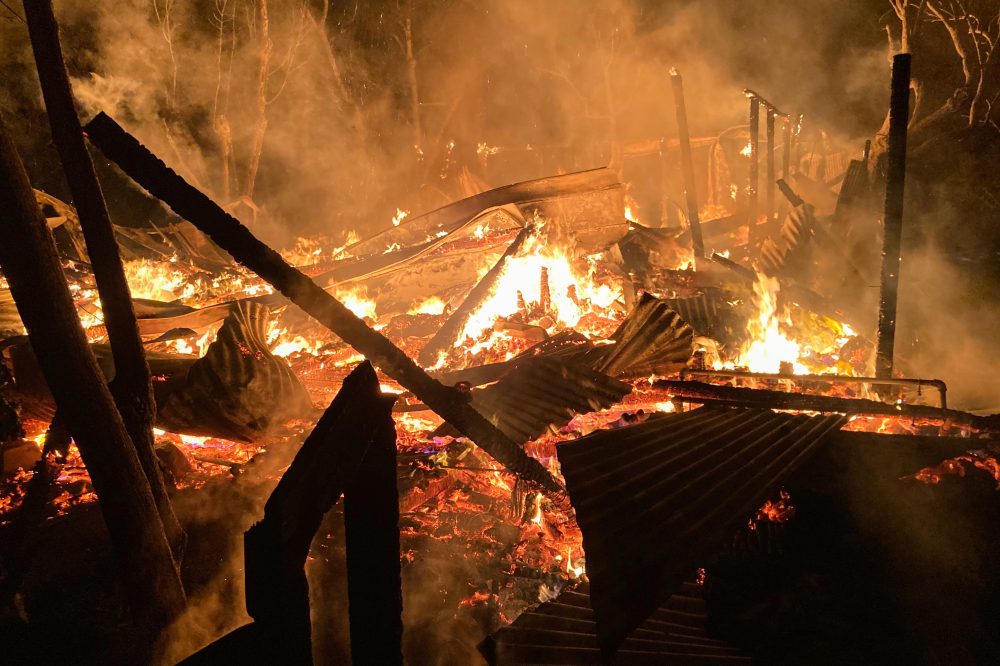

An ironic twist of fate struck practitioners at California’s Tassajara Mountain Zen Center when flames consumed their meditation hall during the final weeks of a three-month spiritual retreat dedicated to studying life’s temporary nature.
The blaze erupted in the building’s attic on March 26, completely destroying the wooden meditation hall and causing damage to the adjacent library. However, quick thinking by monks and staff members prevented the flames from spreading to dozens of other buildings on the property.
Michael McCord, president of the San Francisco Zen Center that operates the retreat, credited the presence of David Zimmerman for limiting the destruction. Zimmerman, a former director at Tassajara with extensive firefighting experience at the location, happened to be leading a retreat when the emergency occurred. He belongs to a legendary group known as ‘fire monks’ who courageously defended the sacred grounds during blazes in 2008 and 2021, even defying evacuation orders.
Working under Zimmerman’s direction, the team used garden hoses and water buckets to control the flames while waiting for volunteer firefighters to navigate the treacherous one-hour journey up a narrow mountain dirt road without safety barriers.
The Cachagua Fire Department praised their efforts on social media, stating: ‘The staff at Tassajara Mountain Zen Center should be incredibly proud, their initial fire attack efforts helped keep the fire contained, buying critical time for responding apparatus to arrive and preventing further damage.’
While losing their cherished meditation space brings sadness to monks and visitors from across the globe, McCord noted the incident serves as a powerful lesson in impermanence – a core Buddhist teaching that all things eventually fade away.
‘We’d like the Zen center to always be here, and the people to be here,’ he explained. ‘But Buddhist teachings tell us that everyone we love and everything we appreciate will eventually go away. It’s not meant to induce fear or anxiety, but to teach us that we need to treasure and take good care of what we have now.’
Officials won’t know the full extent of losses until they examine the debris. Beyond the structure itself, the flames claimed meditation cushions, altar pieces, and special bowls used during ceremonial meals by Zen monks.
Several irreplaceable sacred artifacts may also be lost or damaged, including a 2,000-year-old Buddha statue from the ancient Gandhara civilization that survived a previous electrical fire in 1978. Also buried in the wreckage are a century-old Japanese bell and a fish-shaped wooden drum called mokugyo used during chanting ceremonies.
‘We are eager to see if these items can be salvaged from the rubble and repaired,’ McCord said. ‘Right now, we’re receiving an outpouring of support from around the world. People are really sad. But we’re relieved no one was injured.’
Author Colleen Morton Busch, who documented the monastery’s firefighting history in her 2011 book ‘Fire Monks,’ described these defenders as ordinary people rather than professional firefighters or athletic heroes.
‘They are humble people who share a deep love of Tassajara and have this incredible ability to stay calm and clear-headed — to pause and think what’s appropriate and possible at this moment,’ she observed. ‘That’s cultivated through the practice of meditation.’
Established in 1967, Tassajara holds the distinction of being America’s oldest Japanese Buddhist Soto Zen monastery and the first such facility built outside Asia. Its name comes from an Indigenous Esselen term meaning ‘where meat is hung to dry.’
Weather conditions make the center unreachable during winter months, and it remains closed to visitors from September through April while serving as a training facility for Zen students.
Despite the setback, McCord expressed hope that the center can still welcome summer visitors who come to enjoy the natural hot springs.
Fire has long threatened the remote location, though McCord explained that Indigenous Esselen people traditionally managed the chaparral landscape through controlled burns every quarter-century.
‘There are flowers in that land that bloom only after a fire,’ said McCord, who spent several years at the site during his monk training. ‘The seeds pop out of the pods with the heat of the fire like popcorn. It’s part of the ecology of those grasslands.’
Busch reflected that Tassajara’s isolated beauty, while providing spiritual benefits, also creates inherent dangers.
‘When you’re there it’s all really simple, pared down and fundamental,’ she said. ‘You hear the creek, the birds. All your senses get rebooted in a way.’