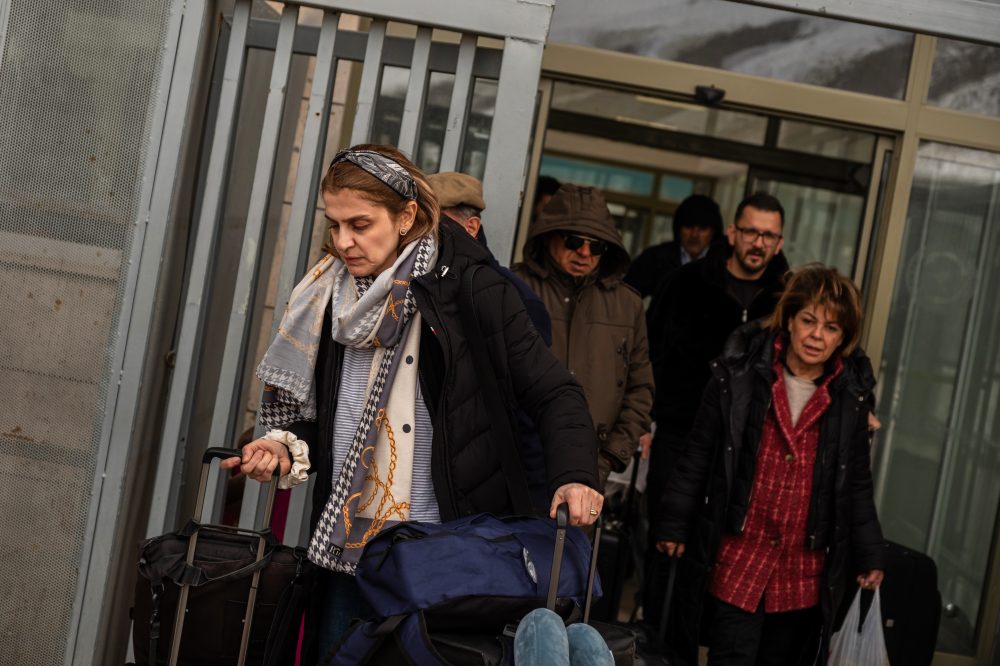

KAPIKOY BORDER CROSSING, Turkey (AP) — The border crossing in Turkey’s Van province stands as one of the limited pathways available to Iranians seeking to reach other parts of the world, following airspace closures in Iran after U.S. and Israeli military actions against Tehran more than a week ago escalated Middle Eastern conflicts.
The majority of people crossing the border in recent days have existing ties to Turkey through employment, relatives, or personal relationships, with many accelerating previously scheduled trips due to the conflict. Several travelers held residency or citizenship in other nations and were using Turkey as a transit point.
Just a handful of Iranian citizens interviewed by The Associated Press at the Kapikoy crossing indicated plans to remain in Turkey indefinitely to avoid the warfare.
Thirty-eight-year-old plastic surgeon Reza Gol explained that the conflict wasn’t his sole motivation for traveling. He was journeying from Iran’s western city of Urmia to treat patients in Istanbul, his former home.
“It’s not clear whether we will leave Iran for good, but I can clear my head a little bit in the meantime,” he said. “You can see it’s not that crowded at the border. Everyone is staying in their houses. For now, people are not leaving everything they have behind and running away.”
Iranian-Canadian dual citizens Pooneh Asghari and her spouse were hesitantly preparing for their flight to Canada, despite no longer maintaining a residence there and both maintaining employment in Iran. Asghari expressed hope for a short absence.
“We’ve been living in Iran for over the last five years,” she said. “All our life is there.”
A woman identifying herself only as Fariba due to safety worries was traveling to Turkey’s western city of İzmir with her son to wait until the conflict subsides.
She explained that most people in her community lack resources to flee, potentially accounting for the absence of mass migration at the border.
“People are very poor now,” she said. “So they are staying at home, and they are scared.”
Turkish entry typically requires no visa for Iranian citizens. Turkey’s trade minister announced Monday the temporary halt of day-trip crossings, while Iranian border authorities have limited some nationals’ passage, according to travelers and regional news outlets.
Since Thursday morning, however, both Iranian citizens and foreign nationals have been moving through the mountainous Kapıköy crossing without issues.
Turkey’s Interior Minister Mustafa Çiftçi reported that 2,032 people entered Turkey from Iran on Wednesday, while 1,966 departed for Iran. Updated statistics weren’t immediately available.
Most border crossers proceeded to Van’s airport to continue traveling. Friday evening found approximately 20 passengers, predominantly Iranian, resting on airport seating while awaiting Saturday morning departures.
Twenty-six-year-old Mehregan, a student in China, was visiting family in Ahvaz during winter break when hostilities began. She drove over 15 hours across Iran to reach the Turkish border. She requested partial anonymity, fearing media interviews could create difficulties with Iranian officials.
The financially struggling student chose to sleep at the airport while waiting for her next day’s Istanbul flight, which would connect to China. However, Saturday’s flight cancellation due to snowstorms forced her to consider city hotels rather than spending another night at the airport.
“If I can’t get on a flight tomorrow from here I will miss my flight to China” and lose the cost of the nonrefundable ticket, she said.
Van, located 1.5 hours from the border, has traditionally attracted Iranians for business, tourism, and commerce. Local hotels and businesses that typically experience busy periods during Iran’s mid-March Nowruz celebrations now anticipate reduced revenue.
“It gets really lively here over Nowruz. A lot of our friends come and spend their holidays here with us,” says Resat Yeşilağaç, owner of two hotels in Van. “Now it’s mostly quiet, apart from people who come because of the war. Most of them are dual nationals and they stop in Van for a day or so before flying out.”
Immigration remains a delicate issue in Turkey, which previously sheltered nearly 4 million Syrian refugees.
Turkey has continued strengthening border security to handle possible waves of people escaping unrest following massive anti-government demonstrations in Iran that faced violent suppression in January.
The defense ministry reported in January that Turkey had constructed 380 kilometers (235 miles) of concrete barriers, 203 observation towers and 43 elevator-equipped towers along the 560-kilometer (350-mile) Iranian border.
Interior Minister Mustafa Ciftci announced Wednesday that Turkey has prepared emergency plans including temporary camps and buffer areas to manage potential refugee flows from Iran. Such an influx hasn’t occurred yet.
Harrison Mirtar, a 53-year-old Iranian-Canadian, crossed at Kapıköy while returning to Canada after visiting his Tehran parents. He expressed frustration about foreign military involvement in his homeland but wasn’t overly concerned about leaving his parents, who survived the devastating Iran-Iraq conflict of the 1980s.
“They are in their homeland,” he said. “Life is going on, but with some bombs.”