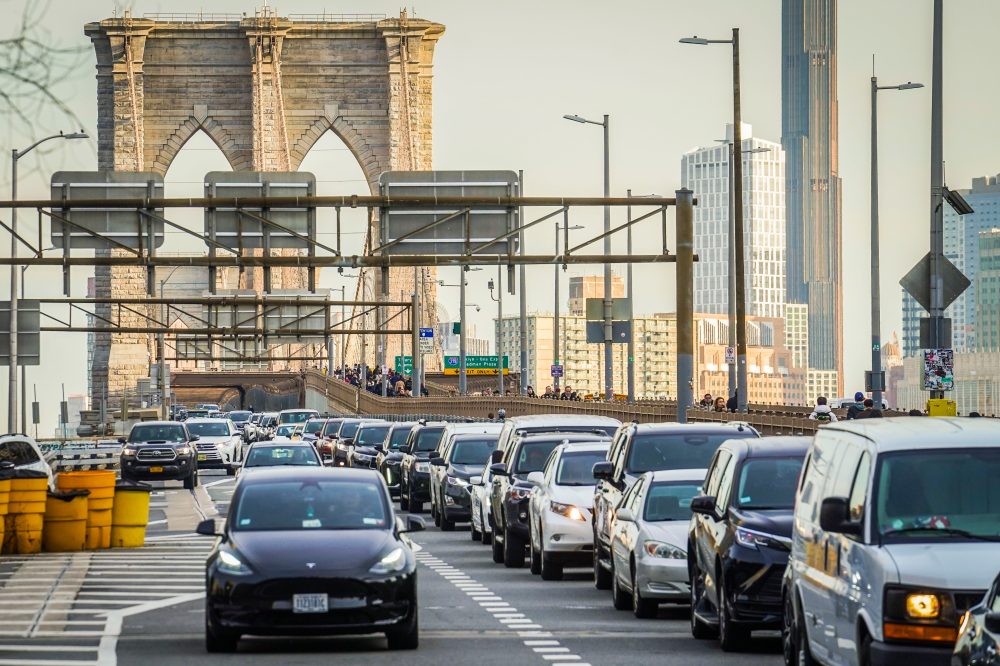

A federal court has rejected President Donald Trump’s attempt to eliminate New York City’s groundbreaking traffic fee designed to ease congestion and fund public transportation improvements.
U.S. District Judge Lewis Liman ruled Tuesday that the Department of Transportation overstepped its authority when it tried to cancel the $9 charge that was previously approved under Joe Biden’s presidency.
The judge determined the Metropolitan Transportation Authority was correct in claiming the department’s decision was “arbitrary and capricious” due to insufficient justification for the reversal.
In his comprehensive 149-page decision, Liman emphasized that New York’s state legislature enacted the fee, the governor signed it into law, and federal agencies had given proper authorization before implementation.
“The democratic process worked,” the judge stated, while acknowledging that Trump and other critics could pursue additional challenges to the program that started January 5, 2025.
Governor Kathy Hochul praised the ruling as validation of what she called a “once-in-a-lifetime success story” that has delivered significant benefits during its first year, including decreased traffic jams and essential transit funding.
“The judge’s decision is clear: Donald Trump’s unlawful attempts to trample on the self-governance of his home state have failed spectacularly,” Hochul declared. “Congestion pricing is legal, it works, and it is here to stay.”
The Department of Transportation has not yet responded to requests for comment.
The fee applies to most vehicles entering Manhattan below Central Park, with costs varying by vehicle type and timing, typically around $9 in addition to existing bridge and tunnel tolls.
While similar traffic reduction programs operate in cities like London, Stockholm, Milan and Singapore, this marks the first such initiative in the United States.
Trump, whose Trump Tower and other real estate holdings sit within the fee zone, has been a vocal opponent of the program.
He promised during his campaign to eliminate New York’s plan immediately upon taking office. Transportation Secretary Sean Duffy followed through in February by withdrawing federal approval.
Duffy characterized the toll as “a slap in the face to working-class Americans and small business owners” and warned of potential federal funding cuts for New York projects if the program continued.
However, Judge Liman issued a temporary restraining order preventing such retaliation while he considered the case. The same judge had previously rejected multiple lawsuits from opponents including New Jersey’s governor, New York City teacher unions, trucking organizations and suburban officials.
Hochul herself had initially expressed doubts about the toll, which was developed years before she became governor. She delayed its 2024 launch due to economic worries before ultimately reducing the fee from $15 to $9.
As the program reached its first anniversary in January, Hochul joined transit officials in highlighting its achievements ahead of her reelection campaign.
Recent Metropolitan Transportation Authority data shows the toll has prevented approximately 27 million vehicles from entering central Manhattan, cutting air pollution by 22% and reducing travel times by 23% for those who choose to drive and pay.
The program has also brought in more than $550 million for the region’s underfunded transit network, surpassing initial estimates.
Economic indicators within the fee zone have improved since implementation, with higher sales tax collections, office lease activity and pedestrian traffic contradicting predictions of economic harm.
“Traffic is down, business is up, and we’re making crucial investments in a transit system that moves millions of people a day,” said MTA CEO Janno Lieber. “New York is winning.”