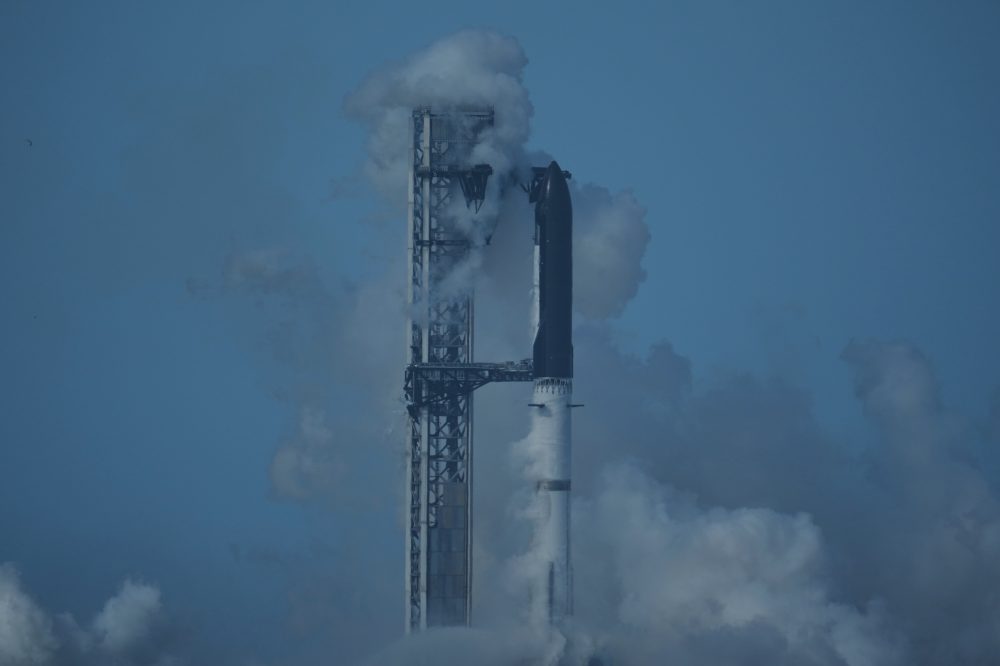

SpaceX’s enormous Starship rocket came agonizingly close to launching on a test flight Thursday, only to have the mission scrubbed at the last possible moment after several engines failed to ignite, triggering an automatic abort.
The company founded by Elon Musk says engineers will need to identify the cause of the engine failure before another launch attempt can be made. The planned mission would have sent Starship on a suborbital path halfway around the globe. It would have marked the 13th test flight for the vehicle, which stands 407 feet — or 124 meters — tall and is powered by 33 main engines, making it the largest and most powerful rocket ever built.
Aboard the spacecraft were 20 of SpaceX’s newest and most advanced Starlink internet satellites, which were scheduled to be released during the roughly one-hour flight. Those satellites were going to attempt to communicate with existing Starlinks already circling Earth, while also capturing images of Starship’s heat shield. Neither the rocket’s first-stage booster nor the upper spacecraft were intended to be retrieved — both were expected to splash down in the ocean.
The stakes are high for the program: NASA is banking on Starship to serve as the vehicle that will deliver its astronauts to the lunar surface within the next several years.