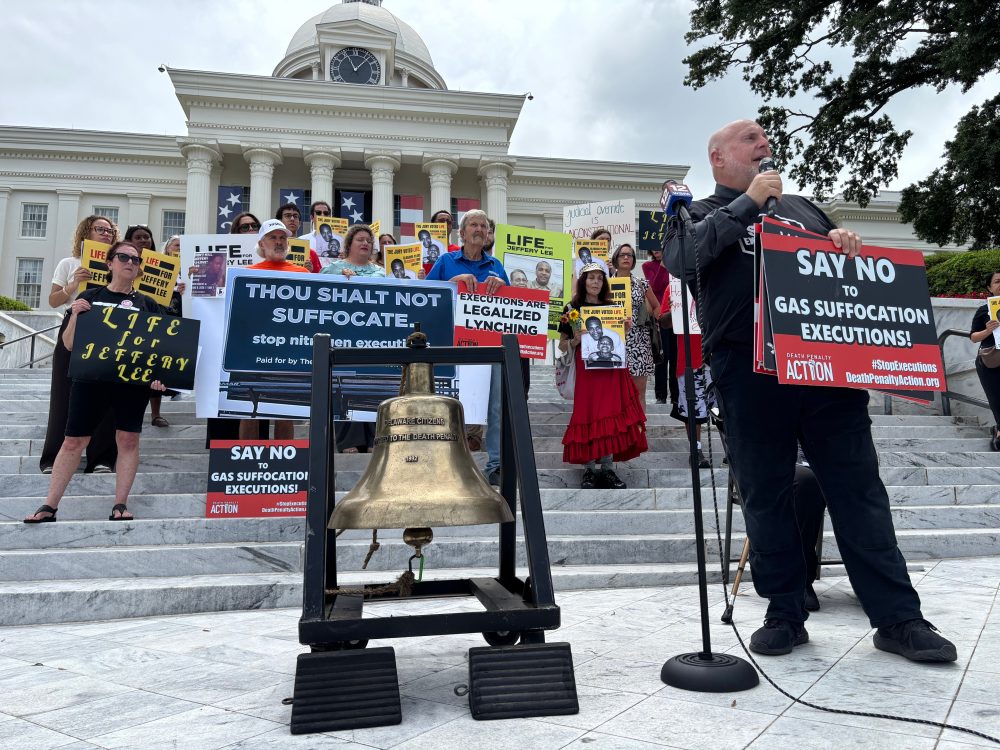

A federal appeals court has ordered additional review of Alabama’s nitrogen gas execution protocol following concerns it may violate constitutional protections against cruel and unusual punishment.
The appellate court returned a case filed by condemned inmate Jeffery Lee to a lower court for further examination.
The Monday decision represents another development in America’s changing approach to capital punishment. States that maintain the death penalty employ various execution techniques, including lethal injection, electrocution, lethal gas and firing squad.
Here’s an examination of current execution practices and those that have been abandoned:
Twenty-eight states plus the federal government permit lethal injection, where condemned individuals receive fatal drug doses while secured to a gurney, according to the Death Penalty Information Center, a Washington, D.C.-based nonprofit organization.
However, lethal injection faces significant challenges. States frequently encounter difficulty securing required medications, partly because pharmaceutical companies have prohibited their products’ use in executions.
Execution personnel have sometimes struggled to locate appropriate veins, experienced needle blockages or disconnections, and occasionally required multiple drug doses to complete the execution.
These complications have led some states to explore alternative execution approaches. Following a failed execution attempt in 2024, Idaho legislators designated firing squad as the state’s primary execution method.
Lethal injection was initially suggested in New York during the late 1800s, though that state ultimately selected electrocution, according to Fordham Law School Professor Deborah Denno. The feature that attracted death penalty supporters to lethal injection — its clinical appearance — disturbed medical organizations nationwide, Denno explained.
“It’s what people would expect when they walk into a hospital, what you would expect doctors to do who are really concerned that you don’t suffer,” Denno said. “So, you transplant that idea onto a method that’s designed to kill somebody, and that’s a really good marketing tool for the public.”
Six individuals have been executed by firing squad since 1976, according to the Death Penalty Information Center. While firing squad use remains uncommon, support for this method appears increasing in certain areas.
Five states — Idaho, Mississippi, Oklahoma, Utah and South Carolina — have approved firing squad use, while Florida and North Carolina have laws permitting any constitutional execution method when needed. Tennessee allows methods like firing squads if primary approaches are deemed unconstitutional.
The U.S. Justice Department announced in April its adoption of firing squads as an approved execution method as President Donald Trump’s administration seeks to accelerate capital punishment proceedings.
“Not to get political, but there is a strand in our culture that is showing a greater acceptance of the use of violence in this particular context,” said Denno. “In this country’s history, we’ve never had that many states adopt firing squads ever.”
During firing squad executions, condemned individuals are typically secured to a chair and shot through the heart by execution staff positioned up to 25 feet (7.6 meters) away. This method aims to rapidly stop the heart, though it can fail.
Legal representatives for South Carolina death row inmates claim a man executed by firing squad last year remained conscious and likely experienced severe pain for up to a minute because bullets struck Mikal Mahdi lower than intended.
Nine states permit electrocution, including Alabama, Arkansas, Florida, Kentucky, Louisiana, Mississippi, Oklahoma, South Carolina and Tennessee. Since 1976, 163 electrocutions have occurred. However, only 19 have taken place since 2000.
This method involves strapping individuals to a chair with electrodes attached to their head and leg before delivering between 500 and 2,000 volts through their body. The most recent electrocution occurred in 2020 in Tennessee.
Texas executed 361 inmates by electrocution from 1924 to 1964, according to the state’s Department of Criminal Justice.
Since 1976, 163 people have died by electrocution, according to the Death Penalty Information Center.
Electrocution executions have experienced numerous problems, especially in Florida, where some condemned individuals caught fire or sustained severe burns, Denno noted. Two states, Georgia and Nebraska, have declared electrocution unconstitutional.
Nevertheless, some death row inmates have selected electrocution or firing squad when given choices between those methods and lethal injection. These selections likely reflect concerns about botched lethal injection executions rather than endorsement of alternative methods, Denno explained.
Nitrogen gas has been employed in eight executions nationwide. Seven occurred in Alabama and one in Louisiana.
Additional states authorizing lethal gas include Arizona, Arkansas, California, Mississippi, Missouri, Oklahoma and Wyoming. In lethal gas executions, condemned individuals are typically secured to a chair or gurney in a sealed chamber before it fills with lethal gas. A mask covers the prisoner’s face while nitrogen gas enters, removing oxygen and causing death. Between 1979 and 1999, 11 inmates died using cyanide gas.
In 2024, Alabama resumed this method, becoming the first state to execute Kenneth Eugene Smith using nitrogen gas.
Smith convulsed violently for several minutes during the execution, and a lawsuit filed by another death row inmate argues the process was torturous and “a human experiment that officials botched miserably.”
In a related case, a federal appellate panel on Monday overturned a lower court’s determination that Alabama’s method doesn’t violate the U.S. Constitution’s prohibition on cruel and unusual punishment. The panel returned the lawsuit filed by Lee, a death row inmate, to the lower court judge for additional review.
Lee remains scheduled for nitrogen execution on Thursday, but the lower court judge is expected to consider whether Lee’s proposed alternative of firing squad execution is viable.
Hanging served as the primary execution method worldwide for centuries, Denno said, and this remained unchanged in the U.S. until lawmakers worried it might face court challenges.
Research data on U.S. executions from 1608 to 2002 documented 9,322 people executed by hanging. However, in capital punishment’s modern period, only three individuals in the U.S. have been executed this way, one each in 1993, 1994 and 1996.
“Hangings are really gruesome, and they were also getting increasingly out of control with huge crowds,” said Denno. “That raised a lot of public concern over what this was doing societally, and there was pressure to come up with something more humane. Parallel to all of that, there was concern among some politicians that this could lead to getting rid of the death penalty entirely, so we better come up with something else.”
This same pattern persists today, Denno said.
“States typically change for one of two reasons: One, there’s a series of botches in their particular state and they think the method is going to be constitutionally challenged or it is being constitutionally challenged,” said Denno. “The other reason is that they look at what other states are doing. If you have a bunch of states adopting a new method, and one particular state fears their method may come under challenge, then they’ll switch for that reason.”