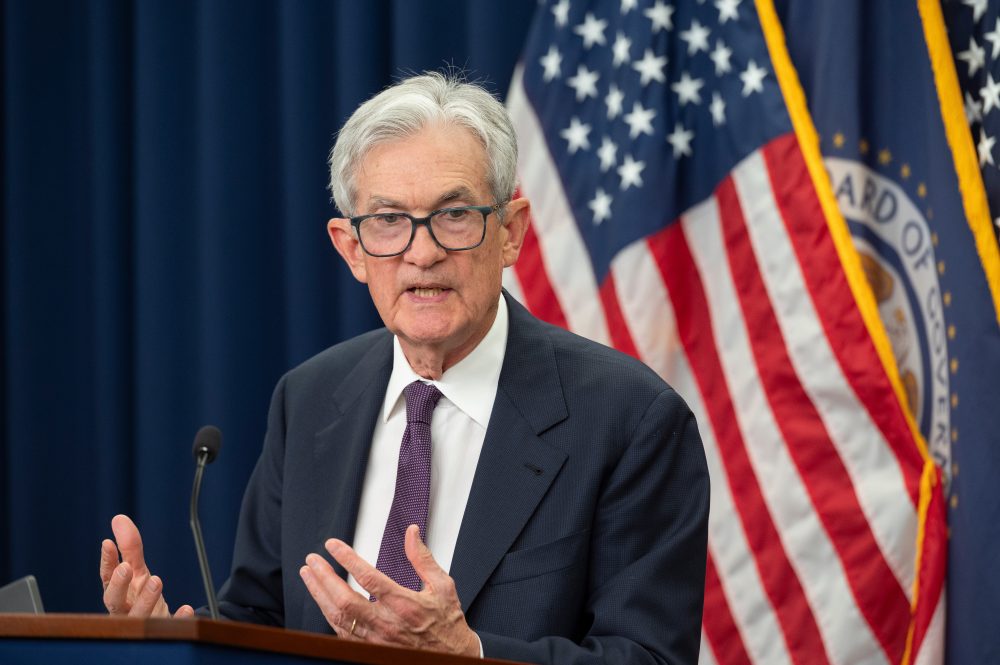

WASHINGTON — In a historic first for the Federal Reserve, outgoing Chair Jerome Powell has announced he will stay on the central bank’s board of governors even after Kevin Warsh, President Trump’s nominee, takes over leadership of the institution.
This unprecedented arrangement means that for the first time in nearly 50 years, a former Fed chair will serve alongside the new leadership on the board, potentially establishing competing power centers within the central bank. The situation comes as multiple Fed officials broke ranks Wednesday by dissenting from the bank’s policy statement, suggesting resistance to changes that Warsh, who has called for “regime change” at the Fed, may want to implement.
Powell, whose term as chair expires May 15, revealed he will stay on the board “for a period of time, to be determined” and has become increasingly vocal since the White House initiated what he calls an unprecedented legal investigation into a Fed building renovation project.
“Warsh is inheriting an institution that will fight for independent, consensus-driven decision-making, a potential obstacle to his vision of wholesale ‘regime change,’” explained Jon Hilsenrath, a senior advisor to StoneX and visiting scholar at Duke University.
This situation marks a dramatic departure from recent Fed leadership transitions involving Ben Bernanke, Janet Yellen, and Powell himself, all of whom moved smoothly from Fed governor positions to the chairmanship.
During Wednesday’s press conference, Powell acknowledged the unusual circumstances when questioned about how having both a current and former chair on the board might function. “I don’t know what the exact specifics of it will be,” he admitted.
While Powell indicated he would step back into a governor role, his continued presence could complicate Warsh’s ability to lower interest rates as Trump has repeatedly demanded. Although economists generally view Powell as favoring rate reductions, he recently stated that inflation is “misbehaving” and suggested rate cuts might not happen for several months.
“We no longer anticipate a rate cut in December,” stated Gregory Daco, chief economist at EY-Parthenon, predicting the Fed will remain “on hold through the remainder of the year.”
Powell emphasized Wednesday that his decision to remain stems from his desire to safeguard the Fed’s political independence rather than promote specific interest rate policies.
“These legal actions by the administration are unprecedented in our 113-year history,” Powell declared. “I worry that these attacks are battering the institution and putting at risk the thing that really matters to the public, which is the ability to conduct monetary policy without taking into consideration political factors.”
The White House has attempted to remove Fed Governor Lisa Cook over mortgage fraud allegations, which she denies, creating a legal test case about presidential authority to dismiss Fed governors. If Trump succeeds in ousting Cook, he could appoint a replacement and gain greater influence over interest rate decisions.
Trump has already appointed three of the Fed’s seven governors. Courts have so far protected Cook’s position, and the Supreme Court appeared to support her case during January hearings.
Powell’s decision to remain also blocks Trump from appointing another governor to replace him. While his chairmanship ends in May, Powell can continue as a governor until January 2028, preventing the president from filling that board seat.
Treasury Secretary Scott Bessent criticized Powell’s choice Wednesday on Fox Business, describing it as “highly unusual” and “a violation of all Federal Reserve norms.”
Powell pushed back against suggestions that his decision politicizes the Fed.
“I’m literally staying because of the actions that have been taken,” he said Wednesday. “I had long planned to be retiring and the things that have happened really in the last three months have left me no choice but to stay.”
Despite the potential for conflict, Powell promised to maintain a “low profile” and avoid becoming a “shadow chair.” “That’s just something I would never do. There is only ever one chair of the Federal Reserve board. When Kevin Warsh is confirmed and sworn in, he will be that chair.”
However, analysts worry about what some call a “two Popes” situation, where having both a chair and former chair on the board could deepen divisions if some policymakers choose to follow Powell’s guidance rather than Warsh’s direction.
The Senate is expected to confirm Warsh during the week of May 11 in what will likely be a narrow, party-line vote. This represents a stark contrast to Powell’s 2022 confirmation for his second term, which passed 80-19, highlighting the Fed’s increasing politicization.
Although Warsh promised congressional lawmakers last week that he would lead independently, Trump continues expressing expectations that his nominee will reduce the Fed’s benchmark rate.
Powell noted Wednesday that the committee’s “center” is shifting away from favoring rate cuts toward a more neutral position. Three policymakers dissented from Wednesday’s statement because they wanted this shift stated more clearly. A fourth official, Stephen Miran, voted for immediate rate cuts, but Warsh will replace him.
The four dissenting votes represented the highest number since October 1992.
“A 34-year high in dissents is not exactly the welcome mat Mr. Warsh was hoping to see upon his arrival,” Stephen Douglass, chief economist at NISA Investment Advisors, wrote to clients. “He might want to wear a hard hat at his first meeting, and not only because the (Fed building) is still under construction.”