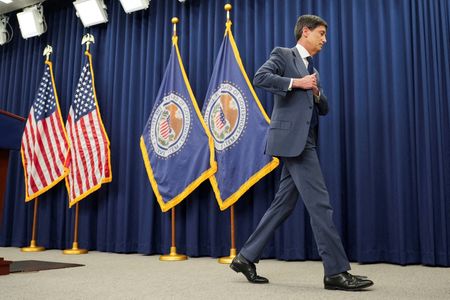

WASHINGTON — Federal Reserve Chairman Kevin Warsh is facing a defining stretch early in his tenure, with a high-stakes Supreme Court decision expected and an upcoming appearance at a prestigious international economic gathering in Portugal both set to influence how his leadership of the U.S. central bank takes shape.
The Supreme Court, now in the final week of its current term, could rule as soon as Monday on whether Fed Governor Lisa Cook can keep her position. President Donald Trump announced last August that he was dismissing Cook, but she has remained on the Fed’s Board of Governors while lower courts — which found she was likely to prevail — allowed her legal challenge to proceed all the way to the nation’s highest court.
Federal Reserve governors are protected from dismissal except “for cause,” a standard that has never been clearly defined or tested through the judicial system. Trump became the first president to attempt to remove a sitting Fed governor, claiming that what he described as inaccuracies on Cook’s home mortgage application warranted her removal.
The move was widely interpreted as an attempt to undermine the Fed’s independence from political influence, with Trump reportedly seeking to place his own picks on the board after growing frustrated that current Fed officials refused to meet his calls for significant interest rate reductions.
During earlier hearings, Supreme Court justices appeared doubtful of the Trump administration’s legal arguments. While the court has permitted the administration to remove officials from other independent agencies, prior rulings suggested the Fed holds a unique legal standing — a signal that legal experts read as an indication the court may move to shield the central bank’s policymakers from being fired without cause.
A ruling that allows Cook to stay in her position would relieve a significant burden for Warsh, eliminating the possibility that his time leading the Fed could be marked by a series of politically motivated dismissals — including potentially his own removal. At the same time, such a ruling would also highlight the limits of Trump’s ability to steer Fed policy, including on interest rates, by protecting Warsh and his colleagues from the threat of being fired.
Recent economic data has complicated the picture further. A key inflation measure for May came in at more than double the Fed’s 2% target, leading investors to increasingly expect the central bank may raise rates in the months ahead — the opposite of what Trump has publicly called for.
Despite that tension, both Trump and Treasury Secretary Scott Bessent have been notably less combative toward Warsh than they were toward his predecessor, former Fed Chair Jerome Powell. Powell’s refusal to cut rates earned him a mocking nickname from Trump, along with what was later dropped as a criminal investigation and repeated calls for his ouster. Powell continues to serve on the Fed’s board.
“Kevin is fantastic, and I want him to do whatever he wants,” Trump said during an appearance on NBC News’ “Meet the Press” earlier this month. “I don’t want to have a big influence on him.”
Warsh’s own style may be helping to manage expectations. The new Fed chairman has indicated he intends to avoid as much as possible any public “forward guidance” — statements hinting at whether interest rates will go up or down on a particular schedule — keeping his personal outlook away from both public view and the president’s attention.
This preference is not new for Warsh. He has long been critical of central banks steering financial markets through guidance during ordinary economic times, arguing that investors should be reacting to actual economic conditions rather than central bank signals.
He moved quickly to put that philosophy into action, overseeing a new policy statement that stripped out forward guidance language and reinforcing the point during his first press conference as Fed chairman following the central bank’s June 16-17 meeting.
“Your question sounded like an encouragement for me to give forward guidance. We’ve dropped forward guidance,” Warsh said when asked about the conditions that might prompt a rate increase. “I can’t give any forward guidance about what we’re going to do next. The good news is, we’ll be meeting in six weeks” and releasing an updated policy statement.
On Wednesday, Warsh is scheduled to appear at the European Central Bank’s annual forum held at a hilltop resort in Sintra, Portugal. It will be his first opportunity to test his low-guidance approach before an audience of global central banking leaders, including ECB President Christine Lagarde, Bank of England Governor Andrew Bailey, and Bank of Canada Governor Tiff Macklem. The four will participate together in a question-and-answer panel.
While Lagarde has also stepped back from forward guidance, the Bank of England continues to offer fairly detailed assessments of how the economy may evolve under various scenarios. Because the U.S. dollar serves as the world’s primary reserve and trading currency, unexpected shifts in American interest rates can send ripples through global markets — making the Fed’s communication approach a matter of international concern.
Pierre-Olivier Gourinchas, who is stepping down as the International Monetary Fund’s chief economist next week to return to academia, offered his perspective in an exit interview with Reuters on Friday. He said strong forward guidance had received “really bad press” because it locked central banks into future actions regardless of how the economy actually developed — pointing to how it slowed the Fed’s response to the inflation surge following the COVID-19 pandemic.
“So I think moving away from these strong forms of forward guidance is entirely appropriate. Saying there is no forward guidance, I don’t think that is actually the case ever. You do it explicitly, or implicitly, the market is going to form a view,” Gourinchas said.