
LA GUAIRA, Venezuela — On Sunday, a crowd of rescue workers and civilians gathered around a massive pile of rubble along Venezuela’s northern coastline — wreckage that looked much like the countless other collapsed structures left behind by two catastrophic earthquakes.
For days following Wednesday’s magnitude 7.2 and 7.5 quakes, search teams and local residents had seen no indication that anyone could still be alive beneath the concrete debris in La Guaira state, one of the regions hit hardest by the disaster.
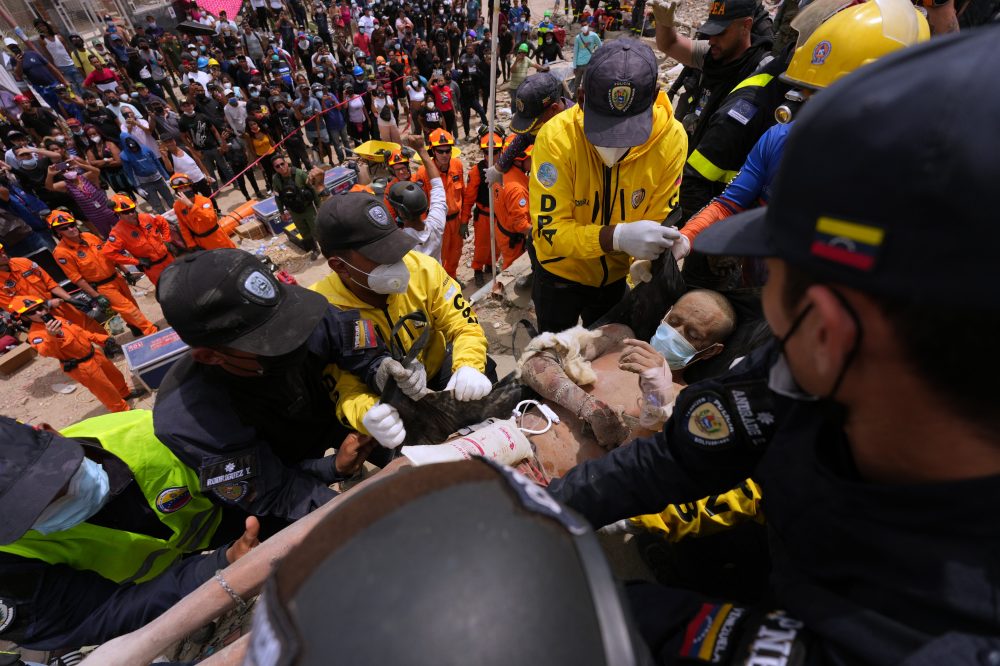
Then Sunday brought an extraordinary development. Rescue crews from Virginia, France, and Venezuela reached into a gap in the rubble and pulled out a pair of dust-covered legs — and then the man they belonged to.
Workers carefully lifted the man from the structure where he had spent four days trapped, his body limp but his hand still clutching his phone. Rescuers placed him on a black tarp and began administering an IV.
Moments later, his young son was brought out — shirtless and barely conscious — passed over the heads of hard-hat-wearing rescue workers with the words “Fairfax County Urban Search & Rescue” printed across their backs.
“Slow, slow, gentle, gentle,” teams called out in a blend of Spanish and English as they moved the father and son through the watching crowd and into a waiting ambulance.
The rescue teams erupted in applause — a rare celebration during days of grim search efforts when the prospect of finding survivors had been fading.
Associated Press journalists Juan Pablo Arraez and Matías Delacroix were among those who witnessed the rescue firsthand. Arraez said the team had been combing the La Guaira area “trying to see if we can see any miracles” when they came upon the U.S. rescue crews and local civilians quietly working to free the two survivors.
“At this stage many begin to lose hope. You see that in their faces,” Arraez said, as helicopters passed overhead. “When somebody makes it out alive, this father and son. It’s more than a glimpse, it’s real hope for people.”
The back-to-back earthquakes represent the worst natural disaster Venezuela has experienced in decades. By Sunday, authorities had confirmed at least 1,450 deaths, with thousands more injured and many others still unaccounted for.
Disaster response experts note that the first 48 to 72 hours following a major earthquake are the most critical window for rescuing survivors, though people with access to food and water can sometimes survive much longer.
Amid the widespread grief, small but powerful moments of compassion and resilience have emerged. Venezuelan firefighters were seen carefully pouring water into the mouth of a dust-covered dog whose head was poking through cracks in the concrete.
One woman, after spending 70 hours buried beneath debris, was brought out on a stretcher sitting upright — smiling and waving to cheering onlookers as she was loaded into an ambulance.