
President Donald Trump continues to assert that maritime drug smuggling into the United States has been virtually eliminated during his time in office.
In a recent Truth Social message, Trump declared that drug trafficking via ocean routes has declined by 98.2%, claiming these shipments have been “stopped.”
When the White House was asked to provide evidence for Trump’s figure, officials pointed The Associated Press toward Customs and Border Protection seizure statistics.
However, drug policy specialists argue that Trump is incorrectly interpreting the CBP information, noting that the actual scope of drug trafficking cannot be measured since authorities have no way to track narcotics that evade detection.
Let’s examine what the data actually reveals.
TRUMP’S CLAIM: “98.2% of Drugs coming into the U.S. by Ocean or Sea have STOPPED!”
THE REALITY: This statement distorts official government information. According to CBP records, drug confiscations in coastal and interior waters dropped 98.2% between July 2025 and November 2025. But this figure doesn’t represent total drug trafficking activity and only compares two individual months rather than showing a broader pattern. The amount of narcotics entering the country without being caught remains unknown.
“Drug seizure data measure interdiction activity, not actual trafficking volume,” explained Dessa Bergen-Cico, a Syracuse University public health professor who researches drug trafficking. “As drug policy researchers have noted, no one knows how much goes uncaught, and changes in seizure data are insufficient to make definitive claims about policy outcomes.”
Interdiction activity means stopping illegal drugs before they reach their intended destination.
During July 2025, CBP confiscated 223,923 pounds of cocaine, fentanyl, heroin, marijuana and methamphetamines from open waters and coastal areas. By November 2025, that figure dropped to 4,463 pounds, creating the 98.2% difference.
According to Bergen-Cico, variations in drug seizure amounts can indicate changes in smuggling pathways, law enforcement tactics, agency responsibilities, drug availability and market demand, or combinations of these elements.
Maritime drug seizures kept declining through December 2025, when authorities intercepted 2,268 pounds. The numbers started climbing again in early 2026. March data, the most recent available, shows 28,500 pounds were seized that month.
Yet none of these figures represent the complete picture of drug trafficking — only what gets confiscated. What remains unclear is what percentage of drugs are actually intercepted versus how many slip through undetected.
Jonathan Caulkins, who teaches operations research and public policy at Carnegie Mellon University and studies drug policy, said the “ignorance of what are the correct figures for either of these important concepts” leads to confusion and wrong conclusions.
Trump’s Monday Truth Social message also threatened to target Iran’s “fast attack ships” if they approached vessels enforcing a blockade of Iranian shipping near the Strait of Hormuz. Both Trump and Iranian Foreign Minister Abbas Araghchi announced Friday that the strait has reopened completely, though Trump stated the blockade would persist until Iran negotiates with the U.S. to end the conflict. Abbas indicated the strait would stay open during the remaining days of a 10-day ceasefire between Israel and Iran-supported Hezbollah forces.
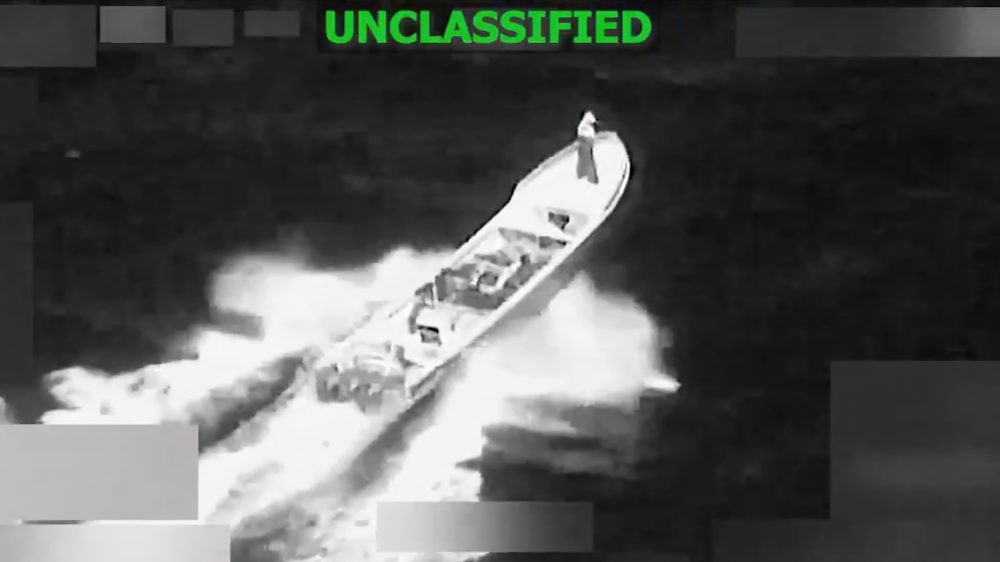
Beginning in September, the Trump administration has launched a series of attacks on ships allegedly involved in drug smuggling throughout Latin American waters. At least 51 vessels have been targeted and 178 individuals have died, with the most recent reported attack occurring Wednesday in the eastern Pacific. More strikes took place Saturday, Monday and Tuesday.
Bergen-Cico noted that cocaine represents the most frequently seized substance in coastal and interior regions, pointing out minimal differences between quantities intercepted during the Biden and Trump presidencies. Cocaine seizures fell 79% from August 2025 to January 2026, a decrease she attributed “driven primarily” to the Trump administration’s naval strikes.
However, this still only measures enforcement activity rather than total trafficking amounts. Additionally, it reflects just one agency’s operations — CBP.
The reduction in coastal and interior drug seizures between fiscal years 2025 and 2026 “do not straightforwardly indicate reduced drug flow,” Bergen-Cico stated. “Rather, they reflect a jurisdictional and operational transition in which traditional CBP maritime interdiction has been partially displaced by U.S. military and Coast Guard operations.”