
Legal experts say the man accused of killing a major health insurance company’s top executive will have a tough road ahead if he tries to convince a jury that he suffered a mental health breakdown when the crime occurred.
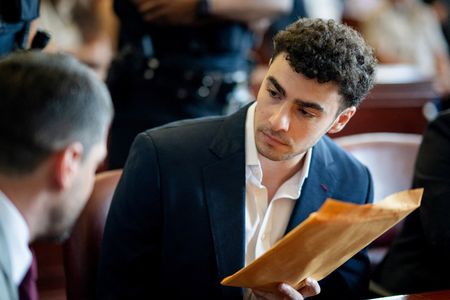
Luigi Mangione stands accused of gunning down UnitedHealthcare CEO Brian Thompson in front of a Midtown hotel in December 2024. His defense attorneys signaled Wednesday that they intend to pursue what is known as an “extreme emotional disturbance” defense — a legal strategy that, if successful, could allow jurors to reduce a murder charge down to manslaughter.
However, former Manhattan state prosecutor Gary Galperin says the alleged level of planning involved in the shooting — and the five-day manhunt during which Mangione reportedly concealed his identity — works directly against the idea that he lost control of himself.
“This is a strategic choice on his part to limit his exposure on conviction, and while legally viable, I think factually he has a high hurdle to convince a jury,” said Galperin, who now teaches at Cardozo School of Law.
Both Mangione’s legal team and the Manhattan District Attorney’s office declined to offer any comment on the case.
Mangione has entered a not guilty plea to state charges of murder, weapons violations, and forgery. His trial is currently set to begin in September.
The killing drew widespread condemnation from public officials but also sparked a broader national conversation about frustration with rising healthcare expenses and insurance company practices.
Under New York law, the extreme emotional disturbance defense differs from a traditional insanity defense. An insanity defense requires a formal psychiatric diagnosis and evidence that the defendant was unaware their actions were wrong. The emotional disturbance defense, by contrast, does not require the defendant to admit they committed the crime.
New York courts have accepted this defense in cases where defendants were overwhelmed by intense emotions like rage or grief, or where they responded to severe trauma. Courts have rejected it, however, when evidence shows that a defendant planned their actions and remained composed and deliberate throughout.
The judge overseeing the case will determine, before jury instructions are given, whether Mangione has presented enough evidence to allow jurors to consider the lesser manslaughter charge. A manslaughter conviction could spare Mangione from a potential life sentence.
Mangione reportedly struggled with chronic back pain, according to people who knew him and his social media activity. Prosecutors say they recovered a notebook in which he criticized the health insurance industry and wrote about killing an executive.
New York Law School professor Anna Cominsky noted that Mangione’s attorneys might try to frame the period surrounding the alleged shooting as a prolonged mental health crisis that was completely out of character for him.
“They could argue this isn’t normally what he did: sit around and talk about how corrupt the insurance industry is,” Cominsky said.
To succeed with this defense, Mangione would need to demonstrate not only that he was in a state of extreme emotional disturbance, but also that there was a “reasonable explanation or excuse” behind that disturbance.
Experts noted that widespread public resentment toward health insurance companies — particularly over claim denials — could make certain jurors more sympathetic to Mangione’s position. Still, they cautioned that bridging the gap between frustration with insurers and a full-blown homicidal breakdown may be too much to ask of a jury.
“Almost any one of us can relate to struggling with a health insurance company — who can’t cite an example?” Galperin said. “But then the question becomes: would it be reasonable for you to lose self-control and go out and do what he’s charged with doing?”