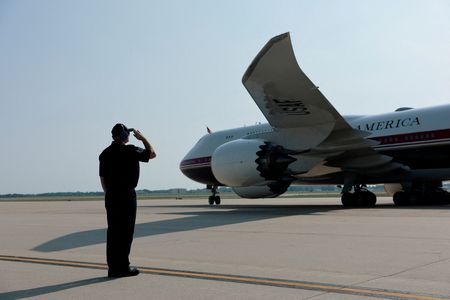

Defense and aerospace experts say the Qatar-donated Boeing 747 currently serving as Air Force One almost certainly needs security improvements — but many are skeptical that a single month is enough time to make a meaningful difference.
President Trump announced Sunday that the aircraft, which made its first presidential flight on July 1, would be taken out of service to be, in his words, “maxed out” with new capabilities. He said the process would take roughly a month.
Concerns about the jet’s defensive capabilities intensified after Trump unexpectedly switched to an older Air Force One for the portion of his trip from Turkey to the United Kingdom on July 8, a move that coincided with escalating tensions with Iran. The newer plane — featuring red, white, dark blue, and gold colors selected by Trump — was donated to the United States by Qatar last year and refitted by defense contractor L3Harris Technologies. It was intended as a stopgap while Boeing continues to face delays delivering the next generation of presidential aircraft.
Douglas Birkey, executive director of the Mitchell Institute for Aerospace Studies, said the standard Air Force One fleet is equipped with an advanced array of defensive systems, including anti-missile technology. “The White House appears to have accepted a lower baseline of protection for the Qatari jet in order to get it flying quickly,” he said.
Birkey explained that the aircraft was likely set up for “neutral or low-level” threat situations, and that officials are now working to bolster its defenses. He said that within a one-month window, any improvements would probably be limited to non-kinetic systems — things like electronic jammers, infrared “dazzler” devices that are designed to confuse heat-seeking missiles, and possibly chaff, which consists of tiny metallic strips released into the air to disrupt radar-guided weapons.
Birkey also noted that infrared-guided missiles are an increasing worry for military planners because they are more difficult to detect than radar-guided threats and “can kind of come out of nowhere.”
The Air Force declined to comment on the matter. White House spokeswoman Karoline Leavitt addressed the situation Monday, saying: “The new Air Force One is perfectly safe for the President’s travels, but will receive additional upgrades and enhancements in the fall which will take approximately one month to complete. During that time, the President will fly on the old Air Force One.”
Mark Cancian, a senior adviser at the Center for Strategic and International Studies, was similarly doubtful about what could realistically be accomplished in that timeframe. “There’s not a whole lot they can do in one month,” he said, adding that any work done would likely be limited to software updates or additions such as flares or chaff.
Cancian said the mid-trip aircraft switch in Turkey was probably triggered by updated intelligence regarding Iranian threats, leading officials to determine that the risk level was beyond what the Qatari-origin jet could safely handle.
Democrats have raised concerns about how quickly the plane was put into service, arguing that more time should have been allowed for security enhancements to be completed. Senator Jeanne Shaheen, speaking at the Farnborough Airshow, called on Congress to take a closer look at the plane’s safety record. “We knew there were some issues around security with the plane. We’ve known that from the very beginning,” she said.