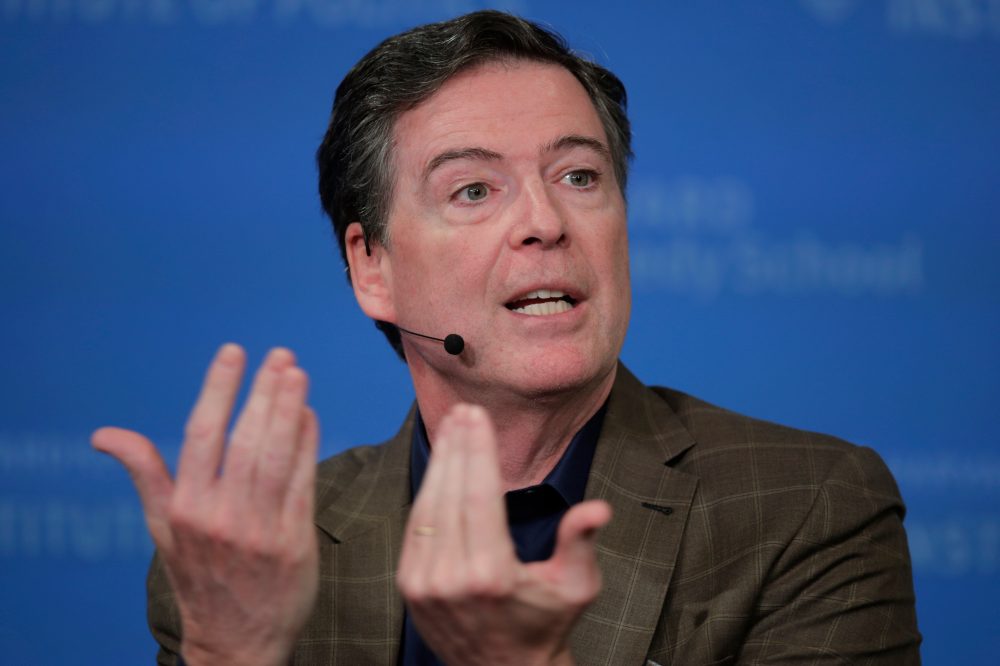

ALEXANDRIA, Va. — Former FBI Director James Comey will appear in federal court Wednesday, launching a criminal prosecution that legal analysts believe will be difficult for the Justice Department to successfully pursue.
Federal prosecutors in North Carolina filed charges Tuesday alleging Comey threatened President Donald Trump through a social media photograph he shared last year showing seashells positioned to form the numbers “86 47.” According to the government, these digits constituted a threat against Trump, who serves as the nation’s 47th president. Comey maintains he viewed the arrangement as expressing a political viewpoint rather than advocating violence against the Republican leader, and he deleted the image once he realized some viewers interpreted it as threatening.
This marks the second time in a year that Comey, who has clashed with Trump since his FBI tenure, faces federal charges. A judge dismissed the previous case involving allegations of false statements and obstruction. Now government attorneys must demonstrate that Comey either deliberately intended to communicate a genuine threat or recklessly ignored the possibility his post could be viewed as menacing.
While the charging document alleges Comey acted “knowingly and willfully,” it provides limited supporting details for this claim. Acting Attorney General Todd Blanche refused to discuss what evidence of criminal intent prosecutors possess during a press briefing. However, robust First Amendment speech protections, established Supreme Court rulings, and Comey’s public denials of threatening intent will likely create substantial obstacles for the government’s case.
“In this situation, ’86’ carries multiple meanings — it doesn’t clearly suggest violence, and the fact that a former FBI Director posted this openly on a public platform indicates he wasn’t trying to communicate a violent threat,” explained John Keller, a former senior Justice Department attorney who previously oversaw prosecution of violent threats against election officials.
Prosecutors filed the case in North Carolina’s Eastern District, where the beach location Comey says he discovered the shells is situated. His initial court hearing is scheduled for Wednesday at the federal courthouse in Alexandria, Virginia, where he currently resides.
The Supreme Court has established that speech loses First Amendment protection only when it constitutes a “true threat.”
This legal standard requires prosecutors to demonstrate, at minimum, that a defendant recklessly ignored the possibility their statement could be interpreted as threatening violence. In a 2023 Supreme Court decision, the majority ruled that prosecutors must prove the “defendant possessed some personal awareness of his statements’ threatening character.”
Additionally, the Supreme Court has determined that exaggerated political rhetoric receives constitutional protection. In a 1969 ruling, the justices found that a Vietnam War demonstrator did not make a deliberate threat against the president when he stated that “If they ever make me carry a rifle the first man I want to get in my sights is L.B.J,” referring to President Lyndon B. Johnson. The court observed that audience laughter when the protester spoke, among other factors, demonstrated it wasn’t a genuine threat of violence.
Concerning this current matter, Merriam-Webster dictionary defines 86 as slang meaning “to throw out,” “to get rid of” or “to refuse service to.” The dictionary notes: “Among the most recent senses adopted is a logical extension of the previous ones, with the meaning of ‘to kill.’ We do not enter this sense, due to its relative recency and sparseness of use.”
Comey removed the post quickly after publishing it, explaining: “I didn’t realize some folks associate those numbers with violence” and “I oppose violence of any kind so I took the post down.”
John Fishwick, who formerly served as U.S. attorney in Virginia’s Western District, suggested the government will likely argue that Comey’s FBI background should have made him aware of the implications.
“I believe they’re going to attempt to argue circumstantially that as former FBI head, you understood what these terms signified and you broadcast them globally as a presidential threat,” Fishwick explained, while acknowledging such reasoning would face challenges given Comey’s clear First Amendment protections.
Comey cooperated with a Secret Service interview last year, and the absence of false statement charges suggests prosecutors lack evidence he deceived agents, Fishwick noted.
Jonathan Turley, a George Washington University law professor, argued in a Tuesday opinion piece that “despite being one of Comey’s longest critics, the indictment raises troubling free speech issues. In the end, it must be the Constitution, not Comey, that drives the analysis and this indictment is unlikely to withstand constitutional scrutiny.”
“If it did,” he continued, “it would allow the government to criminalize a huge swath of political speech in the United States.”