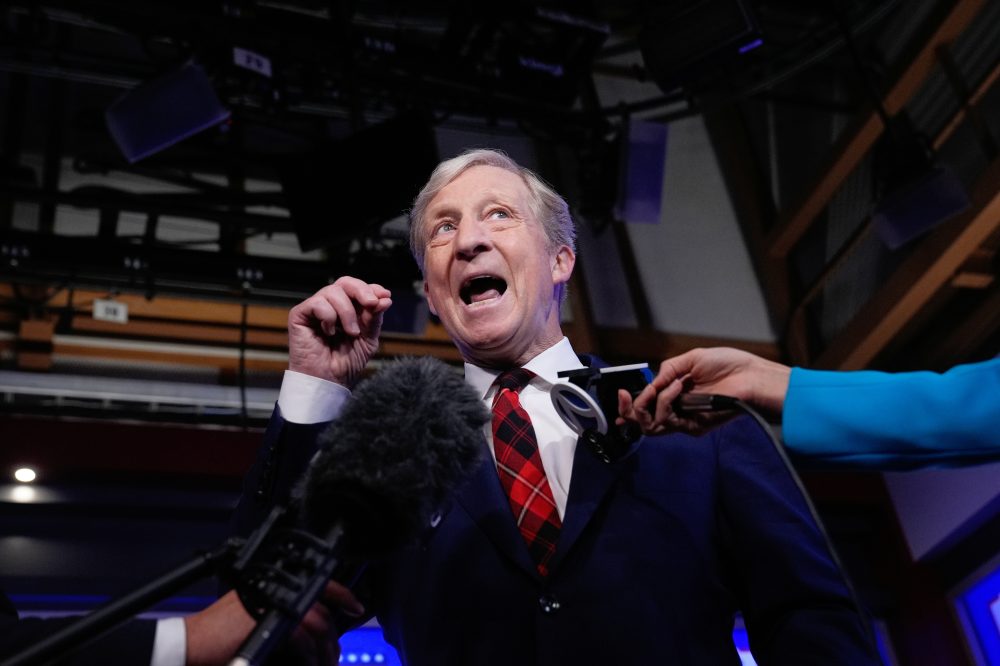

SACRAMENTO, Calif. — Climate activist Tom Steyer is positioning himself as an unlikely champion against wealth inequality in California’s gubernatorial campaign, despite his own $2.4 billion fortune.
The Democratic candidate advocates for increased taxes on wealthy individuals and corporations while earning support from progressive organizations that oppose the existence of billionaires. Steyer, who established one of the globe’s most successful hedge funds, now faces the strongest opposition from business organizations among all candidates.
“I’m the billionaire who wants to tax other billionaires,” Steyer frequently declares, although his support for a billionaire tax measure potentially appearing on California’s November ballot remains lukewarm.
The 68-year-old has consistently embraced the apparent contradictions between his financial achievements and political positions. His hedge fund previously held fossil fuel investments while he simultaneously donated millions to defend California legislation targeting emissions reductions. During his 2019 presidential campaign against Donald Trump, Steyer advocated for removing corporate financing from political campaigns.
“I’m not one of the people who begrudges people’s success,” Steyer explained to The Associated Press, discussing entrepreneurs who achieve wealth in California. “If you’re going to come here and build a company and make a ton of money, great.”
“But you’re part of a system — you’re depending on a system built by, basically, poor people,” he added. “If you aren’t willing to pay your fair share, I feel like you’re spitting on those people.”
These positions have generated both strong support and ongoing skepticism. Progressive allies view him as an exceptional wealthy individual willing to challenge financial interests, while critics across party lines consider him insincere and question whether his campaign promises are realistic. Democratic opponents criticize his attempt to purchase the election, highlighting his advertising spending that exceeds his closest Democratic competitor by nearly 30 times.
Following years of leveraging his wealth to shape politics and policy, Steyer has emerged as a frontrunner in the race to lead America’s most populated state before the June 2 primary election. His former investment firm’s portfolio continues drawing criticism from Democratic rivals.
“You made the billions that you’re using to fund your campaign off fossil fuels,” former U.S. Representative Katie Porter challenged during Tuesday’s debate. Steyer countered by pointing to business groups opposing his candidacy: “That’s how you know I’m for real.”
Steyer established Farallon Capital Management in San Francisco during 1986. He gained recognition among business colleagues for the firm’s quick growth while managing criticism from environmental activists regarding the company’s oil and coal investments. He departed in 2012 to create NextGen America, an organization focused on youth voter engagement.
His political contributions have primarily targeted climate issues, including a $5 million donation in 2010 opposing a California ballot measure that would have suspended greenhouse gas reduction requirements. The environmental legislation survived. Beginning in 2013, he utilized NextGen’s political division to support gubernatorial and Senate candidates with strong climate positions, achieving mixed results.
Steyer has invested over $62 million in California ballot initiatives, including an unsuccessful 2020 campaign to preserve legislation eliminating cash bail requirements. He ranked among the top contributors to a successful 2016 measure imposing tobacco taxes to fund healthcare for low-income residents.
Some view his contributions with skepticism. Republican strategist Rob Stutzman referenced an advertisement Steyer funded last year prominently featuring himself promoting a redistricting ballot measure. The initiative was championed by Governor Gavin Newsom, with Steyer’s only involvement being financial support for advertising.
“Steyer has always been a self-promoter with his dollars,” Stutzman observed.
Steyer identifies three primary challenges: climate change, California’s expensive living costs, and threats from the Trump administration.
Recently, hundreds gathered at a San Francisco ping-pong venue for cocktails and appetizers funded by his campaign while Steyer emphasized his climate commitment. His plan lacks detailed specifics but includes defending the state’s cap-and-trade system.
Major environmental organizations have endorsed his candidacy. Progressive groups also support him, including Our Revolution, established by Vermont Senator Bernie Sanders and dedicated to eliminating corporate and billionaire political influence. State Assemblyman Alex Lee, leading the progressive caucus, backs Steyer partly due to his support for government-operated healthcare, despite repeated legislative failures in Sacramento.
Lee initially hesitated supporting a billionaire but considers Steyer unique.
“He is someone who became wealthy in his lifetime,” Lee explained, “but didn’t go off and become (Mark) Zuckerberg level.”
Meanwhile, Pacific Gas & Electric, among America’s largest utilities, spent $10 million opposing his candidacy. Steyer has promised to “break up utility monopolies” to reduce Californians’ notoriously expensive electricity costs. One advertisement partially funded by PG&E claims Steyer isn’t truly a “different type of billionaire” as he maintains. The California Chamber of Commerce argues Steyer will increase rather than decrease costs.
“His policy promises will cost billions, driving investment out of California and worsening the state’s affordability crisis,” chamber spokesperson John Myers stated.
Whether financial resources and endorsements will convert to votes remains uncertain. Political analysts suggest Steyer’s potential breakthrough would be apparent by now given his extensive spending campaign.
Financial resources proved insufficient during the 2020 Democratic presidential primary. Steyer focused his campaign on appealing to minority voters, emphasizing healthcare access, environmental, and criminal justice inequalities. In South Carolina, his $24 million advertising investment exceeded all other candidates combined, yet he withdrew after placing third.
He frequently attracted attention for personal quirks rather than policy positions — his signature red plaid tie and colorful belt, plus his dance performances to rapper Juvenile’s music.
Steyer had planned $100 million in spending, but his wealth became problematic in a race where competitors like Sanders criticized billionaire existence.
He has exceeded that amount in California’s gubernatorial primary alone, including advertisements targeting opponents. This time, reception has been more favorable.
“Tom Steyer is running on taxing the wealthy, supporting single-payer healthcare, and taking on corporate power — positions that are central to our movement,” Our Revolution Executive Director Joseph Geevarghese stated. “That alignment with a pro-worker, anti-corporate agenda — and the urgency of this race — is why we are backing him.”