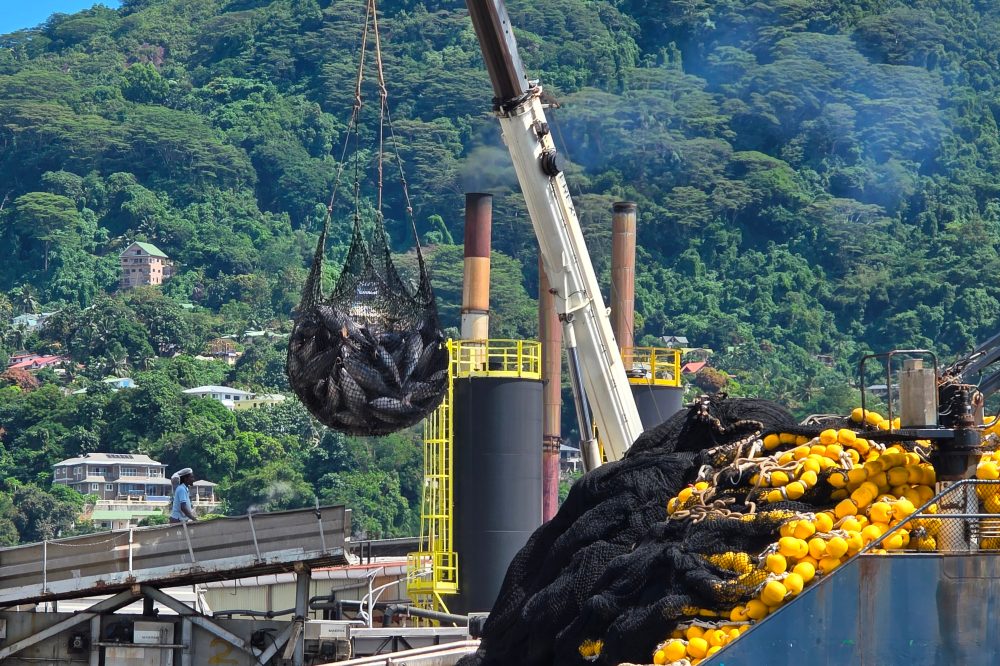

European fishing operations have established themselves as dominant forces in tuna harvesting, operating enormous vessels called purse seiners capable of storing up to 4 million pounds of fish per trip. These massive ships patrol Indian Ocean waters, targeting skipjack, yellowfin and bigeye tuna that eventually reach supermarket shelves in canned form.
When Jess Rattle noticed purse seine vessels operating in the Indian Ocean under flags from Mauritius, Tanzania and Oman, she suspected European corporations might be behind the operations.
“We wanted to understand who really owned these vessels,” Rattle explained. As head of investigations for the London-based environmental charity Blue Marine Foundation, she questioned whether these ships “were owned by the coastal states whose quota they were now using, or in fact, were they owned by the EU?”
Research published Thursday by Blue Marine Foundation and global investigations firm Kroll, shared early with The Associated Press, exposes how extensively European fleets access Indian Ocean tuna resources. The investigation discovered European companies capture one-third of tropical tuna harvests during a period when yellowfin and bigeye species remain under stress while recovering from severe overfishing.
European companies achieve this by registering vessels under flags from Seychelles, Mauritius, Kenya, Tanzania and Oman to secure larger catch allowances, according to Rattle’s research team. This strategy has enabled European-controlled fleets to grow beyond 50 purse seine and support vessels while boosting tropical tuna harvests, contradicting European Union promises to reduce fishing activities.
These revelations surface before the Indian Ocean Tuna Commission’s annual conference in the Maldives, gathering the EU and 28 nations involved in tuna fishing operations.
Although reflagging vessels to foreign nations is standard industry practice and legal, it complicates efforts by observers and regulators to assess European companies’ fishery impact. Parent company ownership often remains hidden through multiple shell companies and foreign registrations, which Rattle and Kroll investigators traced over several months.
While European companies have historically operated under Seychelles flags, Rattle noted their registration under Oman and Kenya flags represents a recent development. Europeche Tuna Group, representing European tuna interests, stated in a release that industry relationships with coastal nations demonstrate long-term regional investment and solid local partnerships.
Spokesperson Anne-France Mattlet explained that European industry supports regional economies through tax payments and fishing license fees, local infrastructure investments, and unloading tuna and other catches at regional ports and processing facilities.
Mattlet confirmed the report’s conclusion that Europeche operates more than 50 purse seine and supply vessels across the Indian Ocean, including those flying non-EU flags.
Maciej Berestecki, European Commission spokesperson, stated that vessel reflagging represents private business decisions uninfluenced by government authorities, and the EU doesn’t advocate for vessels registered under other nations’ flags.
“The EU has done, and keeps doing, its utmost to promote and respect catch limits,” Berestecki stated.
Despite Europe’s geographic distance from the Indian Ocean, European fishing fleets have maintained dominant positions there for decades. Spanish and French tuna operations first brought purse seine technology to the Indian Ocean during the 1980s, enabling rapid increases in annual harvests. These vessels earn their name from enormous nets that surround tuna schools and close like drawstring bags.
However, the EU has occasionally clashed with coastal countries seeking influence over fishing activities in waters near their territories.
Five years ago, as yellowfin tuna populations declined dramatically, the Maldives criticized the EU for failing to present serious proposals for quota reductions during a heated tuna commission meeting. In 2023, the EU opposed Indonesia’s proposal for purse seine fishing gear restrictions, which gained approval from 15 other nations.
Recently, the tuna commission has implemented new management strategies to restore vulnerable yellowfin and bigeye populations, which are beginning to show recovery signs. For example, the EU agreed to cut yellowfin tuna catches for EU-flagged vessels by 21 percent.
These new restrictions may be driving European fishing companies to seek other nations’ quotas to maintain harvest levels, according to Glen Holmes, senior officer with Pew Charitable Trusts.
Holmes and colleagues from Pew, Global Fishing Watch, and other environmental organizations are pushing for increased ownership transparency among Indian Ocean fishing fleets.
Vessel owners have historically registered ships under foreign flags, frustrating transparency advocates who argue this practice limits oversight capabilities. Sanctioned oil tankers in the ‘ghost fleet,’ for instance, regularly change names and flags to hide ownership.
Certain flags have gained reputations as ‘flags of convenience,’ providing companies with low costs and relaxed approaches to fishing or trade regulations. Some countries may lack sufficient resources to enforce maritime laws.
A January report from environmental group Oceana revealed European companies regularly register fishing vessels under foreign nation flags, including some countries the EU has accused of “turning a blind eye to illegal fishing activities.”
Oceana is urging EU countries to start gathering and publishing ownership information for their fishing fleets.
This change would help the EU better implement its own regulations, which prohibit any European individual from financially benefiting from illegal fishing practices, explained Vanya Vulperhorst, Oceana’s illegal fishing campaign director for Europe. It would also reveal “the real EU fleet,” she added.
“What we found last year is that the real European fleet, if you add the non-EU flagged vessels, doubles,” Vulperhorst stated.