
European defense company stocks are experiencing a significant downturn as investors reconsider their positions amid shifting perspectives on modern warfare technology and concerns about inflated stock prices.
The MSCI Europe Aerospace and Defence Index plummeted 9.2% during March, marking its steepest monthly decline in half a decade as what was once a highly profitable investment strategy began to reverse course.
Historically, defense sector stocks have surged during military conflicts – such as following Russia’s comprehensive attack on Ukraine in 2022 – or when former U.S. President Donald Trump demanded NATO members increase their military budgets.
However, this pattern has not emerged since the Iran conflict started on February 28, even as Trump has continued criticizing NATO for insufficient support of U.S. military operations.
“There has been quite a lot of de-grossing (trimming positions) as financial institutions and retail investors have looked to reduce exposure amid increased uncertainty,” said Martin Frandsen, portfolio manager at Principal Asset Management.
Czech weapons manufacturer CSG has seen its stock value plummet nearly one-third since the conflict commenced, while German companies Rheinmetall and Renk have declined approximately 10%, and Swedish firm Saab has fallen about 12%.
European defense stocks had been among the market’s top performers following Russia’s comprehensive Ukraine invasion in February 2022, climbing more than 450% compared to roughly 40% growth for the broader MSCI Europe index.
The surge was driven by European government commitments to increase defense expenditures and Germany’s decision to relax fiscal constraints last year to accelerate its military modernization efforts.
However, contract acquisitions have proceeded more slowly than anticipated by some investors, with agreements postponed or implemented in phases due to budget constraints in nations including France and Britain, according to Morgan Stanley research.
Rheinmetall, which produces tanks, ammunition and air-defense equipment, stated it was “inevitable” that nations would increase air defense spending as the Iran conflict persists, yet this has not prevented the sector’s decline.
While investors maintain general optimism, excitement has diminished and overcrowded bullish investments have been reduced, according to recent Citigroup analysis. Concentrated positioning can magnify price fluctuations when market sentiment shifts.
“The start of the Iran war, the consequent sharp rise in energy prices and supply chain dislocations, seem to have shaken off all sorts of crowded trades,” said Louis-Vincent Gave, CEO at Gavekal Research.
“So just as gold, silver, copper and other metals pulled back aggressively, so did defence stocks.”
Stock valuations also contributed to the decline. When the war began, Europe’s aerospace and defense index was valued at approximately 29 times projected earnings, approaching a record level reached late last year.
“A rise in defence budgets over the coming years was already priced into global defence stock prices,” said Hargreaves Lansdown equity analyst Aarin Chiekrie.
“As a result, the recent pullback is partly due to growth expectations in the sector getting ahead of themselves.”
The Iran conflict has emphasized both the expense and severity of contemporary warfare, with Gulf nations deploying hundreds of U.S.-manufactured Patriot anti-missile interceptors valued at approximately $4 million each.
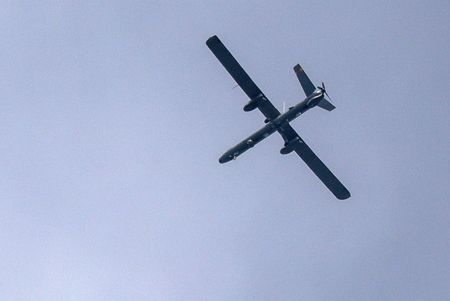
Simultaneously, the war has refocused attention on more affordable military technologies that have also become prominent in the Ukraine conflict, including attack drones and drone interceptors like the Ukrainian-designed system from Japan’s Terra Drone.
“There is a shift in the ‘future of warfare’ question since the outbreak of the Iran conflict, with the growing role of new technologies like much cheaper drones bringing into question the demand for legacy more expensive platforms,” said Ciaran Callaghan, Amundi’s head of European equity research.
Several European defense companies are making substantial investments in drone technology, along with surveillance and anti-drone systems.
Rheinmetall, for instance, established an agreement with U.S.-based Anduril last year to collaboratively develop European versions of Anduril’s Barracuda and Fury drones.
Despite the market correction, analysts maintain that the long-term prospects for European defense stocks remain strong, with government spending pledges continuing to grow and investment flows indicating strategic purchasing during price declines.
LSEG data reveals net investments of $1.32 billion into the WisdomTree Europe Defence exchange-traded fund through 2026, including $377 million since the Iran war began.
Two additional smaller defense ETFs, the iShares Europe Defence ETF and the HANetf Future of Defence ETFs, have collected a combined $355 million this year, with $124 million arriving since the conflict started.
“The longer-term growth picture remains intact … driven by a need for countries around the globe to rebuild their capabilities after decades of underinvestment,” Hargreaves Lansdown’s Chiekrie said.