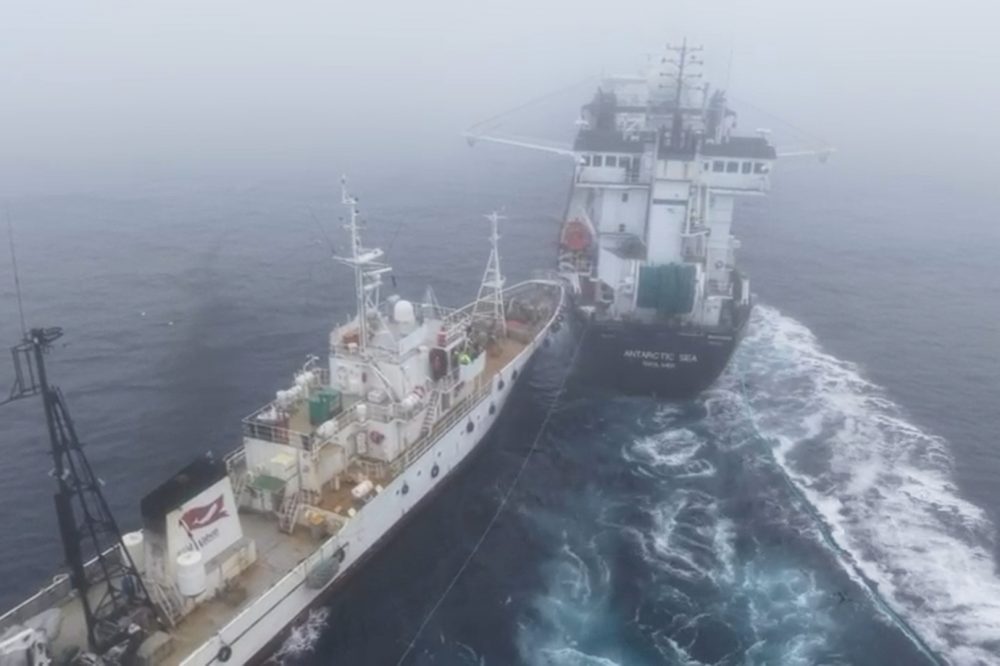

An environmental activist ship intentionally rammed into a commercial fishing vessel in Antarctic waters this week, sparking accusations of reckless endangerment in one of Earth’s most remote and ecologically fragile regions.
The Tuesday incident involved the M/V Bandero, operated by the Captain Paul Watson Foundation, which deliberately approached and struck the Norwegian-flagged Antarctic Sea while it was harvesting krill. Video footage lasting two minutes, obtained by The Associated Press from Aker QRILL Co., captures the Bandero slowly approaching the fishing vessel’s rear section before making contact with its port side.
The confrontation highlights escalating tensions in Southern Ocean waters over Antarctic krill harvesting. These tiny shrimp-like creatures serve as essential food for whales and play a crucial role in combating climate change, while also being sought after for health supplements, fish feed, and various commercial products.
According to Aker’s Wednesday statement, the activist vessel came dangerously close to hitting a fuel tank aboard the Antarctic Sea, potentially threatening an ecosystem populated by numerous whale species, seals, and seabirds that depend on the region’s delicate krill populations.
The Norwegian company reported that its international crew experienced no injuries but was badly shaken by the encounter. Officials announced plans to pursue all possible legal remedies.
“Our crew were put at risk in some of the most remote waters on Earth, and only luck avoided potential environmental damage,” stated Aker CEO Webjørn Barstad.
The Captain Paul Watson Foundation declined to respond to AP inquiries regarding Aker’s claims. However, the organization issued its own statement describing their tactics as “aggressive nonviolence.” The group reported that their crew, under the leadership of French activist Lamya Essemlali, successfully halted all krill fishing activities during a five-hour “direct intervention” targeting two Aker-owned ships. The foundation also released photographs showing crew members deploying large metal devices designed to destroy fishing nets.
Watson, the organization’s founder, was not aboard the vessel, which left Australia last month as part of the foundation’s “Operation Krill Wars” campaign.
“Throughout the encounter, the crew witnessed Antarctic wildlife in the surrounding waters, including penguins, seals, and even a whale, underscoring what was at stake as a small ship challenged a powerful industrial krill operation in a stark David-and-Goliath scenario,” the foundation declared.
Watson established the worldwide Sea Shepherd conservation organization during the 1970s and spent decades building a notorious reputation through vessel ramming and other confrontational maritime tactics that frequently resulted in his imprisonment. His most recent detention occurred in Greenland during 2024, where he spent five months on a Japanese arrest warrant that Denmark ultimately dismissed. Japanese authorities had sought his capture following a 2010 incident where he allegedly directed a ship captain to hurl explosives at what Japan classified as a research whaling vessel.
The Canadian-American activist previously enjoyed backing from Hollywood personalities, but his extreme methods have created divisions within the movement he established. While affiliates in France and Brazil continue supporting his recently formed foundation, Sea Shepherd Global and 20 national branches have shifted focus toward maritime surveillance patrols, policy advocacy, and assisting law enforcement in developing nations where illegal fishing flourishes.
Antarctic krill fishing reached unprecedented levels last season, prompting the first-ever early shutdown of harvesting operations.
Aker operates as the globe’s dominant krill harvester, accounting for more than half of worldwide catches.
The Commission for the Conservation of Antarctic Marine Living Resources oversees this distant fishery. This international body includes 27 countries plus the European Union.
Any formal investigation, including potential criminal charges, will likely begin when the Mongolia-flagged Bandero reaches its next port destination. International maritime regulations require overtaking vessels to maintain safe distances from ships they are passing.
The Bandero takes its name from the tequila business owned by John Paul DeJoria, an American billionaire who created Paul Mitchell hair products and has long supported Watson’s environmental campaigns.