
While President Trump and Republican lawmakers anticipate that rising fuel costs from the Iran crisis will be brief enough to avoid political damage in November’s elections, energy market experts and industry specialists warn that Americans may face sustained high prices at gas stations long after any resolution is reached.
The ongoing conflict has caused crude oil prices to spike, with U.S. oil surpassing $100 per barrel for the first time since the 2022 conflict between Russia and Ukraine began. Diesel fuel has climbed beyond $5 per gallon, reaching levels not seen since the end of 2022. These increases largely result from Iran’s strategic blocking of the Strait of Hormuz, a critical waterway that typically handles about 20% of the world’s oil transportation.
The President has consistently maintained that increased energy expenses represent a reasonable cost for eliminating Iran as a threat. During Tuesday’s remarks, he once again forecasted that energy prices would “drop like a rock” following the conflict’s conclusion.
However, market futures, official government projections, and anticipated summer driving season demand all indicate that oil and gasoline costs will remain elevated even after tensions subside, according to industry experts who note that energy prices historically decrease at a slower pace than they increase.
Matt Smith, who analyzes energy markets for consulting firm Kpler, explained: “It’s going to take time for those prices to come back down.”
Should gasoline costs remain high throughout the summer months, voters may hold Trump’s Republican Party responsible for increased household expenses and penalize GOP candidates during November’s midterm contests. Recent polling indicates Americans are increasingly concerned about living costs. Economic affordability represents a crucial advantage for Democrats, who have opportunities to gain House control and reduce Republican Senate dominance.
While Trump has consistently leveraged social media platforms and presidential communications to influence public opinion, gasoline pricing proves particularly challenging to reframe politically, according to Chris Borick, who studies polling and political science at Pennsylvania’s Muhlenberg College.
Borick noted: “It’s the most in-your-face reminder of affordability concerns, and it’s almost impossible to convince voters of some kind of contextual case that outweighs their emotional reaction.”
White House representative Taylor Rogers defended the administration’s position, stating Trump has been “right about everything,” including oil market predictions.
“Once the military objectives of Operation Epic Fury are completed and the Iranian terrorist regime is neutralized, oil and gas prices will drop rapidly—potentially even lower this before the strikes began,” Rogers declared.
The Energy Information Administration significantly increased its energy price forecasts this month. Current projections show Brent crude averaging approximately $79 per barrel in 2026, representing a 37% increase from the previous $58 estimate, while retail gasoline is expected to average $3.34 per gallon, up nearly 15% from earlier predictions.
Looking ahead to 2027, updated government forecasts project global oil prices roughly 22% higher and domestic gasoline costs about 8.4% above previous estimates, highlighting expectations that supply constraints and geopolitical tensions may maintain elevated energy expenses for years ahead.
Commodity trading markets reflect similar trends, with delivery contracts extending into next year priced above earlier 2026 levels.
According to LSEG data, U.S. crude futures have averaged $68.10 per barrel year-to-date but are projected to average $85.25 for the remaining 2026 period and $71.35 in 2027, compared to approximately $64.70 per barrel in 2025.
Rabobank energy strategist Florence Schmit emphasized that any market stabilization would occur gradually.
“Even if they signed a peace deal tomorrow, it would take months before we see a full resumption of traffic and energy flows,” she explained, suggesting prices might decline to the mid-to-high $70s range by year’s end.
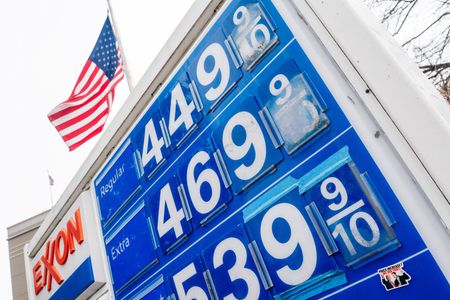
American motorists are experiencing immediate effects. Tuesday’s national average for regular gasoline reached $3.79 per gallon, up from $3.54 one week prior and $2.92 a month ago, based on industry tracking. Current prices show sharp increases from $3.08 twelve months ago, demonstrating broader inflationary trends in energy sectors and reduced crude availability.
Since the February 28 conflict beginning, Trump has examined various approaches to reduce price pressures, with Chief of Staff Susie Wiles leading coordination efforts, according to Reuters reporting.
The current administration has implemented multiple measures to counter supply disruptions and stabilize global markets, including relaxing specific sanctions on Russian energy exports to increase available crude and coordinating with international partners for an unprecedented strategic petroleum reserve release.
The approximately 200 million barrel release from America’s Strategic Petroleum Reserve will occur over multiple months, restricting its immediate price impact.