
Elon Musk’s rocket company has quietly submitted paperwork for a public stock offering that could shatter records as the largest market debut in history, according to a source with knowledge of the matter who spoke Wednesday.
The confidential filing by SpaceX positions the company for a potential market value exceeding $1.75 trillion, demonstrating how space exploration has evolved from risky speculation into a legitimate investment opportunity. The company’s success stems from its innovative reusable rocket technology and the Starlink satellite internet service.
This development follows SpaceX’s combination with Musk’s artificial intelligence company xAI through a transaction that assigned a $1 trillion value to the rocket business and $250 billion to the creator of the Grok chatbot.
The billionaire entrepreneur, recognized as the world’s wealthiest individual, oversees a vast collection of companies including Tesla electric vehicles, space launches, satellite internet, artificial intelligence, and social media platforms.
“Investors could use a sum-of-the-parts analysis, but, like with Tesla, SpaceX’s valuation could very much fluctuate wildly based off how much the public believes in Musk’s vision,” explained Angelo Bochanis, a data and index associate at Renaissance Capital, which specializes in IPO research and investment funds.
“So far, investors seem to be clamoring for any sort of exposure to SpaceX,” Bochanis added.
SpaceX representatives did not provide an immediate response when contacted for comment.
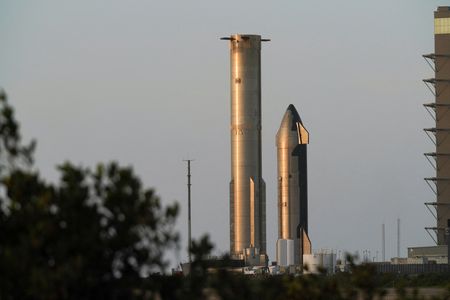
The Texas-based company, operating from Starbase, may attempt to generate more than $50 billion through the stock offering, easily exceeding Saudi Aramco’s 2019 public debut, which currently holds the record for largest IPO.
Such a massive SpaceX launch could revitalize the sluggish IPO marketplace after years of limited activity, with industry observers anticipating strong interest from both individual and institutional investors attracted by Musk’s reputation and the company’s rapidly expanding space and satellite operations.
Based on its recent merger valuation, SpaceX ranks as the world’s most valuable private company. Prior to the xAI deal, the rocket manufacturer was worth approximately $800 billion in secondary trading.
Other prominent startups, including OpenAI (creator of ChatGPT) and competitor Anthropic, are reportedly considering major public offerings, creating a broader evaluation of investor interest in new stock listings.
While many large startups have stayed private longer by accessing substantial private funding, a SpaceX public offering could motivate others to pursue stock market debuts.
Bloomberg News initially reported the confidential filing earlier Wednesday.
A public listing would increase analyst and investor examination of what some call the “Muskonomy” — the entrepreneur’s extensive business network and interconnected financial interests — drawing attention to how his various companies are funded, managed, and valued across markets.
“A likely dual-class share structure would let Musk tap public capital while retaining firm control, even after the substantial dilution that comes with a public offering,” noted Minmo Gahng, assistant professor of finance at Cornell University.
Beyond SpaceX, Musk operates Tesla electric vehicles, Neuralink brain-chip technology, and The Boring Company tunnel construction.
Last year, Musk also incorporated social media platform X into xAI through a stock exchange, providing the AI company with access to the platform’s information and user network.
Concerns about Musk’s capacity to manage multiple trillion-dollar companies might limit investor excitement, according to analysts.
“It is understandable that investors would be concerned with Musk overseeing multiple significant enterprises, especially given his polarizing public profile at times. However, SpaceX appears somewhat differentiated,” said Kat Liu, vice president at IPOX.
“The business is operationally mature, technologically ahead in several key areas, and profitable, which provides a solid fundamental underpinning,” Liu continued.
This announcement coincides with NASA preparing to send four astronauts on a 10-day lunar mission as early as Wednesday evening, representing the most ambitious American space venture in decades.
According to January reporting citing informed sources, SpaceX earned approximately $8 billion in profit from $15 billion to $16 billion in revenue last year.
An increasing number of wealthy individuals and private companies have funded a renewed American space competition, investing significantly in rockets, satellite networks, and moon-related projects, including SpaceX and Jeff Bezos’ Blue Origin.
With NASA increasingly relying on commercial partners and rising defense spending, space has become a strategic arena defined by technological advancement, national security concerns, and potential economic opportunities.
SpaceX has also requested authorization to deploy up to 1 million solar-powered satellites designed as space-based data centers, far exceeding current or planned deployments.
For nearly twenty years, NASA engineers and researchers have theorized about relocating power-intensive computing operations beyond Earth.
The SpaceX-xAI merger has attracted investor interest in how Musk might utilize an integrated system of rockets, satellites, and AI technology to address technical and financial challenges, expanding artificial intelligence infrastructure into space.
Artificial intelligence has emerged as Wall Street’s preferred investment theme, with AI-related companies driving a significant technology stock rally and increasing valuations throughout the sector.