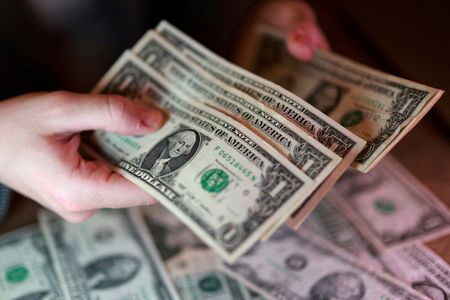

The U.S. dollar held steady Monday as fresh uncertainty rattled a fragile ceasefire between the United States and Iran, following threats from President Donald Trump to resume hostilities in the Middle East and an announcement from Tehran that it had shut down the Strait of Hormuz.
Despite the escalating tensions, peace negotiations between the two countries entered a second day in Switzerland. The talks are taking place under the framework of a memorandum of understanding reached last week, which extended an April ceasefire by at least 60 additional days.
Chris Weston, head of research at Pepperstone, said the rapid breakdown in compliance with the deal’s terms was not unexpected. “Ultimately, what matters to markets is the flow of cargo through the Strait of Hormuz,” he said.
Shipping data confirmed a steep drop in vessel traffic through the waterway on Sunday following Tehran’s closure announcement. The development pushed oil prices higher, with Brent crude futures rising 1.30% to $81.62 per barrel.
“The physical market remains tight and that should provide some support, but flows in FX and commodities, particularly gold, will continue to be heavily influenced by developments in the energy complex,” Weston added.
The British pound slid in early trading as investors weighed political turmoil in the United Kingdom, where Prime Minister Keir Starmer was reportedly reconsidering his political future following a decisive parliamentary election victory by rival Andy Burnham. Sterling fell 0.24% to $1.32055, while the euro dipped 0.1% to $1.1462. The Australian dollar was down 0.19% at $0.70035, and the New Zealand dollar last traded at $0.573.
Strategists at Commonwealth Bank of Australia noted that markets would be watching closely to see how Burnham approaches fiscal policy and whether existing fiscal rules might be relaxed. “A loosening in fiscal rules would likely be poorly received by the UK bond market and weigh on pound,” they wrote in a research note.
Japan’s yen slipped to 161.53 per dollar, hovering near a two-year low set the previous week. A move beyond 161.96 would push the currency to its weakest point since 1986. Japanese Finance Minister Satsuki Katayama reiterated Monday that authorities stood ready to respond to currency fluctuations at any time.
“The MOF may be getting sore necks watching USD/JPY surge into the 2024 high,” said Matt Simpson, senior market analyst at StoneX. “Yet they may also feel powerless to do anything about it — as intervening against the tide of a hawkish Fed and strong U.S. fundamentals could prove costly and futile.”
The yen has given back all the gains it made following a round of interventions in late April, as a hawkish shift by the Federal Reserve has prompted traders to increase their bets on interest rate hikes this year. U.S. Treasury yields also remained under pressure, with 2-year note yields climbing to their highest level since early 2025 at 4.2276%. Markets are currently pricing in roughly 43 basis points of rate increases this year, with a 25 basis point hike fully expected by September.