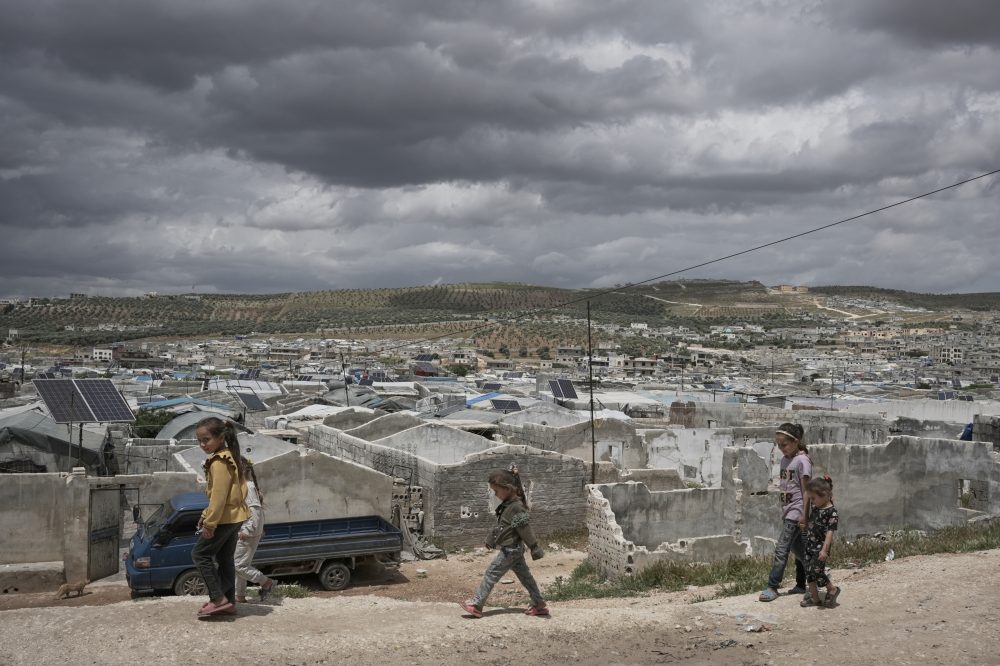

ATMEH, Syria (AP) — When rebel forces successfully removed President Bashar Assad from power in late 2024, ending more than thirteen years of devastating warfare, Sobhieh al-Saleh believed she would immediately abandon her temporary shelter and go back to her original residence.
However, she remains housed at the al-Karama camp, a temporary settlement located in Atmeh within Idlib province close to the Turkish border, alongside her spouse and eleven children.
“I went and saw my house and it was completely razed to the ground,” she told The Associated Press regarding her residence in al-Lataminah across Idlib province, which she abandoned during the peak of the fighting. While over half of the camp’s population has departed, she lacks the financial means to reconstruct her dwelling and relocate, similar to many other impoverished Syrians.
Therefore, she remains in difficult living conditions. Annually, rainwater seeps into her shelter, and during summer months, she and approximately 40,000 other camp residents must endure extreme temperatures and insect problems.
The Syrian conflict that began as protests in 2011 and continued until late 2024 devastated the nation, forcing over 90% of its roughly 26 million citizens into economic hardship. According to United Nations estimates, reconstruction efforts will require hundreds of billions of dollars.
The warfare resulted in 500,000 deaths, over 1 million injuries, and forced more than half of Syria’s prewar population of 23 million to flee their homes.
Under interim President Ahmad al-Sharaa, the administration has made progress in rebuilding Syria’s international relationships, seeking relief from devastating sanctions while pledging comprehensive reforms.
Over a year following the conflict’s conclusion, more than 7 million internally displaced Syrians cannot return to their original communities. According to United Nations data, one million continue residing in temporary shelters like al-Saleh.
Al-Sharaa has promised that displaced Syrians will no longer remain in temporary housing and will receive proper accommodations before 2027 ends. Saudi Arabia has committed $1.5 billion to support this effort.
However, even with significant investment pledges and partnerships designed to create employment and economic opportunities, the enormous scope of destruction means reducing poverty and facilitating returns will require considerable time.
The World Bank calculates that postwar rebuilding would require approximately $216 billion. Nearly 18 months after ending five decades of Assad family control, substantial portions of Syria’s major urban centers including Aleppo and Raqqa in the north, Homs in the center, and sections of Damascus remain destroyed.
Meanwhile, the government faces time constraints. Humanitarian organizations, which have endured years of significant funding reductions, continue scaling back programs that millions of Syrians depend upon.
“Where are we going to get money to rebuild? We’re barely able to provide ourselves with bread and water,” al-Saleh said. “No aid has come to the camp since the liberation.”
Most recently, the World Food Program announced on May 13 that it reduced by half its food assistance program to the most vulnerable that once supported 1.3 million people. It also cut a bread subsidy program that millions relied on.
Simultaneously, Syrian inflation has increased dramatically, preventing people from accumulating sufficient savings for reconstruction.
“The cost of building materials has surged beyond comprehension. I can barely afford to take my medications,” said Abdulhamid Abu Alaa, who lives with his family in the same camp as al-Saleh.
He explained that he and numerous others continue repaying loans they obtained to cover essential living expenses.
Abu Alaa stated that despite Syria’s significant diplomatic and economic progress, he encourages the government to address quickly the needs of the nation’s most impoverished citizens who remain in terrible conditions.
“The government’s priorities need to change, and put the needs of the poorest people above all things,” he said.
The United Nations continues pledging to maximize its available resources to help reduce Syrian financial hardships and support al-Sharaa’s 2027 initiative.
During a visit to a camp in Idlib’s Maarat Misrin area, the U.N. resident and humanitarian coordinator in Syria, Nathalie Fustier, said that the private sector and international financial institutions might need to help al-Sharaa reach the late 2027 deadline.
“I don’t know exactly how long it will take,” Fustier said. “Maybe there will still be camps, but we will be working again and again to end these camps.”