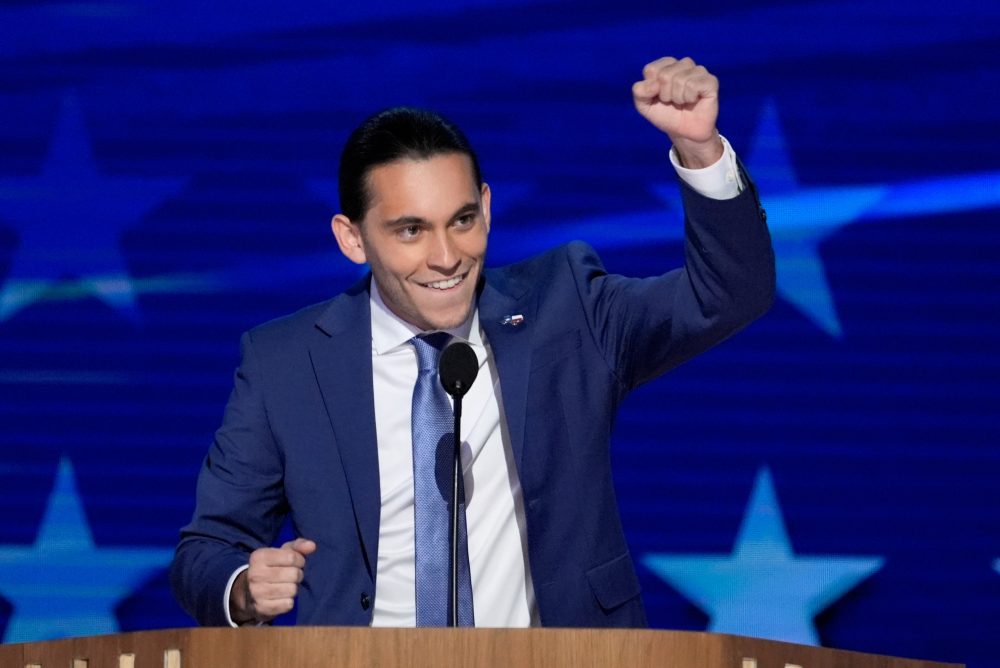

WASHINGTON — A Tuesday evening political rally in Houston featured the usual lineup of Democratic lawmakers and candidates, but the biggest draw wasn’t running for any office.
Carlos Eduardo Espina, a progressive social media personality with over 14 million TikTok followers, worked the crowd at the Mexican restaurant venue, posing for photos that supporters quickly shared across their social networks.
The Houston event served a dual purpose beyond energizing voters ahead of Texas’ March 3 primary election. It also marked the debut of a new Democratic approach aimed at recapturing Latino support that shifted toward the GOP in recent cycles.
Espina joined nine other Houston-area online personalities as part of this fresh strategy, which centers on building partnerships with digital content creators to better connect with Hispanic communities.
The TikTok star, who has previously endorsed Democratic causes and candidates, believes party leaders are finally recognizing they must modernize their outreach beyond conventional campaign methods.
“I do think there’s a lot of failures in the past Democratic Party, but I think initiatives like this one are pretty cool,” Espina shared during an interview.
The Congressional Hispanic Caucus’ political division developed this approach, launching it as Texas early voting commenced. Officials want to harness the appeal of local digital stars like Espina to more effectively deliver Democratic messages to Latino audiences.
Party strategists plan to expand this program, dubbed “RUIDO” — meaning noise in Spanish — to additional competitive races where Hispanic candidates and communities could determine outcomes. Hispanic Caucus PAC leadership hasn’t yet selected future investment locations.
“The Trump campaign reached out to those nontraditional voices to amplify their message,” explained Rep. Linda Sanchez of California, who chairs the caucus’ political action committee, referencing Republican success with influencers and podcast hosts in previous elections. “We didn’t anticipate that was going to be a way by which politics was disseminated. We’ve seen the contrary, that we do need to be in those spaces, as well.”
This program launches while Democrats wrestle with widespread party dissatisfaction and questions about effectively engaging key voter groups — particularly young people, communities of color, and non-college graduates who moved away from the party during the 2024 presidential race.
Former President Donald Trump gained significant Latino voter support that year through heavy investment in streamers, podcasters, and other digital content producers.
The Hispanic Caucus initiative provides financial support to accepted content creators, with funds designated for travel costs when collaborating with political campaigns, according to program documentation.
Previous election cycles saw both parties purchase sponsored posts from influencers, who must legally reveal these paid partnerships. Espina noted the compensation offered represents a small portion of his typical video earnings, which regularly attract hundreds of thousands of views, though smaller creators might find the support more meaningful.
The Spanish-language political content creator, whose videos consistently receive hundreds of thousands of likes, emphasized that elected officials must ultimately make their own case to voters. However, he stressed that genuine communication and meaningful messages are essential for online political success.
According to Espina, the party moved away from addressing “working class people” concerns and began discussing economic and cultural topics in ways that felt disconnected from voters’ actual experiences.
“I think a lot of that messaging a few years back kind of got lost. But now I think, especially after the wake-up call from the 2024 election, things have definitely gotten better,” he observed.
The caucus recruited nine Houston-area digital creators spanning various content types — from political commentary to food, travel, sports, and local interest topics. Their follower counts range from several thousand to approximately 100,000.
“People are going to act more when they hear from a family member, when they hear from a friend,” explained Carlos Castillo, another network participant. “Just talking to people in an organic way, whether it’s through get-ready-with-me videos and just slightly mentioning, ‘Oh, also, by the way, the primaries are coming up in our state.’”
Castillo compared the program’s financial support to commission offers he receives from corporations like Comcast, United Airlines, and FIFA Houston.
Whether this local influencer recruitment strategy will prove successful for Democrats in competitive districts remains uncertain. Both major parties have recognized across recent election cycles that traditional campaigning alone cannot reach politically disengaged voters.
This trend will likely increase the influence of content creators like Espina.
“Honestly, that I have more influence, at least right now, as a social media content creator, than I would in any kind of elected office, at least any that I can run for,” Espina said when asked about potential candidacy plans.
“Who knows, maybe I’ll run against Ted Cruz in a few years,” he joked, referencing Texas’ Republican senator. “That would be pretty fun.”