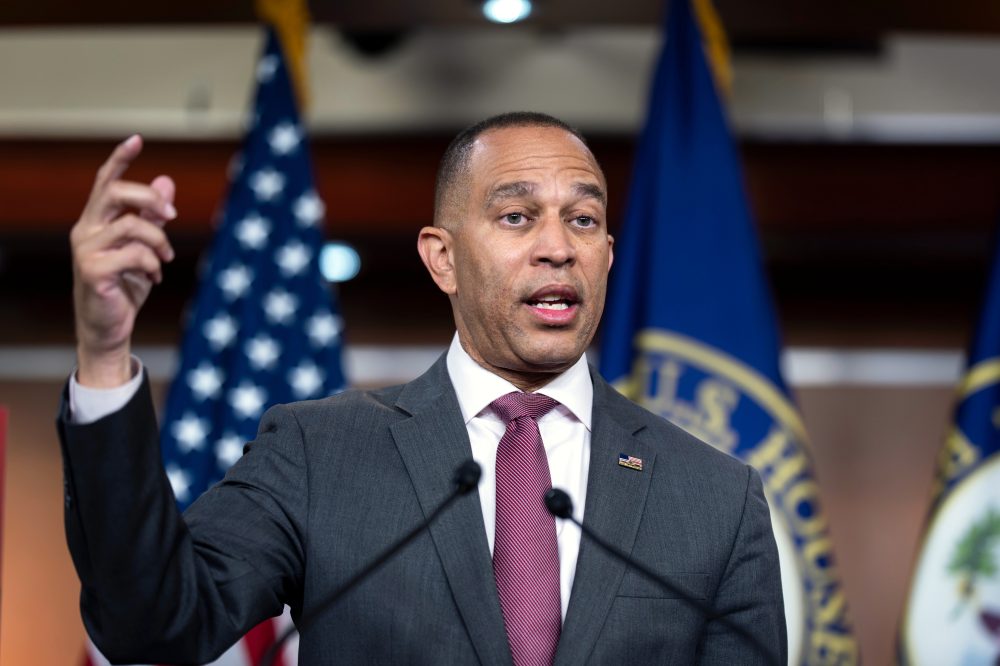

With 100 days to go before midterm elections, House Democratic leader Hakeem Jeffries is launching a major campaign push, and he’s doing it from battleground Pennsylvania.
On Sunday, Jeffries is set to unveil what Democrats are calling the Fighting for an Affordable America agenda, designed to sharpen the party’s message heading into November and draw voter attention to kitchen-table economic concerns.
The kickoff is taking place in Pennsylvania’s 7th District in the Lehigh Valley, where Jeffries and Pennsylvania Gov. Josh Shapiro — considered a possible 2028 Democratic presidential contender — are throwing their support behind Bob Brooks, a retired firefighter challenging the district’s incumbent Republican congressman. Democrats see the seat as part of their path to reclaiming the House majority.
Jeffries, who represents New York, described the mission as “making clear to the American people that we’re focused on lowering the cost of groceries and gas and housing, we’re committed to a country that provides affordable health care for every American.”
Not far away, Brooks’ opponent — freshman Republican Rep. Ryan Mackenzie — is holding his own 100-day event, signaling that both parties are treating this district as a critical contest.
While the campaign season has been in full swing for much of this year, Sunday’s events mark a symbolic turning point. The political landscape has already been shaped by redistricting battles, heated primaries in both parties, and a Supreme Court ruling on campaign finance.
Midterm elections have historically served as a judgment on the party holding the White House, and this cycle is no different. The races are unfolding during President Donald Trump’s second term, with his military action against Iran and economic agenda backed by the Republican-controlled Congress influencing the political climate.
“We gotta win the midterms,” Trump said during a recent visit to a Mack Truck plant in the district, where he campaigned for Mackenzie.
Trump has been traveling to competitive states to rally behind Republican candidates. He recently visited Georgia, which features a high-profile Senate race, and has a trip to battleground Michigan planned. At his rallies, Trump touches on a wide array of topics beyond candidate support, including the U.S.-Mexico border, opposition to transgender rights, and criticism of judges.
Republicans are counting on Trump’s signature legislation — the One Big Beautiful Bill Act, which includes tax cuts and spending reductions — as well as a recently passed House measure aimed at restricting stock trading by lawmakers, to win favor with voters.
However, Republicans face a tough historical pattern: the president’s party typically loses House seats in midterm elections. They’re also dealing with public disapproval of the ongoing war with Iran.
Democrats are hoping to channel voter frustration over the war and redirect focus to economic pressures like rising grocery and gas prices as they compete for seats in the narrowly divided House.
While all 435 House seats are on the ballot this fall, control of the chamber typically comes down to a small number of truly competitive races. Analysts identify fewer than 20 seats as genuine toss-ups.
Pennsylvania’s 7th District is one of the most closely watched, but Democrats are also targeting Republican-held seats in the state’s 1st, 8th, and 10th districts. Pennsylvania carries significant weight both as a presidential swing state and as a potential key to flipping the House.
On the other side, House Speaker Mike Johnson of Louisiana is preparing his own national fundraising and campaign tour to help Republicans hold onto their majority.
Republicans currently hold a financial advantage over Democrats in the race for House control. A lingering question is how the Supreme Court’s June ruling on campaign finance — which now allows national parties to make direct contributions to candidate campaigns — will ultimately affect the outcome.