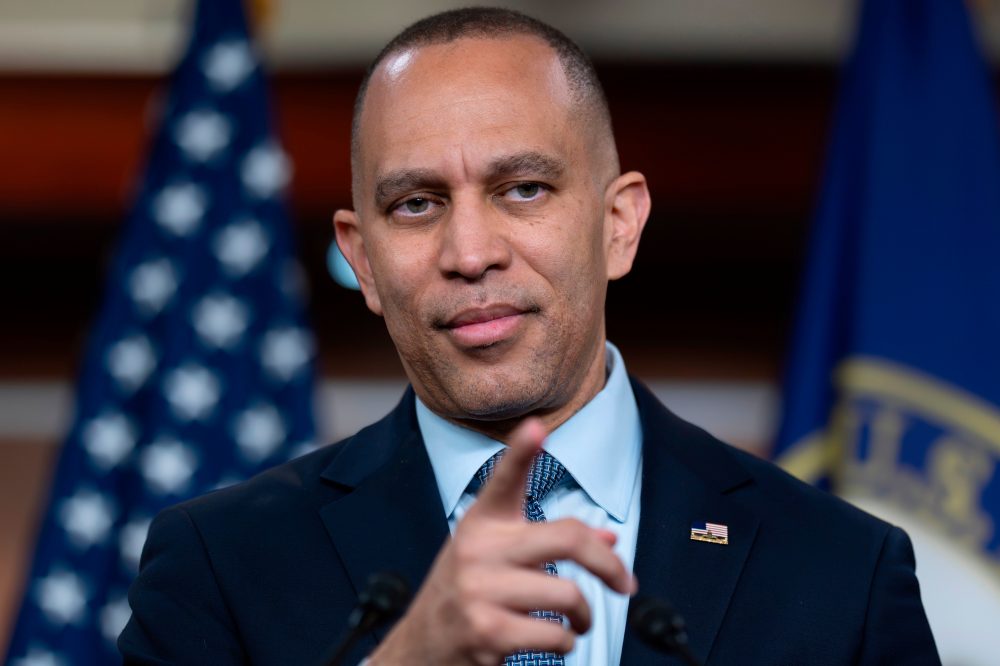

WASHINGTON — The battle for House control has become significantly more challenging for Democratic leader Hakeem Jeffries following a series of court decisions that have erased his party’s redistricting victories and potentially weakened Black political representation across the South.
Jeffries had previously cautioned Republicans about engaging in redistricting warfare, and when Democrats responded with a redrawn map in Virginia last month, the seat exchanges essentially balanced out.
“F— around and find out,” Jeffries declared following the electoral win.
However, within days, consecutive court decisions completely altered the landscape for House control and the speaker’s position by eliminating Democratic advantages in Virginia and potentially reducing Black representation by Democrats throughout the Deep South.
These changing dynamics have served as an alert for Democrats, who had been expected to reclaim the House this November while benefiting from President Donald Trump’s declining approval numbers, and represent a challenge for Jeffries as his party confronts an expanding field of Republican-leaning districts.
An outside organization supporting the leader has invested approximately $60 million, with a substantial portion directed toward Virginia alone, depleting Democratic resources as they face off against Trump’s Republicans.
“It sort of crystallizes the election is now a contest between one side that has the money and the maps, and the other that has the voters and the candidates,” explained Jesse Ferguson, a Democratic strategist and former deputy director of the House Democrats’ campaign arm.
Jeffries, who could become the nation’s first Black House speaker, recognized that Democrats might need to capture twice as many Republican districts — gaining six seats instead of three — to secure the majority following the redistricting battles.
However, he maintained confidence that Democrats would gain seats, similar to their 2018 performance during Trump’s initial presidency, arguing that Republicans depend on redistricting rather than policy solutions to secure victories.
Trump Republicans “don’t give a damn” about Americans’ economic hardships, Jeffries stated, echoing the president’s own language.
During a private Wednesday session with House Democrats, Jeffries framed the upcoming work in nearly existential language for the nation.
He characterized the court decisions against the Voting Rights Act and the Virginia legislation as “disgusting.” He also cautioned his colleagues that Republicans would campaign with “diabolical intensity” to regain House control, which Democrats must not only match but “we have to exceed it with righteous intensity at all times.”
“Failure is not an option,” he informed the Democrats, according to someone present who was granted anonymity to share the private comments. “We have to win, and we are going to win.”
The path to House majority control was never simple, but wasn’t anticipated to become this complex. Republicans maintain a narrow majority, among the smallest in contemporary House history, and midterm elections typically benefit the opposition party as a balance against the White House.
When Trump declared last summer that Republicans deserved five additional GOP seats from Texas, it initiated a redistricting campaign that prompted Jeffries to respond similarly.
Instead of maintaining what they describe as the moral high ground, Democrats chose to retaliate, believing they couldn’t rely entirely on national institutions — specifically the courts — to counter the GOP strategy.
Jeffries traveled to Austin to support Texas Democrats opposing their state’s redistricting proposal and stood with those legislators in Chicago after they departed to prevent statehouse Republicans from achieving a quorum. He participated in private California Democratic meetings as they launched their counteroffensive, a voter initiative that secured five additional Democratic seats. Democrats also gained a seat in Utah.
The pattern continued from there.
“We had to very quickly make a decision, set a course and take a risk,” recalled Rep. Jared Huffman, D-Calif., remembering the private discussions last summer. “There was no guarantee this was going to work out.”
The Virginia legislation became pivotal, representing Jeffries’ most significant move, essentially bringing Democrats to equal footing or potentially giving them an advantage in seat gains while securing Old Dominion more firmly for the party.
He energized approximately 1,000 church attendees in Richmond before Election Day as voters prepared to cast ballots.
House Speaker Mike Johnson on Wednesday described the Democratic Virginia strategy as a “crazy overreach” that was appropriately rejected by the state’s highest court.
“Fortunately, the plan failed spectacularly,” Johnson stated.
While Democrats anticipated the Supreme Court would weaken the Voting Rights Act, the Virginia Supreme Court’s decision to overturn last month’s election outcomes caught many off guard.
Jeffries participated in a weekend conference call with angry Virginia Democrats who expressed renewed determination to win Republican seats directly, despite their setback over map modifications.
The final count following nearly a year of redistricting conflicts continues to evolve as Republican state legislatures across the South hurry to redraw their maps after the Voting Rights Act ruling, with many preparing to eliminate districts represented by some of Congress’s most experienced Black legislators.
Rep. James Clyburn, the experienced Democratic representative from South Carolina whose own position faces risk, held the justices, not Jeffries, responsible for the Virginia outcome and similar situations.
“What the hell, he can’t control the courts,” Clyburn declared, promising to seek reelection regardless of how his district boundaries are redrawn. “Don’t put that on Jeffries. We won the vote.”
Jeffries accepted that this year’s maps are nearly finalized and shifted focus to 2028, when he said Democrats will intensify their efforts to address the GOP redistricting challenge before the next election.
“We know this unprecedented assault on Black political representation, the likes of which we have not seen since the Jim Crow era, the ghost of the Confederacy” will persist, he stated. “The challenge that is in front of us is ensuring that there is a decisive and overwhelming response in advance of 2028.”